
A boutique apartment hotel in Vienna is a small, independently run property - typically fewer than 100 rooms or apartments - where design, service, and location are shaped by a host rather than a corporate brand book. It sits one tier above a standard serviced apartment and one tier sideways from a hotel: full kitchen, residential floor plan, a named person to message, and an interior that looks like somewhere a Viennese designer would actually want to live. A corporate aparthotel chain - Adina, Adagio, Zoku - delivers the opposite trade: 100+ standardised units, a 24-hour desk, a loyalty programme, and a footprint built for predictability. Both are licensed and professional, but they answer different questions.
This article defines the category, maps the operators running boutique apartment hotels in Vienna, sets the 2026 commercial benchmarks, and explains how MINT Vienna boutique apartments at the Naschmarkt - five apartments, host-led, in Vienna's 6th district (Mariahilf) - sits inside that category. According to the Savills 2026 European Serviced Apartment Report, serviced-apartment demand has compounded at 5.9% a year since 2019 versus 1.1% across the wider hotel sector - boutique apartment hotels are the design-led, locally-rooted slice of that growth.
What you'll find on this page
- The industry definition of a boutique apartment hotel
- The 2026 Vienna and European market numbers that frame the segment
- A taxonomy table comparing boutique apartment hotels with corporate aparthotel chains
- A directory of the Vienna boutique apartment hotel landscape, including 2026 entrants
- How MINT @Naschmarkt sits within that landscape
- What to confirm before booking a Vienna serviced apartment
- Ten frequently asked questions on pricing, check-in models, and evaluating boutique independence
What is a boutique apartment hotel?
The clearest definition comes from the Boutique & Lifestyle Lodging Association's categories framework. BLLA distinguishes five boutique tiers - Classic, Luxury, Concept, Micro, and Residential. Classic Boutique properties are, in BLLA's language, "essentially living organisms within their cities" - residential-style furnishings reflecting the surrounding neighbourhood (Grätzl), food and beverage locally sourced. Residential Boutique is the sub-category that maps most directly onto the boutique apartment hotel format: serviced apartments with hotel-level finish, designed for longer stays.
The Hospitality Net / BLLA white paper that established this classification lists the non-negotiables across all boutique tiers: cultural authenticity, historical grounding, not part of a chain, unique services, meaningful social spaces. Independence is the defining feature, not a marketing claim.
Cvent's 2024 boutique-hotel guide is concrete on scale: boutique hotels "usually have less than 100 guest rooms" and are "independently owned, with many operating as family-run businesses." That 100-room ceiling is the test most boutique-curious travellers can apply at a glance. A 250-room property by a hotel group calling itself boutique is using the word as a design adjective, not a category.
Add the word apartment and three more features become non-negotiable:
- A full kitchen in every unit, not a kettle and microwave.
- A residential floor plan - separated living and sleeping space - rather than a hotel-room layout.
- Self-catering and self-pacing - periodic housekeeping rather than daily turndown, no required restaurant or breakfast room.
A boutique apartment hotel sits at the intersection of those rules: small enough to be independent, designed enough to be intentional, equipped enough to live in. Not a hotel suite. Not a generic short-term rental. A licensed, professionally operated middle category.
For readers comparing categories at the platform level - Airbnb against hotels against the wider serviced-apartment segment - how boutique apartment hotels sit within the licensed serviced-apartment category is the decision guide.
Bottom line: A boutique apartment hotel meets three tests at once: fewer than 100 independently owned units, a residential floor plan with full kitchen, and a design language that reflects the neighbourhood it sits in. Fail any one and it belongs in a different category.
Vienna's boutique apartment hotel market in 2026
Vienna had its biggest tourism year on record in 2025. The Vienna Tourist Board's January 2026 performance report recorded 20,065,000 overnight stays, up 6% year-on-year, with international visitors making up 83% of all stays. Germany, the US, and the UK are the top three source markets - Germany at 3,543,000 stays (+2%), the US at 1,259,000 (+3%), and the UK at 800,000.
"2025 was the most successful year for city tourism in Vienna since records began," Norbert Kettner, CEO of the Vienna Tourist Board, said in that report. The city has 450 hotels offering around 42,400 rooms, with 60% of beds in the four- and five-star categories - a structurally premium market.
The rate environment confirms it. According to HVS and STR data summarised in Hospitality Net's Vienna hotel market spotlight, Vienna's average daily rate reached €211 across the 12 months to June 2025, occupancy hit 76.8%, and revenue-per-available-room grew 7.3% year-on-year. That €211 ADR is the benchmark any Vienna boutique apartment hotel is priced against.
Compare to the European serviced-apartment average. Savills' 2026 European Serviced Apartment Report, drawing on CoStar data, puts European serviced apartment occupancy at 79% in 2025 and ADR at €136. Vienna's hotel ADR runs roughly 55% above the pan-European serviced-apartment average - a clear premium-market signal.
Growth matters as much as rate. Savills tracks a 5.9% compound annual growth rate for serviced-apartment demand since 2019, against 1.1% for the wider hotel sector - the segment is growing roughly five times faster than hotels in Europe. Investor appetite for European serviced apartments rose 22% in 2026, and the sector recorded €1.2 billion in European transaction volumes in 2025. The wider hotel sector was nearly flat: a Boutique Hotel News write-up of the HVS European Hotel Valuation Index put European hotel value growth at just 0.2% in 2025. "Leisure demand continues to boost hotel performance across Mediterranean markets and in Northern Europe," said Margherita Rivetti, co-author of the HVS index, in that coverage.
One more demand vector. The Boutique Hotel News 2026 trends feature reports that mid-term bookings (28 to 90 nights) surged 136% between 2019 and the end of 2025, rising from roughly 20 million to 46 million nights and now accounting for around 19% of total rental demand. This is the segment boutique apartment hotels are uniquely placed to serve.
Key fact: Vienna ADR is €211 against a European serviced-apartment ADR of €136 - Vienna runs about 55% above the pan-European benchmark. Boutique apartment hotel pricing in Vienna sits at the top of that premium, not below it.
Boutique apartment hotel vs corporate aparthotel chain
The honest positioning is to put a boutique operator next to the corporate chain tier and let the differences declare themselves. Adina, Adagio, and Zoku are all licensed, all professionally operated, and all very different from a five-apartment, host-led property in the 6th district.
| Category trait | Corporate aparthotel chain (Adina, Adagio, Zoku tier) | Boutique apartment hotel | MINT @Naschmarkt positioning |
|---|---|---|---|
| Portfolio size at a single property | 124-131 units (Adina Vienna 131; Adagio Vienna City 124; Zoku Vienna ~130 lofts) | Fewer than 100 units, often far fewer | 5 apartments |
| Design language | Standardised brand template across cities | Locally rooted, story-driven interiors | Hand-finished, each apartment a distinct interior story |
| Check-in model | 24-hour reception desk, branded lobby | Host-led or self check-in with named contact | Self check-in plus direct host (Christian) access throughout the stay |
| Neighbourhood positioning | Functional locations (business districts, near rail hubs) | Embedded in residential / market neighbourhoods | 1 minute on foot from the Naschmarkt; Karlsplatz subway (U-Bahn) 3 minutes |
| Typical Vienna ADR range | €150-€280 (parity with city hotel ADR of €211) | €185-€400, depending on size and tier | €185-€375 across the MINT portfolio |
| Loyalty programme | Yes - Adina app, Accor ALL, brand-level | None - direct booking, transparent pricing | None - direct booking only |
| Kitchen provision | Kitchenette (Adina studios 23-38m²) up to full kitchen (Adagio, Zoku) | Full kitchen in every unit | Fully equipped kitchen in every apartment |
| Stay length the format is built for | 1 night to several months, predictable turnover | 2 nights to several months, periodic housekeeping | 2-night minimum; stay tiers from Wochenend+ (7+) to Resident (28+) |
A few notes on that table. Adina's two Vienna properties - Adina Serviced Apartments Vienna and Adina Apartment Hotel Vienna Belvedere - are both in District 10, near the main railway station. Aparthotel Adagio Vienna City sits at Uraniastrasse 2 in District 1 near the Ringstrasse - standardised Accor mid-scale format. Zoku Vienna operates around 130 lofts in District 2 near the Prater, with loft sizes from 24m² to 30m² - closer to BLLA's Micro-Boutique format than to a Residential Boutique apartment hotel.
The boutique apartment hotel category is not a value judgement against any of these properties. It is a different product, for a different brief.
Watch out: A property's design language is the easiest thing to copy. The hard things to copy are independent ownership, sub-100-unit scale, and a host you can actually reach.
Vienna's boutique apartment hotel landscape: the verified directory
The Vienna boutique apartment hotel landscape is small, scattered, and growing. The directory below covers operators verified as operating (or confirmed as opening in 2026) via official sites and the Vienna Tourist Board's new hotels and hotel projects register. Three names you may see referenced elsewhere - Fraser Suites, Staybridge Suites, and citizenM - are confirmed not operating in Vienna and have been omitted.
| Operator | District | Type | Design positioning |
|---|---|---|---|
| Grätzlhotel | Primary cluster: 12th (Meidlinger Markt); rooms across 2nd, 4th, 9th, 12th | Independent, neighbourhood-integrated rooms in converted ground-floor shops (24 rooms total) | Each suite is a former tobacconist, tailor, record shop, bakery, or shoemaker, with conservation-conscious conversion by architect Markus Kaplan (BWM) |
| Singerstrasse 21/25 Aparthotel | 1st (Innere Stadt) | Independent boutique aparthotel near Stephansplatz | Historic building, traditional interior style, 24/7 reception with full apartment format |
| Miiro SpittelBerg | 7th (Neubau / Spittelberg) | Design-led independent group, 132 rooms, opening spring 2026 (4-star) | Design boutique hotel; not an aparthotel, but a marker of the 7th district's boutique trajectory |
| Hotel Indigo Vienna Naschmarkt | 5th / 6th border (Rechte Wienzeile 87) | IHG boutique-hotel brand - not an aparthotel | Branded boutique hotel; included for District-6 proximity context only |
| Bob W. Vienna Döbling | 19th (Döbling) | Tech-enabled serviced apartments, 67 rooms, expected July 2026 (4-star) | First Bob W. in Austria per the Vienna Tourist Board; serviced-apartment format at sub-100-unit boutique scale |
A few caveats. Miiro SpittelBerg at 132 rooms sits above the 100-room boutique ceiling on scale alone, but it is independent and design-led - and as a 2026 entrant in the 7th district boutique belt, the most relevant new arrival for travellers researching the neighbourhood. The Vienna Tourist Board lists April 2026; Miiro's own site says March - use "spring 2026." Hotel Indigo Vienna Naschmarkt at Rechte Wienzeile 87 is an IHG branded boutique hotel, not an apartment hotel - included for District-6 context since it appears in any "Naschmarkt boutique hotel" search. Bob W. Vienna Döbling is confirmed only via the Vienna Tourist Board at the time of writing - treat as "expected July 2026."
For deeper context on the Naschmarkt neighbourhood - accommodation types, the market itself, the cafés and wine bars that ring it - Vienna's 6th district accommodation landscape is the local guide.
One name commonly grouped with this list that doesn't belong on it: Ruby Hotels - Ruby Lissi (1st district), Ruby Marie (7th district), Ruby Sofie (3rd district). Ruby brands itself as "lean luxury" design hotels. They are hotels, not apartment hotels - no full kitchens - and Ruby is now part of IHG's portfolio. Chain-adjacent design hotels are a real and reasonable option; just a different category from a boutique apartment hotel.
From a guest: "There are so many generic hotel brands these days but this approach really makes you feel connected to the city." Fabian Feldtmann, co-founder of Grätzlhotel, speaking to Monocle about the neighbourhood-integrated boutique format. Monocle also reports 7,112 building permits were issued in Vienna in 2024 for additions, extensions, and conversions - the renovation pipeline is wide open.
Vienna's boutique districts: where the segment lives
Foreign travellers researching Vienna often default to the 1st district - the Innere Stadt, the Ringstrasse, the grand hotels. That is luxury and chain territory: Mandarin Oriental, the Ritz-Carlton, Park Hyatt. It is not where the boutique apartment hotel segment lives.
The boutique-rich belt is one and two districts west: the 6th (Mariahilf) and 7th (Neubau). Mariahilf is the Naschmarkt - Vienna's open-air market - flanked by cocktail bars, coffee roasters, design-driven independent shops along Mariahilferstrasse, and the Theater an der Wien. Neubau is Vienna's most aesthetic district by reputation: the MuseumsQuartier on its 1st-district border, the cobbled Biedermeier lanes of Spittelberg, independent restaurants, the contemporary-art scene. The Vienna Tourist Board's 2026 pipeline confirms the pattern - Miiro SpittelBerg in the 7th, Hotel Schani Wien City in the 2nd, Palais Chotek in the 9th.
Geography matters because boutique is partly a location story. A property on a four-lane through-road next to a railway station is asking design to do work that location undermines. The 6th and 7th districts let a property be small because there is enough neighbourhood within five minutes' walk to do the heavy lifting.
The other districts to know:
- District 1 (Innere Stadt): Luxury and chain hotel territory. Adagio Vienna City sits here. Singerstrasse 21/25 is the rare independent boutique aparthotel.
- District 2 (Leopoldstadt / Prater area): Zoku Vienna. Lifestyle-hybrid rather than boutique-rich.
- District 10 (Favoriten): Adina's two Vienna properties near the main railway station. Functional, not boutique.
- District 12 (Meidling): Grätzlhotel's primary cluster at Meidlinger Markt - a quieter neighbourhood-integrated model far from the centre.
- District 19 (Döbling): Bob W. Vienna Döbling opening July 2026.
MINT sits 1 minute on foot from the Naschmarkt and 3 minutes' walk from Karlsplatz subway (U-Bahn) - in the geographic centre of the boutique-apartment-hotel belt.
Local tip: The single best test of a boutique property's neighbourhood claim is to walk a 10-minute radius around its front door. If half of what you find is chain restaurants and tour coaches, the "boutique neighbourhood" framing is doing more work than it should.
MINT @Naschmarkt: a boutique apartment hotel, on the criteria
We are five apartments. Christian and family. One minute on foot from the Naschmarkt, in Vienna's 6th district (Mariahilf). That is the honest scale - and on the BLLA criteria, exactly what a boutique apartment hotel looks like.
Apply the category tests:
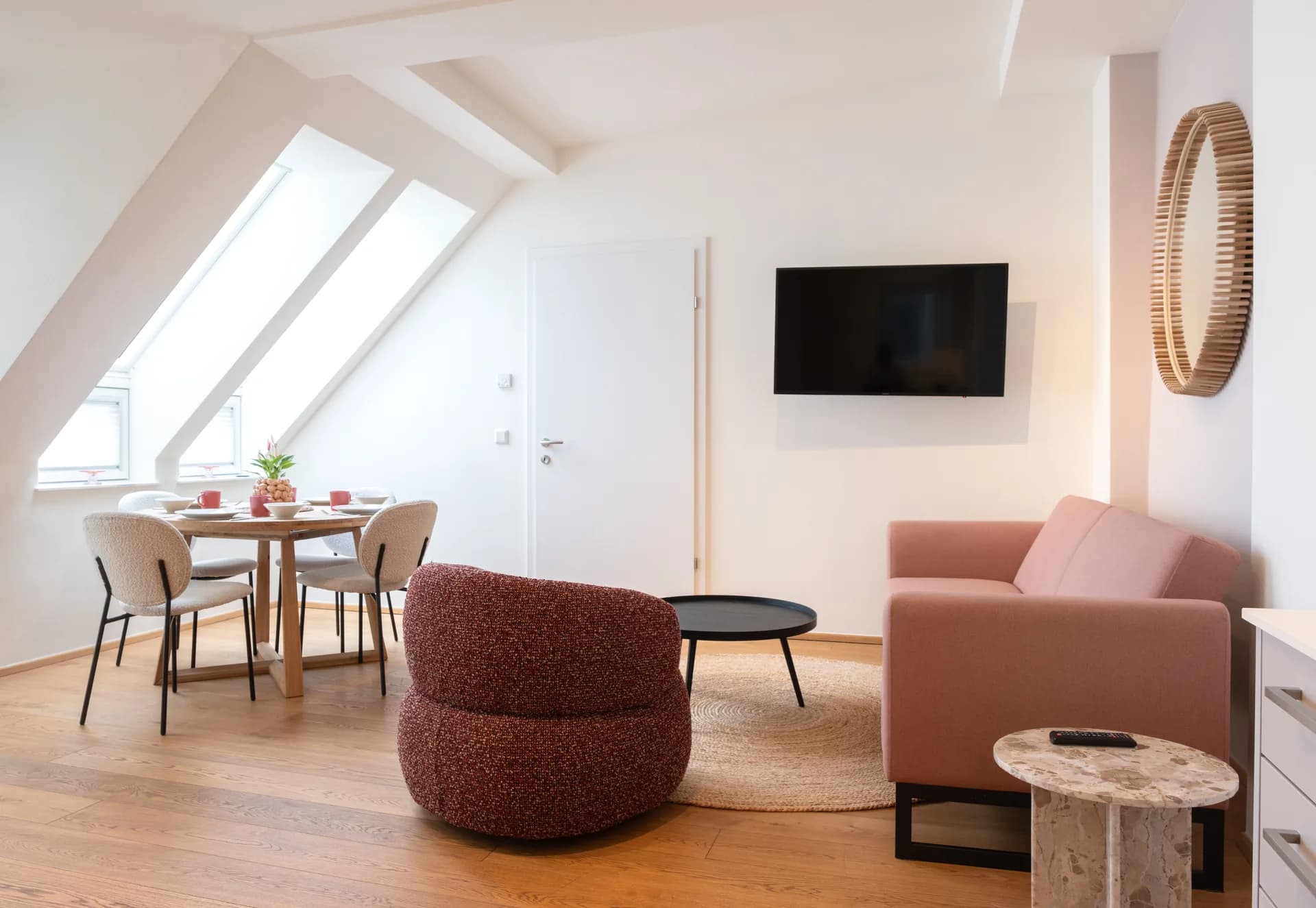
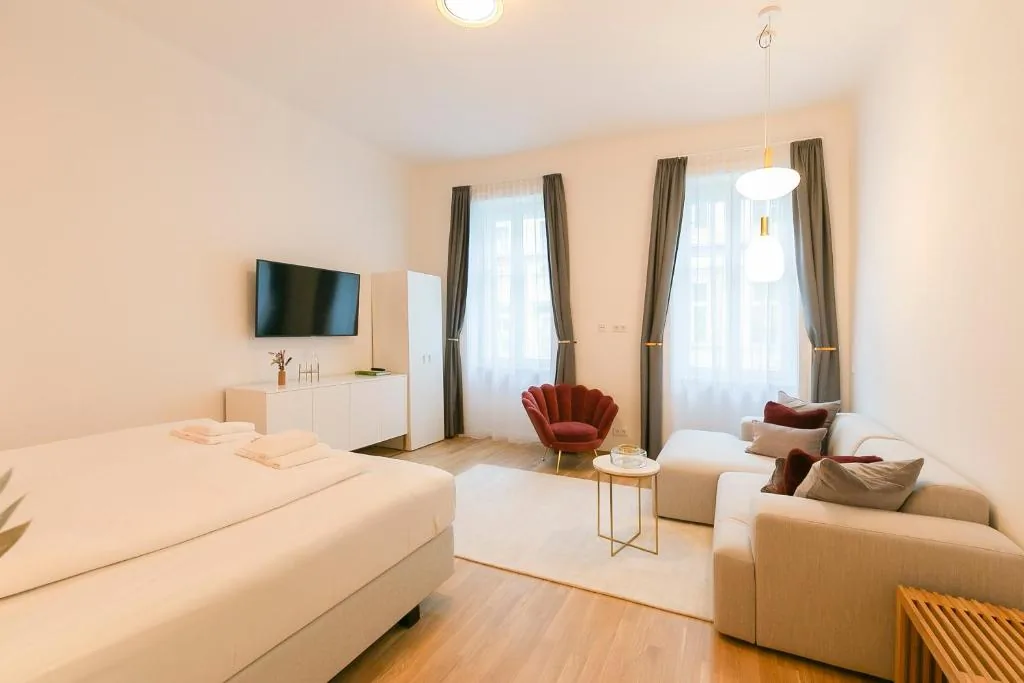
- Under 100 units. Five apartments: Mini MINT (35m²), Double MINT (55m²), Double MINT with Balcony (55m²), MINT Artisan (65m²), and the Penthouse Maisonette (85m², two floors, private rooftop terrace).
- Independent ownership. Host-led by Christian. No hotel group above us. No corporate brand book. No loyalty programme.
- Residential floor plan and full kitchen. Fully equipped kitchen, separated living and sleeping space, king-size bed, washing machine, air conditioning, elevator, and high-speed internet in every apartment. No spa, no pool, no restaurant, no fitness centre, no 24/7 front desk, no on-site parking - those are hotel amenities, not boutique-apartment-hotel amenities.
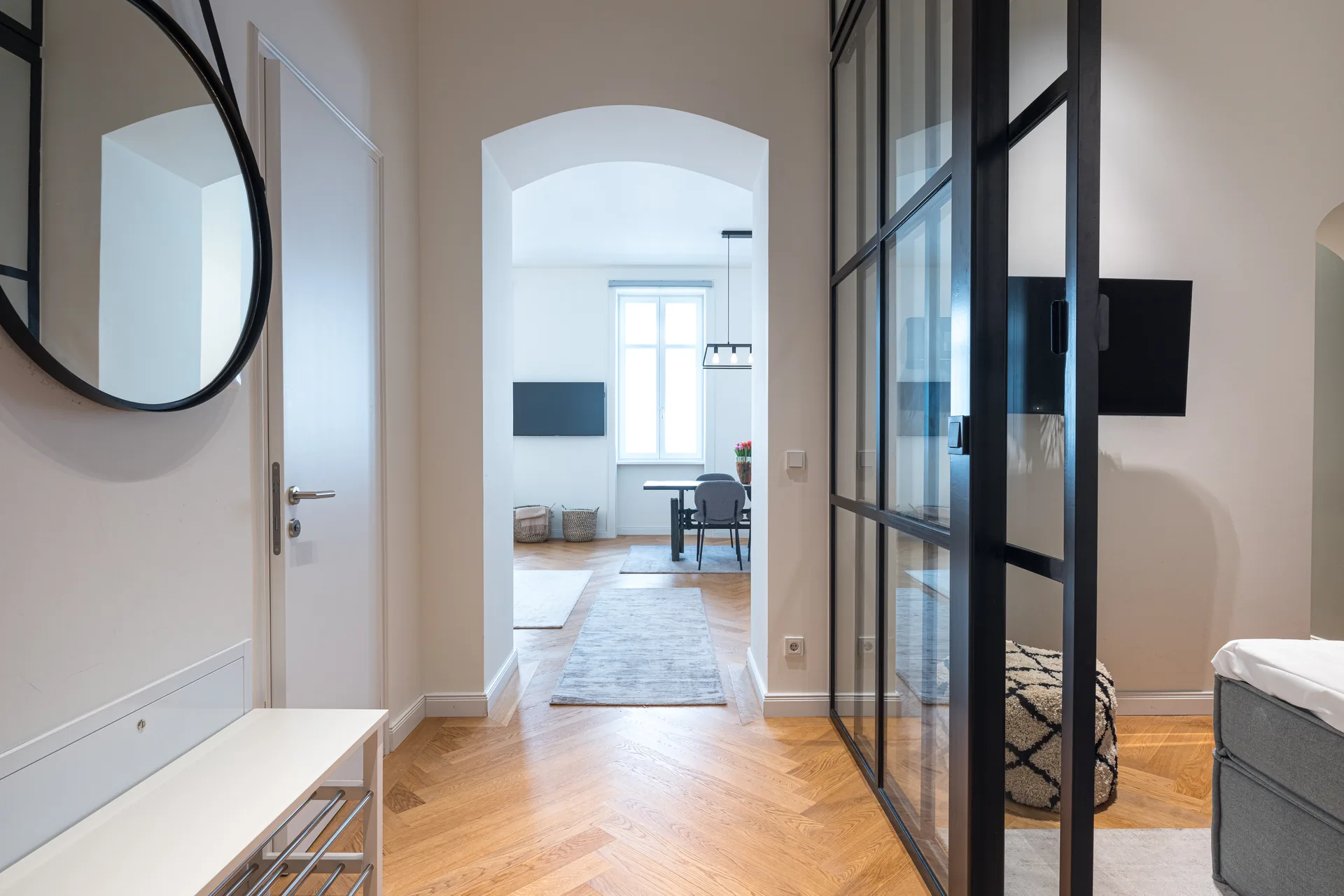
- Locally rooted design. Each apartment has its own design story. The Artisan has warm terracotta walls, herringbone oak floors, and curated art - a gallery you can live in. The Penthouse has two separate bedrooms, floor-to-ceiling windows, and a private roof terrace.
- Host-led service. Self check-in, instructions before arrival, direct WhatsApp access to Christian throughout the stay. For a Naschmarkt coffee recommendation, an early check-in request, anything else - the message reaches the host.
Five apartments is a number you can hand-finish. Five apartments is also a number where direct booking through mintaustria.com means your message reaches the person responsible for what your stay feels like.
For the design-conscious traveller who reads the terracotta-and-oak interior of MINT Artisan - gallery-style boutique apartment as the BLLA Classic Boutique criterion made physical, the Artisan is the natural choice. For travellers who want the everyday-boutique tier at the Vienna hotel ADR benchmark - €215 a night, with a private balcony - Double Mint with Balcony - the everyday-boutique tier is the entry point.
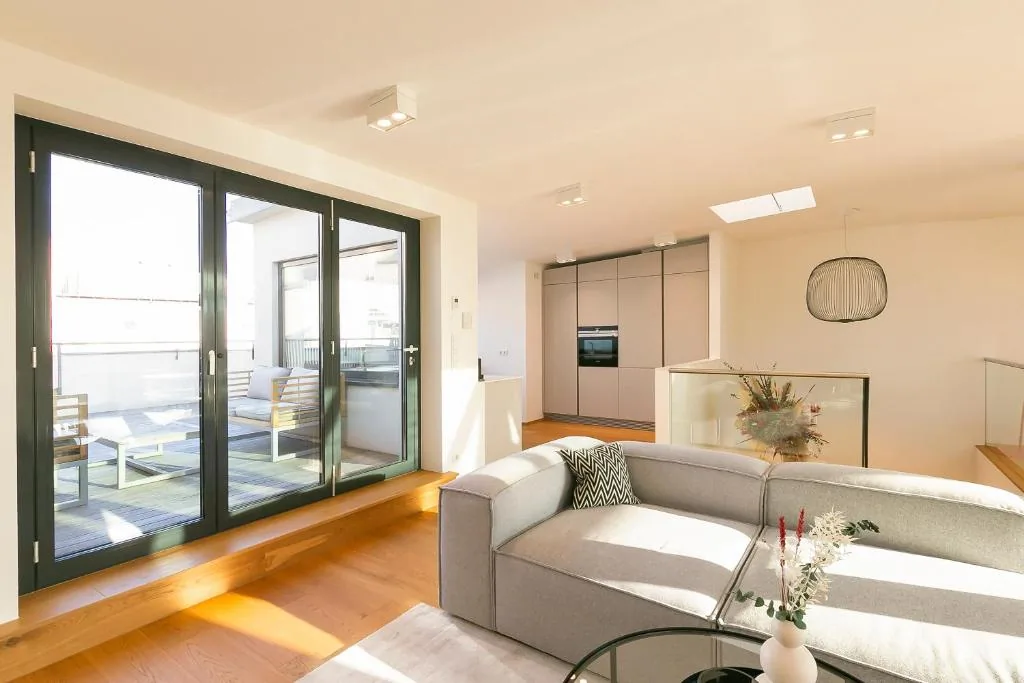
Looking for the closest thing Vienna's 6th district has to a boutique apartment hotel at the premium tier? MINT Penthouse - 85m² maisonette with private rooftop terrace is two floors, two separate king-size bedrooms, floor-to-ceiling windows, and a private roof terrace, 1 minute on foot from the Naschmarkt. From €375 a night, sleeps 4.
MINT's three boutique-tier apartments - side by side
| Apartment | Size | Differentiating design feature | Sleeping configuration | Walk to Naschmarkt | From-price per night |
|---|---|---|---|---|---|
| Penthouse Maisonette | 85m² | Two-story maisonette, private rooftop terrace, floor-to-ceiling windows | 2 separate king-size bedrooms - 4 guests | 1 min | €375 |
| MINT Artisan | 65m² | Warm terracotta walls, herringbone oak floors, curated art | King-size bed, pull-out - 4 guests | 1 min | €185 |
| Double Mint with Balcony | 55m² | Private balcony | King-size bed + pull-out sofa - 3 guests | 1 min | €215 |
Stay-tier discounts apply across all three: Wochenend+ for 7+ nights (-15%), Fortnight for 14+ nights (-20%), Resident for 28+ nights (-25%) - the discount tier aligned with the mid-term-stay segment growing at +136% globally since 2019.
Key fact: The 1-minute walk to the Naschmarkt is the structural advantage. Boutique apartment hotels in Vienna's 6th district are scarce, and proximity to the city's most photographed market - every café, every wine bar, every Heuriger producer at the Saturday farmer's market - is what the boutique format is supposed to deliver. We live above it.
What to know before booking a Vienna boutique apartment hotel
A short list for the traveller arriving from London, San Francisco, Sydney, Berlin, or Zurich on a 3- to 5-night Vienna stay.
Confirm the kitchen actually exists. "Kitchenette" and "fully equipped kitchen" are not the same thing. A kitchenette is a kettle, microwave, and small fridge. A full kitchen is a hob, oven, dishwasher, full-size fridge, and proper utensils. On a 4-night stay where you cook breakfast and a couple of dinners, the difference is the entire reason for booking the format.
Ask about housekeeping frequency before you book. Boutique apartment hotels are typically weekly clean, not daily - appropriate for the format, and a feature for travellers who do not want a refresh truck running through the corridor every morning.
Clarify Betriebskosten, Heizkosten, and security deposit. Vienna serviced apartments occasionally split out Betriebskosten (operational service charges) and Heizkosten (heating costs) on top of the nightly rate, particularly on longer-stay contracts. Security deposit pre-authorisation is standard, refunded within 7-14 days. Direct-booking pages on independent operators' sites tend to be the most transparent on these line items; OTA listings sometimes add platform service fees that are not immediately visible.
Prefer direct booking when you can. Boutique operators typically offer direct booking with all-in pricing and a named host. The OTA layer - Booking.com, Airbnb, Expedia - adds a service-fee margin and routes communication through a generic inbox. For the boutique format specifically, where the host relationship is part of the product, that intermediary works against you.
Confirm check-in mechanics ahead of time. Most boutique apartment hotels use self check-in via a keybox, smart lock, or pre-arrival key drop. MINT sends instructions before arrival, and Christian is directly reachable by WhatsApp from the moment you book.
A forthcoming MINT spoke article will cover how boutique apartment hotels operate day-to-day in Vienna, including a practical procedural walkthrough of check-in, housekeeping, and host availability.
For business travellers on 7- to 21-night stays, boutique apartment hotels work well - the residential format, the cooking option, and the host model are all positives. The wider business-travel market lens, including corporate housing and traditional aparthotel chains, is covered in a separate MINT hub on the business-travel market for Vienna serviced apartments.
Check availability and book direct - direct booking, all-in pricing, and the message goes to Christian.
Frequently asked questions
What is a boutique apartment hotel, and how is it different from a regular hotel?
A boutique apartment hotel meets three tests at once: fewer than 100 independently owned units (typically far fewer), a residential floor plan with a full kitchen, and a design language rooted in the surrounding neighbourhood. Compared to a standard hotel room, it offers 50-100% more living space, separated living and sleeping areas, and the ability to self-cater. Compared to a generic short-term rental, it is licensed, professionally operated, and host-led rather than algorithm-managed.
How does MINT @Naschmarkt differ from corporate aparthotel chains like Adina or Adagio?
Scale, design, host model, and location. MINT is 5 apartments hand-finished by a single host; Adina and Adagio operate 100+ standardised units per Vienna property under a corporate brand. MINT is in District 6 (1 minute from the Naschmarkt); Adina is in District 10 near the main station, Adagio is in District 1 near the Ringstrasse. No loyalty programme, no chain reservation system, no 24-hour reception. A host you can reach directly and an apartment that looks like Vienna rather than a brand book.
What design and amenity standards should I expect at a boutique apartment hotel in Vienna?
The standard amenity set: fully equipped kitchen, washing machine, high-speed Wi-Fi, air conditioning, bed linen and towels, free luggage storage. MINT delivers all of those plus an elevator and a king-size bed in every apartment. What boutique apartment hotels typically do NOT have - and MINT does not offer - is a spa, pool, restaurant, fitness centre, 24/7 front desk, or on-site parking. Those are hotel amenities. The trade is intentional: smaller scale, more space inside the apartment, residential rather than hospitality-industrial finish.
How is boutique apartment hotel pricing in Vienna structured, and what is the typical nightly rate?
Vienna's hotel ADR is €211 (HVS / STR, 12 months to June 2025) versus a European serviced-apartment ADR of €136 (Savills 2026) - Vienna runs roughly 55% above the European benchmark. Boutique apartment hotels in Vienna typically price from €180 to €400 a night, with stay-tier discounts on longer bookings. MINT's range: Double Mint with Balcony from €215 (Vienna ADR benchmark), Artisan from €185, Penthouse from €375. Stay-tier discounts: 7+ nights -15%, 14+ nights -20%, 28+ nights -25%.
How does check-in work at a boutique apartment hotel - is there a reception desk?
Most boutique apartment hotels use self check-in (keybox, smart lock, or pre-arrival key drop) rather than a staffed 24-hour reception. At MINT, instructions are sent before arrival, Christian is reachable by WhatsApp throughout the stay, check-in is from 15:00 and check-out by 11:00, with early or late available on request. The absence of a lobby reception is a feature of the residential format - your front door is your front door, not a corridor off a hotel lobby.
Which Vienna districts have the most boutique apartment hotel options?
Vienna's 6th district (Mariahilf - Naschmarkt, cocktail bars, Mariahilferstrasse) and 7th district (Neubau - Spittelberg, art museums, independent restaurants) are the boutique-rich belt. The 1st district (Innere Stadt, Ringstrasse) is luxury and chain hotel territory. The 2nd hosts Zoku as a corporate-lifestyle hybrid. The 10th (Favoriten) is corporate-aparthotel territory near the main railway station. The 2026 pipeline confirms the 6th/7th trend: Miiro SpittelBerg opens in the 7th in spring 2026.
What kind of traveller is best suited to a boutique apartment hotel rather than a chain hotel?
The strongest fit is the design-conscious leisure traveller booking 3 to 5 nights - someone who wants a kitchen, a separate living area, and an interior that looks like Vienna rather than a chain template. Cultural-trip travellers (museum, opera, architecture focused) are also natural - the apartment becomes part of the cultural experience rather than just a place to sleep. Business travellers on 7- to 21-night stays who want more space than a hotel room work too. Per Expedia's Unpack '26 report, drawing on 24,000 global travellers, more than half now book multiple hotels within one destination - the "Hotel Hop" pattern often includes one boutique-independent stay per trip. Not the right fit for travellers who need 24-hour concierge, on-site spa, restaurant, or loyalty-points accumulation.
How can I evaluate whether a boutique apartment hotel is genuinely independent or boutique-branded but chain-backed?
Five checks: ownership (independently owned, or part of a hotel group? Ruby Hotels, for example, is now part of IHG's portfolio); portfolio size (a genuine boutique property has fewer than 100 units; 130+ under one brand is corporate scale); kitchen facilities (a true boutique APARTMENT hotel has a full kitchen, not a kettle and microwave); the host model (named host or corporate reservations desk?); and direct booking transparency (boutique operators typically offer direct booking with all-in pricing displayed on their own site).
Are there hidden fees or extra charges when booking Vienna serviced apartments?
Potential extra-charge items: Betriebskosten (operational service charges), Heizkosten (heating costs, sometimes billed separately on longer stays), cleaning fees, security deposit. Booking via an OTA (Airbnb, Booking.com, Expedia) typically adds a platform service fee on top of the advertised rate. Best practice: direct booking exposes all-in pricing in one flow. MINT's direct booking page displays the all-in rate; the message reaches Christian, not a generic OTA inbox.
What is the Vienna hotel and serviced apartment market performance in 2025-2026?
Vienna recorded 20,065,000 overnight stays in 2025 (+6%) - the city's best year on record, with 83% international visitors. Vienna hotel ADR reached €211 with occupancy 76.8% and RevPAR up 7.3% in the 12 months to June 2025. The European serviced-apartment segment ran 79% occupancy at €136 ADR in 2025, growing demand at a 5.9% CAGR since 2019 against 1.1% for the wider hotel sector, with €1.2bn of European transaction volume in 2025. The 2026 Vienna pipeline includes Miiro SpittelBerg (spring, 7th), Hotel Schani Wien City (April, 2nd), Palais Chotek (May, 9th), Bob W. Vienna Döbling (July, 19th), and Hotel Schani Naschmarkt (September, 2nd despite the name).
Sources
- Boutique Hotel Categories & Definitions - BLLA
- White Paper for Defining Boutique and Lifestyle Lodgings - Hospitality Net / BLLA
- What Is a Boutique Hotel? The Complete Guide - Cvent, 2024
- Spotlight: European Serviced Apartment Report 2026 - Savills, April 2026
- Vienna 2025: Best Year Ever for Tourism - Vienna Tourist Board, January 2026
- Hotel Valuations Stall Across Europe - Boutique Hotel News, March 2026
- Vienna Hotel Market Spotlight YE June 2025 - Hospitality Net, September 2025
- Expedia Group Reveals 2026 Travel Trends - Short Term Rentalz, October 2025
- The A-Z of Travel, Hospitality and Living: Trends to Watch in 2026 - Boutique Hotel News, January 2026
- New Hotels & Hotel Projects - Vienna Tourist Board
- Vienna's Neighbourhood Transformations - Monocle
- Adina Serviced Apartments Vienna - Official site
- Aparthotel Adagio Vienna City - Official site
- Zoku Vienna - Official site
Last updated: May 2026. Christian, Host & Founder - MINT @Naschmarkt.