
Relocating to Wien on a 1-3 month assignment means setting up a foreign address, registering it with the Austrian state, opening a bank account, getting a SIM, sorting transit, and getting work done - usually all in the first ten days. A serviced apartment under MINT's Resident tier (28+ nights) collapses most of that into one transaction: you book, you arrive, you register your address using a stable landlord-signed Meldezettel, you skip the 3-6 month deposit and 1-2 month agency fee a traditional Wien rental would demand, and you start working. The all-in price for a 28-night Resident-tier stay frequently lands below the up-front cash a traditional Wien lease would require before your first night. This guide walks through how that works in 2026, what the first-week setup actually involves, and which apartment fits which kind of relocator.
According to a Vienna Tourist Board B2B 2025 performance report, Wien recorded 20,065,000 overnight stays in 2025 - an all-time record - with 83% from international visitors. Behind that headline sits a quieter structural shift: Europeans are travelling and working away from home for longer. The Savills European Serviced Apartment Spotlight 2026 tracks the serviced apartment sector growing at a 5.9% CAGR since 2019 against 1.1% for the wider hotel market, with occupancy at 79% versus 75% for hotels. The 28+ night stay is no longer niche.
What you'll find on this page
- The 2026 market context - why extended stays are the fastest-growing segment in European hospitality.
- MINT's Resident tier and stay-length pricing - how the 28-night threshold works and what each apartment costs.
- A side-by-side first-month cash comparison: serviced apartment vs traditional Wien rental.
- The Day-1-to-Day-7 setup checklist - Meldezettel, SIM, transit pass, bank account, in the right order.
- Wien district selection for foreign relocators - six central districts compared.
- Honest persona mapping - which MINT apartment fits which kind of relocator.
- Ten FAQs covering Resident tier, Meldezettel, Ortstaxe, transit pricing, banking, SIM, and booking logistics.
Bottom line: For a 1-3 month Wien assignment, the question is rarely "serviced apartment or hotel?" It's "serviced apartment or traditional rental?" Once deposit, agency fee, utility setup, and furniture sourcing for a traditional lease are honestly tallied, a 28+ night Resident-tier stay at MINT - utilities, fast Wi-Fi, weekly cleaning, and landlord-signed Meldezettel included - frequently comes out ahead.
Why foreigners are choosing extended-stay apartments in Wien in 2026
Wien sits second globally in Mercer's 2024 Quality of Living City Ranking - behind only Zurich and ahead of Geneva, per the Vienna Tourist Board's summary of the Mercer 2024 ranking. The exact wording: "In 2024, Vienna - this time in second place behind Zurich - continues to show that the city is a global leader when it comes to the highest standards of urban living." That ranking is one reason a steady stream of European, North American, and Asian professionals accept Wien assignments rather than declining them.
The other reason is that Wien is structurally cosmopolitan. According to a February 2026 analysis from The International citing Statistik Austria preliminary figures, about 37% of Wien's population - more than 754,000 of the city's roughly 2.04 million residents - hold foreign citizenship. Wien accounted for nearly two-thirds of Austria's total population increase in 2025. Translation: arriving in Wien as a foreign professional is statistically routine. The city has absorbed enormous international inflows. But - and this is the part most "Vienna relocation guide" content soft-pedals - the housing entry complexity has not decreased proportionally.
The structural growth in extended-stay demand matters for what's available. Savills' 2026 report tracks the European serviced apartment sector at 5.9% CAGR since 2019, with €1.2bn in European transaction volumes in 2025 and an average daily rate of €136. The number of Europeans planning trips of 7-12 nights increased by 11% in 2025 - Savills classifies this as structural, not cyclical. A 2025 GSAIR findings summary from Serviced Apartment News reports the global serviced apartment ADR at £145 and identifies corporate relocations as a leading growth driver. Alistair Murray, COO at Ariosi, frames the outlook plainly: "Flexibility will be the guiding principle heading into 2026 to accommodate ongoing wider geopolitical and geoeconomic changes." Corporate travel programmes are realigning toward serviced apartments in part because they offer professional management, cost transparency, and consistent duty-of-care standards informal arrangements cannot match.
Practically, the supply of credible extended-stay options in Wien in 2026 is wider than five years ago. Branded platforms like Blueground, AltoVita, and Zoku operate Wien inventory aimed at corporate relocation. Boutique host-run operations like MINT serve the same window with a different posture - five hand-finished apartments, one host, one neighbourhood. The choice is now about fit. (For a 1-21 night business-travel stay rather than a relocation, see our Vienna business apartments market overview.)
Watch out: Wien's short-term-rental rules are tightening. Airbnb-style listings face a 90-day annual cap on rentals of entire homes in much of the city. For a genuine 3-month relocation, this rules out a meaningful share of Airbnb inventory. We unpack platform choice in detail in our Airbnb vs serviced apartments Vienna decision guide; the short version for relocators is that a licensed serviced apartment removes the regulatory uncertainty.
How MINT's Resident tier pricing works (and what the 28-night threshold buys you)
MINT runs four published stay tiers across all five apartments - same structure regardless of which unit you book. Discounts auto-apply at checkout based on stay length. No application form, no employer letter, no negotiation.
- Standard (2+ nights): baseline nightly rate.
- Wochenend+ (7+ nights): −15%.
- Fortnight (14+ nights): −20%.
- Resident (28+ nights): −25% - the tier most relocators on 1-3 month assignments hit.
The Resident tier exists because a relocator booking for a month is not a tourist. Your kitchen handles real cooking, the washing machine handles a working person's laundry cycle, the desk handles client calls and code. The discount reflects that you're a resident of the building for the duration.
Table 1 - Stay-length pricing tiers across MINT Wien (2026)
| Tier | Mini MINT (35 m², sleeps 2) | Double MINT (55 m², sleeps 3) | Double MINT Balcony (55 m², sleeps 3) | Artisan (65 m², sleeps 4) | Penthouse (85 m², sleeps 4) |
|---|---|---|---|---|---|
| Standard (2+ nights) | €185 / night | €205 / night | €215 / night | €185 / night | €375 / night |
| Wochenend+ (7+ nights, −15%) | ~€157 / night | ~€174 / night | ~€183 / night | ~€157 / night | ~€319 / night |
| Fortnight (14+ nights, −20%) | ~€148 / night | ~€164 / night | ~€172 / night | ~€148 / night | ~€300 / night |
| Resident (28+ nights, −25%) | ~€139 / night | ~€154 / night | ~€161 / night | ~€139 / night | ~€281 / night |
Figures based on published base rates from MINT property pages. Final rate at booking reflects seasonality. A 28-night Resident-tier stay at Mini MINT totals approximately €3,885.
A note on Wien's local accommodation tax. The current Ortstaxe rate is 3.2% of the accommodation payment until 30 June 2026, rising to 5% from 1 July 2026 and to 8% from 1 July 2027, per the City of Vienna's official Local Tax guidance. Exact source wording: "Individuals staying in the lodgings for more than three consecutive months are exempt." A 28-night Resident-tier stay sits inside the taxable window. The Resident tier is a pricing-tier discount from MINT; the Ortstaxe exemption is a separate tax-side question that only kicks in after three consecutive months. The tax itself is host-collected and remitted to the city - it does not typically appear as a separate guest line item.
Cost honesty: serviced apartment vs traditional Wien rental for 1-3 month stays
The "serviced apartments are expensive" reflex comes from comparing nightly rates to monthly rents in isolation. That comparison is misleading once you include what a traditional Wien lease demands up front before your first night.
The numbers are not folklore. The City of Vienna's official guidance on renting a flat sets out the regulated ranges: "In general, the security deposit equals the amount of a three to six months' gross rent." On agency fees: "Commissions...may only amount to a maximum of two months' rent. For tenancy agreements limited to three years, only a maximum of one month's rent may be charged as commission." For a 1-3 month assignment that's - at minimum - three months' rent in deposit plus one to two months' agency fee plus the first month's rent itself, before any utilities are connected, before any furniture is sourced, before any internet is installed.
The Resident tier removes those line items. The MINT all-in nightly rate covers the apartment, the utilities, gigabit Wi-Fi, weekly cleaning, linen changes, and AC. There is no deposit. There is no agency fee. There is no utility activation.
Table 2 - First-month cash outlay: MINT Resident tier vs traditional Wien unfurnished rental (2026)
| Cost component | Traditional Wien rental (typical 1-bed unfurnished, 6th/7th district comparable) | MINT Resident tier - 28 nights at Mini MINT |
|---|---|---|
| Security deposit | 3-6 months' gross rent | €0 |
| Real estate agency fee | Up to 2 months' rent (1 month if lease ≤3 years) | €0 |
| First month accommodation cost | ~€1,000-€1,200 (1-bed unfurnished) | ~€3,885 (28 × €139) |
| Utility activation | ~€100-€300 setup plus ongoing bills | Included |
| Furniture / kitchen / linen setup | €500-€2,500+ (apartments rent unfurnished) | Included |
| Total estimated up-front cash before move-in | ~€4,600-€11,000+ | ~€3,885 (all-in) |
Traditional figures based on the City of Vienna's official rental-expenditure guidance and standard 1-bed unfurnished rates in Wien's 6th/7th districts. MINT figure uses 28-night Resident-tier maths from the Mini MINT €185/night base with −25%. For a deep-dive on monthly rental pricing by district, our upcoming Wien apartment pricing guide will break this down; for the full furnished-vs-traditional rental comparison, the dedicated furnished-rental guide we have queued handles the contract-terms nuance.
Key fact: For a relocation window of 1-3 months, the up-front cash requirement of a traditional Wien lease frequently exceeds the all-in cost of a serviced apartment stay. The break-even shifts in favour of traditional rental only once your stay is long enough to amortise the deposit and agency fee.
That cost arithmetic is why most large corporate travel programmes have shifted toward serviced apartments for 1-3 month placements: predictable invoicing, no deposit on the company's books, no furniture or utility headaches for the placed employee. The boutique end of the market (MINT, and a handful of similar host-run operators) sits alongside corporate-platform options like Blueground, AltoVita, and Zoku; for a platform-by-platform corporate-housing comparison, our upcoming corporate housing platforms guide covers that territory.
Arriving in Wien for a 1-3 month stint? MINT's Mini MINT studio is a 35 m² unit 1 minute from the Naschmarkt - fully equipped kitchen corner, gigabit Wi-Fi, washing machine, AC, and the Resident tier kicks in automatically at 28 nights for the −25% discount. Solo professional on an assignment, postdoc on a semester position, consultant on a project window - Mini MINT is the most common Resident-tier booking pattern we see.
Day 1 to Day 7 in Wien: the practical setup checklist
The first week is where most "Vienna relocation guide" articles vanish into platitudes. Here's the operational sequence in the order it actually runs.
Day 1-3: Meldezettel registration
Anyone moving into a Wien residence must register the address with the Austrian state. The City of Vienna's English-language registration guidance uses this exact wording: registration must happen "three days after moving into your new flat or house at the latest." The source does not specify calendar vs working days - for specifics, particularly if your move-in falls across weekends or holidays, contact your Bezirksamt directly. The conservative interpretation is calendar days.
What you need:
- A completed Meldezettel form signed by both you and the property owner/landlord.
- Your valid passport (for non-Austrian citizens) or equivalent travel document.
- A free in-person appointment at any Meldeservicestelle (Residence Registration Service Centre) at a Wien Bezirksamt.
Initial registration is free of charge. Additional certificate copies cost an application fee of €21 plus €6 per sheet. The Work in Austria official guide to registering at your new home confirms the same 3-day deadline and the same documentation, and notes the certificate is a prerequisite for opening a bank account, signing a phone contract, and dealing with most other Austrian administrative services.
MINT's host-run model matters here. When you book a Resident-tier stay, the landlord signature for the Meldezettel is available immediately. There is no chasing a remote owner, no Airbnb-style messaging chain, no waiting for a property manager to schedule a witness signature. Christian co-signs on Day 1.
Day 1-3: SIM card
For a 1-3 month stay, prepaid is the practical choice - no Meldezettel required at activation, no Austrian bank account required, just your passport. A CheckEverything.at 2026 mobile phone plans guide explains that anonymous prepaid SIMs were phased out in 2019, so ID verification is now mandatory at point of sale. Standard 2026 options:
- A1 B.free prepaid: €9.90 per 4 weeks, 50GB plus calls and SMS.
- HoT smart (on Drei network): €5.90 per month, 10GB LTE.
- YESSS prepaid (on A1 network): €7.99 per month, 10GB plus 1,000 minutes/SMS.
eSIM activates in minutes via QR code; EU roaming is included on most plans. MINT's gigabit Wi-Fi bridges the first-day connectivity gap.
Day 4-7: bank account
Most Austrian physical banks (Erste Bank, Raiffeisen, Bank Austria) require the Meldezettel before opening a resident current account. The bank needs the address registration, the address registration needs a stable address, and that stable address is what MINT provides on Day 1. Plan Meldezettel inside 72 hours, then book your bank appointment in week one. Digital alternatives (N26, Wise) can be set up before arrival using a foreign address - useful bridges for the first few days. If your employer is paying MINT directly via corporate invoicing, the bank-account question can wait; if you're a freelancer needing a local IBAN for client payments, prioritise it.
Day 4-7: transit pass
From 1 January 2026, the Wiener Linien 31-day Vienna pass costs €65.20 digital or €75.00 physical. The annual pass is €461 digital or €467 physical - €1.26 per day for unlimited travel on U-Bahn, tram, bus, and Schnellbahn across the Vienna core zone. Single tickets are €3.00 digital. The widely-cached €51/month historic figure is obsolete.
For a 28-night MINT stay, the pass is genuinely optional: Kettenbrückengasse U4 is a 3-minute walk and Karlsplatz interchange (U1/U2/U4) is an 8-minute walk. Most central errands - Naschmarkt produce, Café Sperl, MuseumsQuartier, Staatsoper - are walkable. Buy the pass if your work location is in an outer district. At fewer than 22 trips per month, single tickets at €3.00 each win.
Other setup items
- Healthcare: EU citizens use EHIC for short stays; non-EU arrivals typically have employer-provided coverage. Freelancers should arrange international cover before arrival.
- Visa / taxes: stay duration and visa type interact with apartment lease length - covered in our upcoming Wien visa-types and apartment-leasing guide.
- German: central Wien works in English; outer districts and government offices are German-first. Translation apps suffice for most week-one bureaucracy.
For the full apartment setup detail - utility registration nuance, internet provider comparisons, furnishing logistics - our Wien apartment setup logistics guide covers that territory.
Wien districts that actually work for foreign relocators on 1-3 month stays
MINT's base is the 6th district (Mariahilf), 1 minute from the Naschmarkt. We're honest about which other districts suit relocators well - the central, transit-rich ones - and leave out outer districts MINT cannot realistically serve from the 6th. The table covers the six districts most relevant to a 1-3 month relocator. For a deep dive on the 6th specifically, our upcoming Wien 6th district housing guide goes further; our Naschmarkt-area accommodation overview is already published for shorter-stay district context.
Table 3 - Wien district selection for foreign relocators (2026)
| District | Vibe / character | Typical demographic | U-Bahn / transit | 1-3 month relocation fit |
|---|---|---|---|---|
| 1st - Innere Stadt | Historic centre, most expensive | Corporate-sponsored expats | U1/U3 Stephansplatz | Excellent IF budget unlimited; rarely cheapest |
| 4th - Wieden | Hip and cool, near Naschmarkt, urban energy | Young professionals, freelancers, design crowd | U1 Karlsplatz, U4 Kettenbrückengasse | Strong fit; energy without 1st-district pricing |
| 6th - Mariahilf (MINT's district) | "Sometimes referred to as one of the top 15 coolest districts in Europe" - verbatim from a 2025 Expatica Wien district guide. Café culture, Mariahilferstraße shopping, Naschmarkt | Mixed locals + expats, professionals + students | U4 Kettenbrückengasse (3 min), U3 Neubaugasse | Strongest 1-3 month fit - walkable, central, transit-rich |
| 7th - Neubau | Trendy, "Vienna's answer to New York's Brooklyn" per the same Expatica guide, MuseumsQuartier-adjacent | Young professionals, creative industries | U2/U3 Volkstheater, U3 Neubaugasse | Strong fit; design-led longer stays |
| 8th - Josefstadt | Quiet, residential-professional, near Rathaus | Established professionals, academics, families | U2 Rathaus, tram 2 | Good fit for quieter long stays; less nightlife |
| 9th - Alsergrund | University quarter (University of Vienna, Sigmund Freud University) | Academics, researchers, students, medical professionals | U2 Schottentor, U4 Friedensbrücke | Excellent for postdoc/researcher persona; calm |
District characterisations for the 1st, 4th, 6th, and 7th are confirmed via the Expatica Wien district guide; 8th and 9th reflect commonly-held local characterisations. For relocators with families needing international-school access (typically 19th/Döbling and 18th/Währing), our upcoming Wien family-relocation guide covering school districts goes deeper. Outer districts (10th, 11th, 22nd, etc.) are excluded - if your work is in Floridsdorf, you want housing in Floridsdorf, not in Mariahilf.
A pattern that recurs: many relocators use MINT in the 6th as a first-month landing pad while searching for a longer-term flat in whichever district their work or family commitments suggest. The Resident-tier 28-night stay gives you a Meldezettel-ready Wien address from Day 1 and a walkable central base from which to scout flats without the pressure of having signed a 12-month Mietvertrag sight-unseen.
Settling in? Once you know your neighbourhood, our guide to where locals actually eat in Vienna covers 33 spots by cuisine - from your first weeknight dinner to the places worth booking ahead.
MINT apartments for relocators: matching the unit to the stay profile
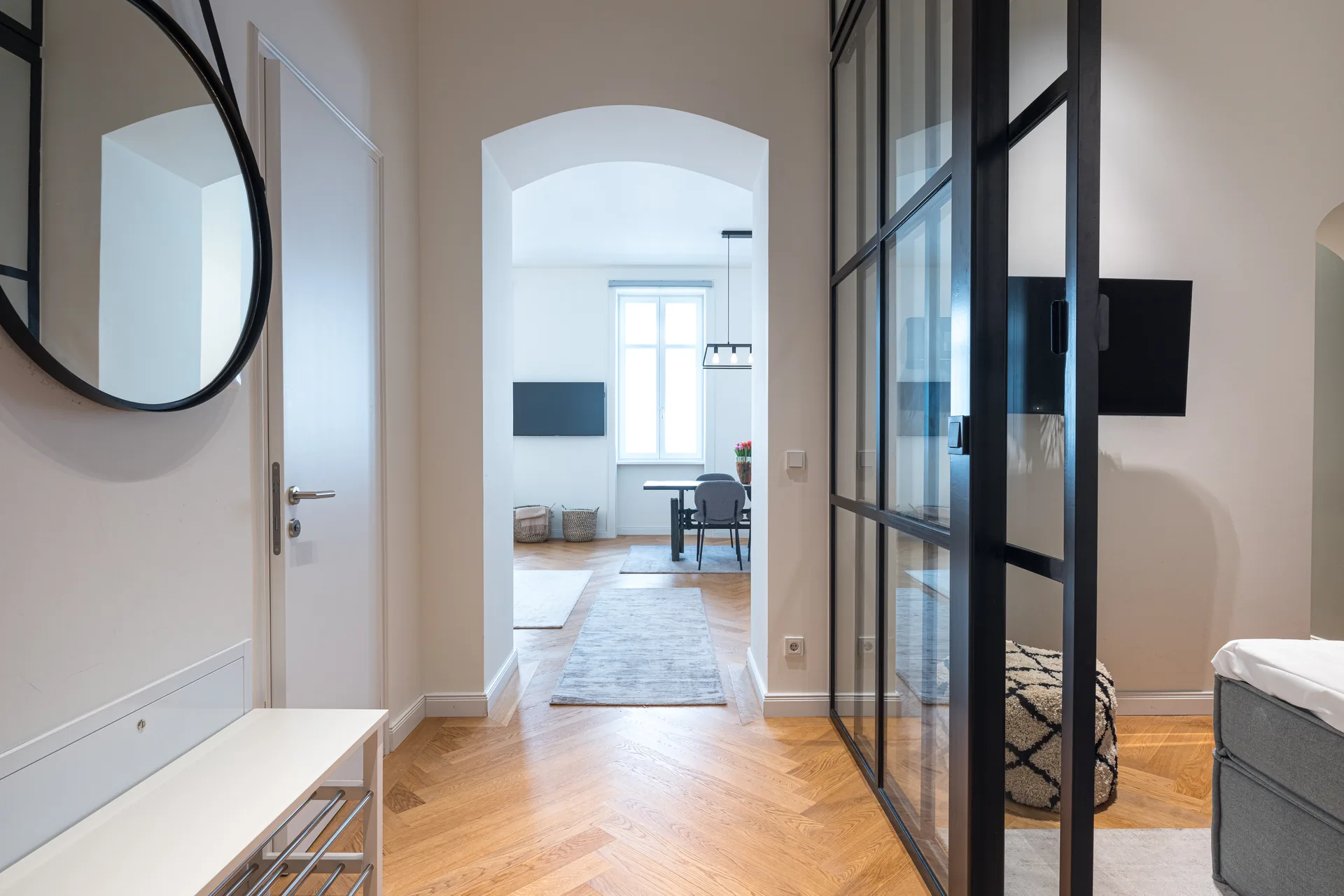
MINT runs five apartments, all in the same 6th-district building, all 1 minute from the Naschmarkt and 3 minutes from Kettenbrückengasse U4.
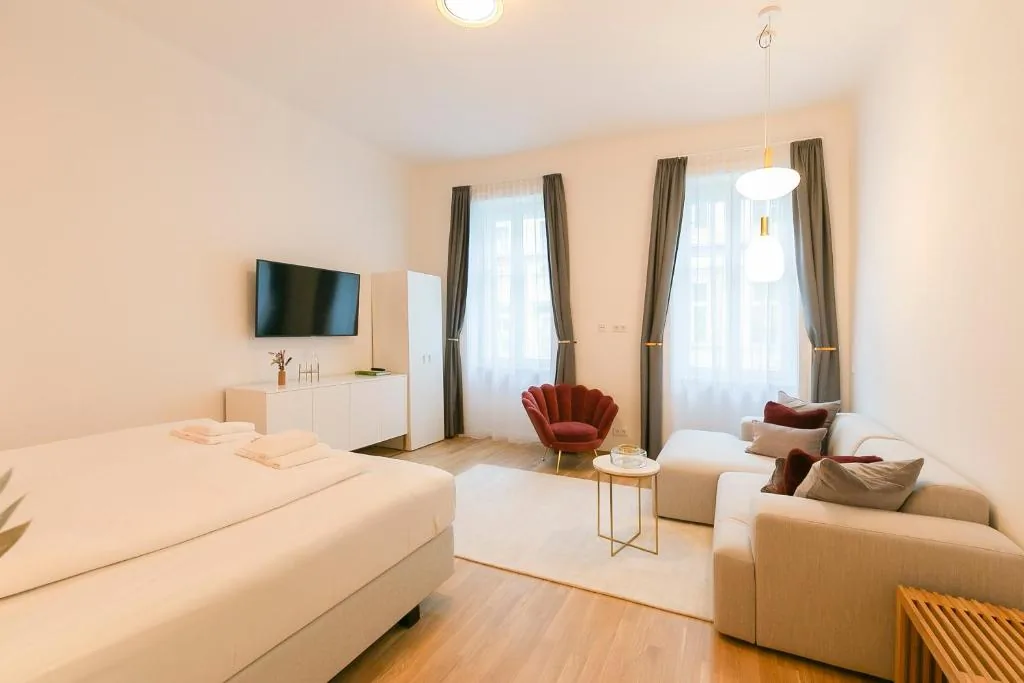
Mini MINT - the solo-relocator default. 35 m² studio, sleeps 2, base rate €185/night (~€139/night under Resident tier). King-size bed, fully equipped kitchen corner, washing machine, AC, gigabit Wi-Fi, free luggage storage. The most common Resident-tier booking: solo professional on a 1-3 month assignment - consultants, postdocs, digital nomads, freelance designers, employees on internal transfers. The studio layout works because the relocator's reality is "work + sleep + cook a real meal" rather than "entertain a household." Mini MINT also proves out the Resident-tier cost case most cleanly against a traditional rental.
Double MINT with Balcony - the couple relocator. 55 m² plus private balcony, sleeps 3, base rate €215/night (~€161/night under Resident tier). King-size bed plus pull-out sofa bed, fully equipped kitchen, balcony, AC, washing machine. Pattern: couple arriving because one partner has a Wien assignment, or solo professional on a longer stay who wants outdoor space and a sleeping area for visitors. Double MINT with Balcony shifts the apartment from "place to crash" to "place to live" - material for stays approaching 90 nights.
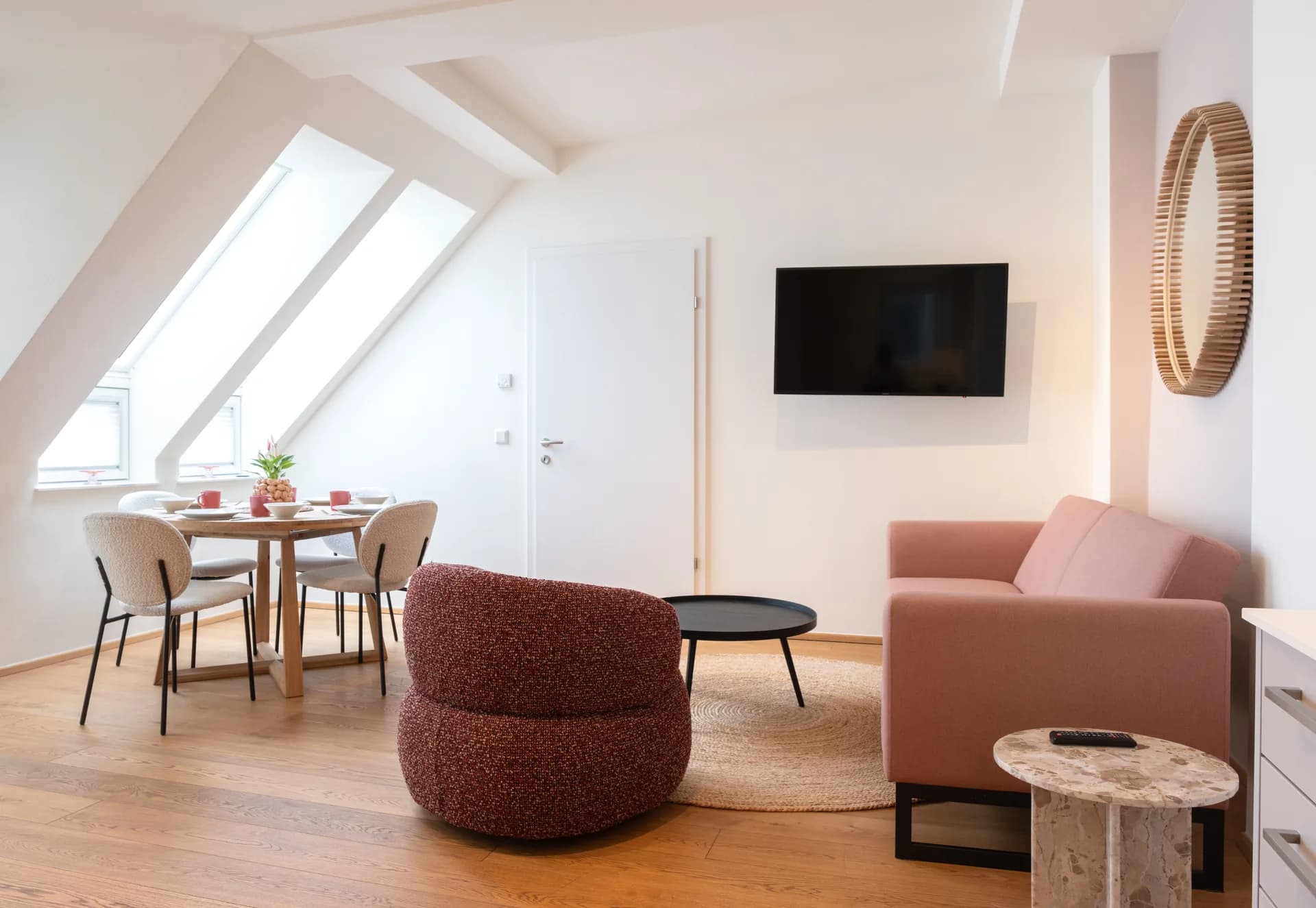
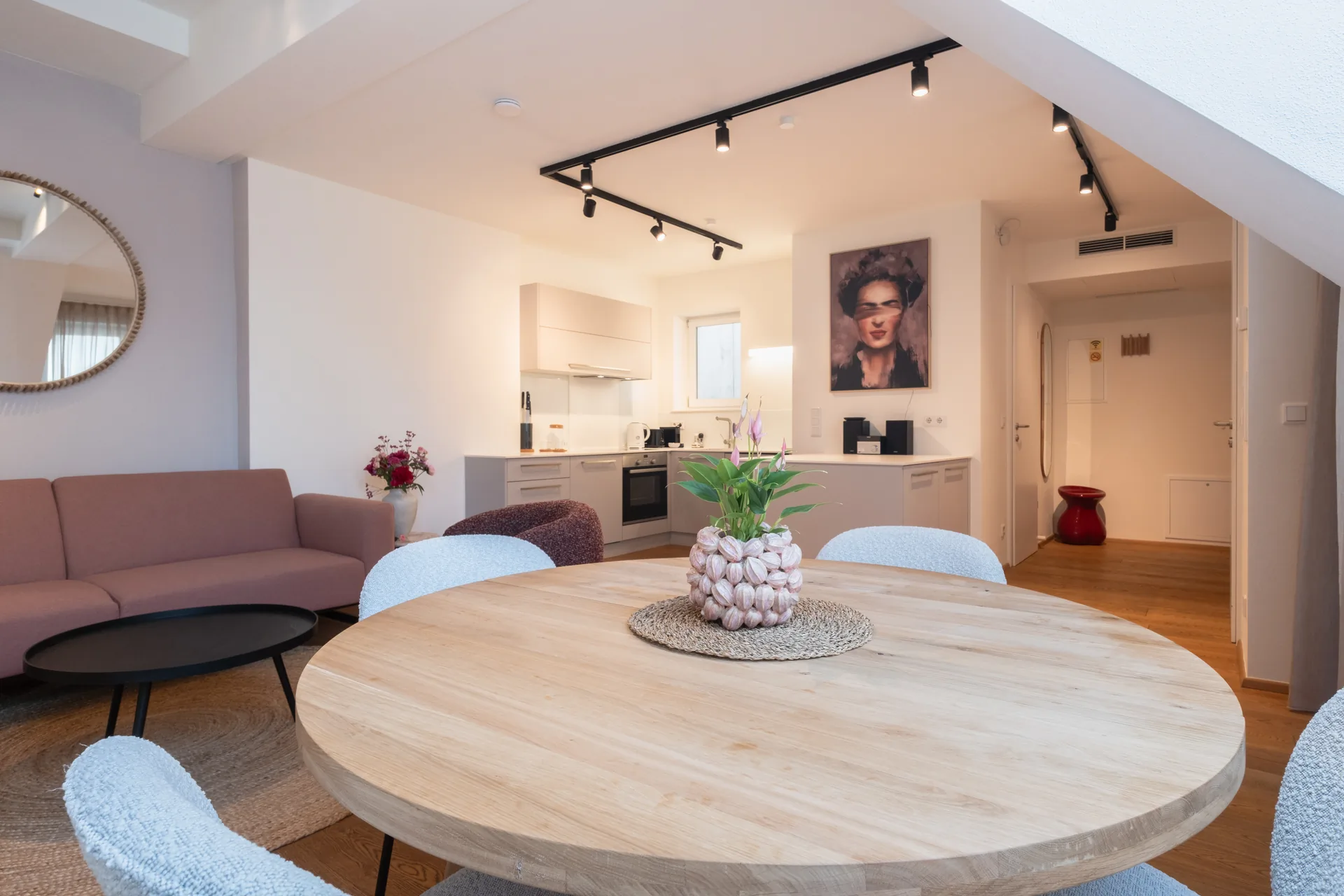
Penthouse Maisonette - the family / executive relocator. 85 m² across two floors, two separate bedrooms, sleeps 4, base rate €375/night (~€281/night under Resident tier). Private roof terrace, floor-to-ceiling windows, fully equipped kitchen, AC, washing machine. Pattern: family relocation for a corporate placement, or premium executive on a multi-month engagement bringing visiting family. Penthouse Maisonette is the only MINT unit with two truly separate bedrooms and a roof terrace - relevant when the household includes children or visiting parents. For full family-amenity comparisons including shorter stays, our family apartments guide covers that frame.
MINT Artisan and Double MINT - the supporting roster. MINT Artisan is 65 m² at €185/night base - design-led, terracotta-toned. Pattern: architects, academics, artists, museum-sector professionals on residency-style stays. For broader category context on Wien's boutique apartment-hotel scene, our boutique apartment hotels overview gives the wider frame. Double MINT is 55 m² at €205/night base - the no-balcony couple/group baseline. Pattern: couple or friend-group on a shorter Resident-tier window (28-42 nights) where outdoor space is not the priority.
Two niche profiles deserve specific framing. Researcher / postdoc on a visiting position: academic appointments often run 4-10 months. MINT's Resident tier suits the first 28-90 nights as a base while the postdoc searches for a longer-term flat closer to their host institution (the 9th for University of Vienna, the 1st/4th for TU Wien, the 13th/Lainz for OEAW). Corporate-placed family on a multi-month placement: family relocations typically run 3-24 months. The Penthouse is the appropriate unit for the first 28-90 nights while a longer-term flat is sourced - usually the 18th, 19th, 8th, or family-friendly pockets of the 7th.
Ready to pick dates? Check availability and book direct - no platform fees, and Christian responds same-day during Wien hours if you need to confirm Meldezettel co-signature timing or anything else before arrival.
Frequently asked questions
1. What is MINT's Resident tier and how does it differ from a standard booking?
The Resident tier is MINT's 28+ night pricing discount of −25% off the base nightly rate. Mini MINT drops from €185 to approximately €139/night effective. No separate application, no employer letter - it auto-applies at booking when stay length reaches 28 nights. The discount cascades across all five apartments; you book direct and the system computes the rate. The tier name signals intent: a relocator booking for a month is treated as a resident of the building, not a short-stay tourist.
2. Do I need a Meldezettel for a 1-3 month MINT stay?
Yes. Anyone moving into a Wien residence must register their address - the Meldezettel - within three days of moving in, per the City of Vienna's official guidance. Applies regardless of nationality and regardless of whether you're at a hotel, serviced apartment, or private rental. Documents: the Meldezettel form signed by both you and the host/landlord, plus a valid passport or travel document. Registration is free at any Wien Meldeservicestelle. MINT's host-run model means the landlord signature is available immediately on Day 1. The Meldezettel is the prerequisite for opening a physical Austrian bank account and signing a phone contract. For interpretation of the 3-day deadline - particularly if your move-in falls across weekends or holidays - contact your Bezirksamt directly.
3. What does the Wiener Linien 31-day transit pass cost in 2026, and is it worth it for a 28-night MINT stay?
From 1 January 2026, the 31-day Wien public transport pass costs €65.20 digital or €75.00 physical. It covers U-Bahn, tram, bus, and Schnellbahn across the entire Vienna core zone. The annual pass is €461 digital (€1.26/day). For a 28-31 night stay from MINT's Naschmarkt base, the pass is genuinely optional: Kettenbrückengasse U4 is 3 minutes' walk and Karlsplatz interchange is 8 minutes. Most central errands are walkable. Buy the pass if your work location is outside the central districts, or if your routine involves cross-city moves more than three or four times a week. Single tickets are €3.00 digital - at fewer than 22 trips per month, single tickets win. The historic €51/month figure widely cached online is obsolete.
4. Can I open an Austrian bank account during a 1-month MINT stay?
Yes, typically - provided you have the Meldezettel first. Most Austrian physical banks (Erste Bank, Raiffeisen, Bank Austria) require the Meldezettel to open a current account. Once registered at MINT's address (Day 1-3), apply for a bank account within the first week. Digital alternatives (N26, Wise) can be opened before arrival using a foreign address - practical bridges for the first few days. If your employer is paying MINT directly via corporate invoicing, the bank-account question can wait; freelancers needing local IBAN for client payments should prioritise it.
5. Which SIM card should I get for a 1-3 month Wien stay?
For a 1-3 month expat stay, a prepaid SIM is the practical choice - no Meldezettel or Austrian bank account required, just your passport (SIM registration mandatory since 2019). Recommended 2026 options: A1 B.free at €9.90/4 weeks for 50GB, HoT smart on Drei at €5.90/month for 10GB, or YESSS at €7.99/month for 10GB plus 1,000 minutes. eSIM activates in about 5 minutes via QR code; EU roaming is included on most plans. MINT's gigabit Wi-Fi bridges the first-day connectivity gap.
6. Which Wien district suits a 1-3 month relocator?
For most foreign relocators, the 6th (Mariahilf - MINT's district), 7th (Neubau), 4th (Wieden), or 9th (Alsergrund - for academics) are the strongest fit. All four are central, transit-rich, expat-friendly, and walkable. The 1st (Innere Stadt) suits corporate-sponsored stays without budget constraints. The 8th (Josefstadt) is quieter - good for residential-professional relocators. See Table 3 for the full comparison. A common pattern: start at MINT in the 6th for the first month while scouting longer-term flats elsewhere if your work base is outside central Vienna.
7. What kitchen and workspace setup can I expect in a MINT apartment?
Every MINT apartment includes a fully equipped kitchen (oven, hob, fridge, dishwasher, microwave, cookware, glassware, cutlery), washing machine, gigabit Wi-Fi, AC, flat-screen TV, and king-size bed. Linen and towels are included. The building has an elevator, shared laundry room, and free luggage storage. No daily housekeeping - a weekly clean is standard for stays of 7+ nights. No on-site parking; most relocators skip a car since central-Wien U-Bahn is faster anyway. Desk-height counter space works for a laptop plus external monitor.
8. Is a serviced apartment or a traditional Wien rental cheaper for a 1-3 month stay?
For most 1-3 month stays, a serviced apartment is cheaper in total first-month cash outlay. A traditional Wien rental requires 3-6 months deposit plus up to 2 months agency fee before your first night - 4-8 months' equivalent rent up front in addition to the first month's rent, per the City of Vienna's official guidance. MINT's Resident tier at 28+ nights totals approximately €3,885 all-in for a 28-night Mini MINT stay - no deposit, no agency fee, utilities and Wi-Fi included. See Table 2 for the side-by-side. The break-even shifts in favour of traditional rental only once your stay is long enough to amortise the deposit and agency fee - usually beyond 6 months.
9. Do I pay Vienna Ortstaxe (local accommodation tax) on a 28+ night MINT stay?
Yes - for stays under three consecutive months, Wien's Ortstaxe applies. A 28+ night Resident-tier stay sits within the taxable window. The current rate is 3.2% of the accommodation payment (VAT and breakfast excluded, minus 11% lump sum) until 30 June 2026, rising to 5% from 1 July 2026 and 8% from 1 July 2027, per the City of Vienna's official Local Tax guidance. The exact official wording for the exemption: "Individuals staying in the lodgings for more than three consecutive months are exempt." A 28-night Resident-tier stay is a pricing-tier discount from MINT; it is not a tax exemption. The Ortstaxe is host-collected and remitted; it does not typically appear as a separate guest line item.
10. How quickly can MINT confirm a 1-month Resident booking?
MINT processes direct bookings via the website - confirmations for available dates are automated and immediate. For Resident-tier stays (28+ nights), direct contact with Christian is recommended to confirm arrival logistics, early check-in if needed, Meldezettel co-signature timing, and any apartment-pairing preferences if you're considering more than one unit. Message via WhatsApp, email, or the booking inquiry form on the property page. Christian responds same day during Vienna hours.
Sources
- Vienna 2025 Performance Report - Vienna Tourist Board B2B
- Spotlight: European Serviced Apartment Report 2026 - Savills
- Mercer 2024: Vienna holds its own - Vienna Tourist Board (Wien.info)
- Foreign Citizens Make Up 37% of Vienna - The International (citing Statistik Austria)
- 2025 GSAIR findings - Serviced Apartment News
- Registration and notice of change - City of Vienna
- Registering at your New Address - Work in Austria
- Local tax - temporary stays at lodgings - City of Vienna
- Financial expenditure - renting a flat in Vienna - City of Vienna
- New fare structure from 1 January 2026 - Wiener Linien
- Mobile Phone Plans Austria 2026 - CheckEverything.at
- Living in Vienna: how to choose a district - Expatica
Last updated: May 2026. Christian, Host & Founder - MINT @Naschmarkt.