
Vienna's business-apartment market in 2026 sits at a measurable, awkward gap: a 7-to-21-night corporate assignment is too long for a €211-a-night hotel and too short for a corporate-housing platform that wants you to commit to a month or more. This guide is the market overview for foreign business travelers - consultants, project leads, executives - trying to work out which segment of Vienna's accommodation landscape actually fits their stay.
The hook isn't a marketing claim. Vienna ranked first in the world in the 2024 ICCA Congress City Ranking with 154 congresses, ahead of Lisbon (153), Singapore (144), Barcelona (142), and Paris. That single statistic is the structural anchor for everything below: a city that hosts more international congresses than any other in the world has, by definition, a structural - not cyclical - demand for business accommodation.
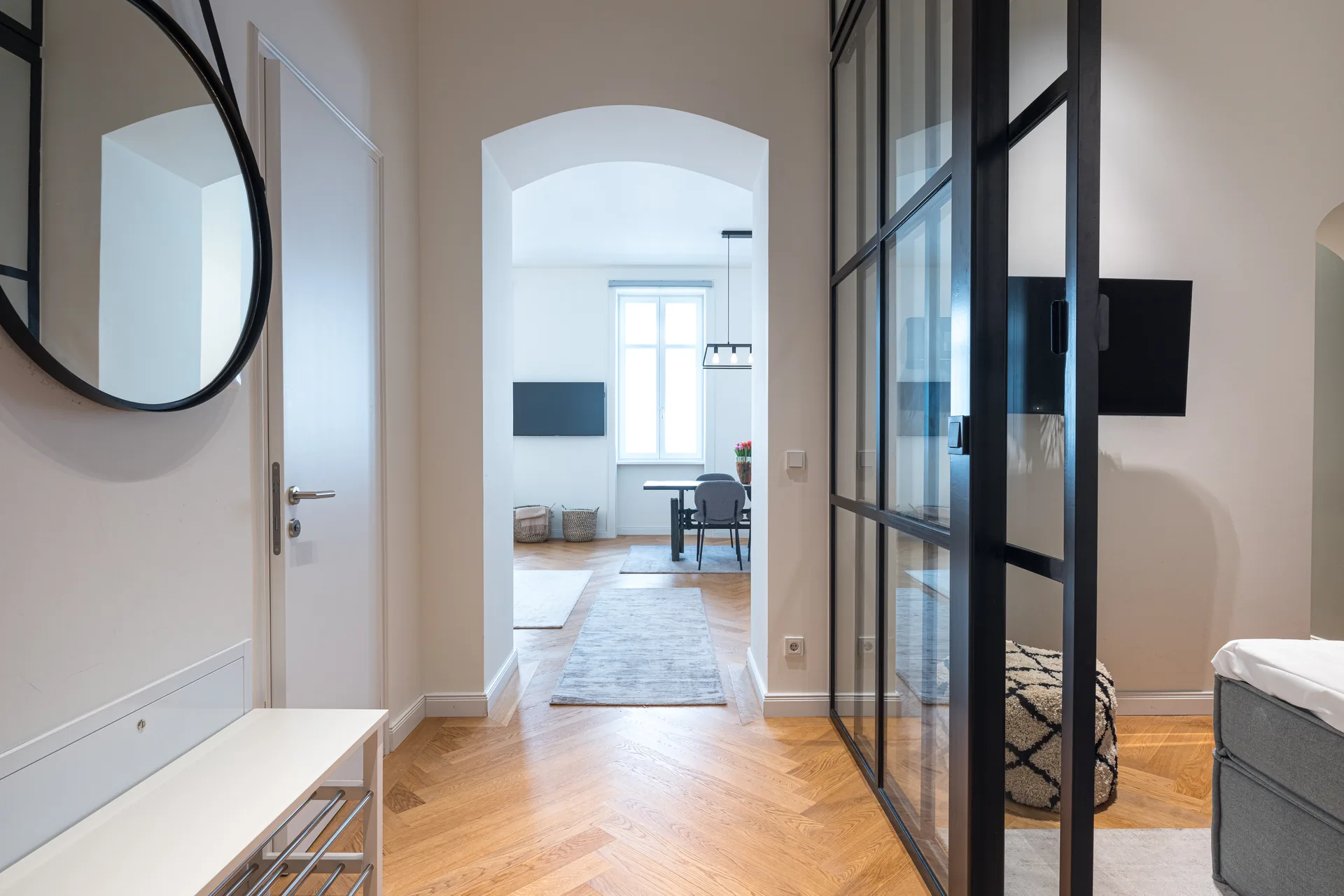
We run MINT Vienna boutique serviced apartments - five hand-finished apartments one minute from the Naschmarkt, the city's open-air market in the 6th district. We don't claim to be neutral about the market this article describes. But the overview is built on verified data, and where we appear, we appear at the same level of specificity as everyone else: nightly rates, square metres, minimum stays, and what's actually in the apartment.
What you'll find on this page
- Why Vienna's business-travel demand is structural, not cyclical
- The 2026 pricing landscape, in one comparison table
- Why the 6th district (Mariahilf) routes well to the city's main venues
- What's changing in supply, including the regulatory professionalisation paradox
- The three operator types - chain aparthotel, corporate-housing platform, boutique direct-book
- The MINT tier - executive (Penthouse) and consultant (Double MINT)
- Booking mechanics: stay-tier discounts, the 7-21 night gap, regulatory trust signals
- The 2026 outlook
- Frequently asked questions
Why Vienna in 2026? The business-travel case
The numbers Vienna closed 2025 with are unusual. The Vienna Tourist Board's 2025 performance report recorded 20,065,000 overnight stays, up 6% year-on-year - the strongest year since records began. International visitors accounted for 83% of those stays. Accommodation revenue from January through November 2025 alone hit €1,254,168,000, up 4%. As Norbert Kettner, CEO of the Vienna Tourist Board, put it, "2025 was the most successful year for city tourism in Vienna since records began."
Key fact: 60% of Vienna's hotel beds sit in 4- and 5-star categories - the city's strategy explicitly targets premium-spending, longer-staying visitors, not low-margin volume.
The congress numbers tell a more specific story for business travelers. Vienna's first place in the 2024 ICCA Congress City Ranking is built on 154 international association congresses - 66% of all 233 congresses Austria hosted that year. The meetings industry generated €1.3 billion in economic added value and supports 23,500 year-round jobs in the city. As Anita Paic, Head of the Vienna Convention Bureau, noted on the ICCA release, "Around 250 bids for meetings through 2038 are underway worldwide." That pipeline visibility - fourteen years of forward-bidding - is what makes Vienna business-traveler demand a structural rather than cyclical phenomenon.
Beyond congresses, Vienna concentrates the kind of work that requires foreigners to be in the room. The city hosts UN headquarters at the Vienna International Centre (IAEA, UNIDO, CTBTO), OPEC, OSCE, and the EU Agency for Fundamental Rights. Multinational corporates run regional CEE/SEE headquarters from the city - automotive, pharma, tech, banking - and major consulting firms staff Vienna offices for CEE projects.
The 2026 outlook reinforces it. Engine's 2026 business travel forecast projects global business-travel spending at USD 1.62 trillion in 2026, growing 3.2% year-on-year, with extended-stay bookings increasing as average business trip length rises 10% since 2023. As Suzanne Neufang, CEO of the GBTA, framed it, "The indicators are pointing to a more predictable era ahead for business travel pricing, with travel managers navigating a steadier landscape."
The accommodation question is what that demand resolves into.
The 2026 pricing landscape
The single most useful number in Vienna's 2026 accommodation market is hotel ADR. According to Hospitalitynet's Vienna Hotel Market Spotlight (YE June 2025), Vienna's average daily rate for hotels reached €211, up 6.2% year-on-year, with occupancy at 76.8%. Gross operating profit per available room grew 13.8% YoY - meaning the city's hotel operators are not under price pressure, and aren't likely to discount aggressively in 2026.
That €211 hotel benchmark is the line every other accommodation type prices against. Below the table, we explain each row.
| Accommodation type | Typical nightly rate (Q1 2026) | Size / format | Min stay | Key differentiator |
|---|---|---|---|---|
| 4-5★ branded hotel (Vienna ADR) | €211 (up 6.2% YoY) | ~28-35 m² standard room | 1 night | Daily housekeeping, restaurant, 24h reception |
| Vienna short-term-rental average | ~€150 (USD 162) | Varies; whole apartments common | 1 night | Self check-in; quality and licensing varies |
| Managed business apartment (studio) | €115-€128 | 31-41 m² studio | Often 30+ days | All-inclusive utilities; bi-weekly clean |
| Chain aparthotel (Adagio, Zoku) | €84-€109 promotional | 22-35 m² studio/loft | 1+ nights | Branded operations, F&B and coworking on-site |
| Boutique direct-book (MINT Double MINT) | €205 from | 55 m², 3 guests | 2 nights | Full kitchen, host contact, 1 min Naschmarkt |
| Boutique direct-book (MINT Penthouse) | €375 from | 85 m², 2BR + roof terrace | 2 nights | Two-floor maisonette, executive tier |
Sources: hotel ADR via Hospitalitynet; short-term-rental average via AirROI Vienna market data (2026); managed business-apartment rates via Vienna Residence (operator-published); chain aparthotel rates from Zoku Vienna promotional banners and Aparthotel Adagio Vienna City marketing; MINT rates from operator listings.
A note on the table's gap: a dedicated serviced-apartment ADR benchmark for Vienna Q1 2026 is not publicly available - the relevant STR Global / CBRE / Savills reports are behind paid subscriptions. The numbers above are the strongest verified proxy data points, and the comparison stands without inventing a figure that doesn't exist.
Bottom line: A standard hotel room in Vienna costs €211 a night for roughly 30 m². MINT's Double MINT is €205 a night for 55 m² - about 1.8x the floorspace at €6 less per night. The same arithmetic, on a 14-night assignment, is roughly €84 saved with materially more space and a kitchen.
The space differential is what business travelers feel after a long workday. The pain point is recognised across the sector - as Vienna Residence puts it on its own listings, "standard hotel accommodations lack the personal space needed after demanding workdays." It's also why Res:harmonics' 2025 sector commentary reports that profit levels for serviced apartments can be 10-20% higher than equivalent hotels - the format earns more because it solves a real space problem and supports longer stays.
For a deeper per-budget rate breakdown across Vienna's apartment tiers, we'll cover monthly rate granularity in a dedicated piece.
Location matters: the 6th district advantage
For a foreign business traveler, the question is rarely "is this central?" - Vienna is small enough that any inner district works. The question is "does this route well to where I need to be?"
Vienna's main business venues cluster in three rings. First, the Innere Stadt (the historic 1st district, the city core) - the Hofburg congress complex, the major branded hotels, and most consulting offices. Second, the 3rd district / waterfront / 22nd district axis - UN City (the Vienna International Centre), Austria Center congress hall, OPEC, and many multinational headquarters. Third, the 9th district / university belt - the medical university, AAB, and several pharma offices.
The 6th district (Mariahilf, Vienna's busy retail and residential neighbourhood that runs between the inner ring and the western train station) sits one ring out from Innere Stadt. Its anchor is the Naschmarkt, Vienna's 1.5-kilometre open-air market - the geographic peg every Vienna recommendation in this article uses.
According to the Naschmarkt's official transit guide, the market is approximately:
- 7 minutes' walk to Karlsplatz U-Bahn (lines U1, U2, U4) - the closest interchange to Innere Stadt
- 1.6 km / about 20 minutes' walk to Stephansplatz, the symbolic centre of the 1st district
- ~10 minutes by U-Bahn from Vienna Central Station (Hauptbahnhof) via U1 to Karlsplatz, then a 500 m walk
For a business traveler, the practical translation is: Karlsplatz in 7 minutes on foot; UN City in roughly 25-30 minutes door-to-door via U4 then U1; the airport in about 25 minutes via the CAT from Wien Mitte plus an underground transfer. Westbahnhof is two U-Bahn stops away on U6.
AirROI's 2026 Vienna market data lists Mariahilf among Vienna's top-performing short-term-rental districts by revenue, alongside Innere Stadt, Leopoldstadt, Neubau, and Favoriten. The reasons that work for STR economics - proximity to dining, walkability, transit density, residential character - are the same reasons it works for a 10-day project where you'd rather not eat hotel breakfasts.
If your interest is broader than business stays specifically - restaurants, walking routes, where to actually live in the area for a few weeks - our Naschmarkt accommodation types and neighborhoods guide covers the geography in more detail.
Supply trends: what's changing in 2026
Two things are happening in Vienna's accommodation supply that matter to a business traveler in 2026.
The first is straightforward growth. Vienna closed 2025 with 450 hotels, approximately 42,400 rooms, and 84,600 beds (Vienna Tourist Board). Hospitalitynet recorded four hotel openings in the year ending June 2025, adding 522 rooms - a 6.5% growth in supply, including the new Mandarin Oriental in the luxury category. Short-term-rental supply expanded faster: AirROI's 2026 data shows 8,204 active listings in Vienna with 55.7% YoY supply growth.
The second thing is the regulatory paradox. Vienna's Bauordnungsnovelle 2023 (Building Ordinance Amendment) took full effect on July 1, 2024. In residential zones, full-apartment short-term rentals are now banned outright - only home-sharing while the resident is present remains allowed. In non-residential zones, short-term rentals are capped at 90 days per year without an exemption permit. The grace period ended December 31, 2024; enforcement strengthened in 2025. Penalties for illegal short-term rental in Vienna residential zones can reach EUR 50,000 or two weeks' imprisonment - among the strictest in Europe.
Watch out: A short-term-rental booking in a Vienna residential zone is at material risk of cancellation if the host is non-compliant. Licensed professional operators in commercially zoned buildings - chain aparthotels, registered serviced-apartment operators, boutique direct-book - are unaffected.
The paradox is that overall STR supply still grew 55.7% even as residential-zone listings were being shut down. The explanation is composition: unregulated residential listings are contracting, while purpose-built and properly licensed stock is expanding. The market is professionalising - slowly, with friction - but the direction is one-way.
The serviced-apartment sector at the European level mirrors this professionalisation. According to Savills' 2026 European Serviced Apartment Report, the number of extended-stay and serviced apartment brands grew from 14 in 2015 to 25 by early 2026. The GSAIR 2025 findings record investor interest in the segment at 27% in 2025, up three percentage points year-on-year, with a European pipeline of 16,500 additional rooms by 2030 (Germany alone accounts for 20% of that pipeline).
For a fuller comparison of how Airbnb, hotels, and serviced apartments stack up side by side after the regulatory shift, we cover that decision in detail separately.
Finding the right fit: boutique vs chain vs platform
Once you've ruled out a hotel for an extended business stay, you're choosing between three operator types. They look similar from the outside - "furnished apartments for business travelers" - and behave very differently once you book.
| Operator type | Best for | Min stay | Typical nightly rate | Naschmarkt access | Host contact |
|---|---|---|---|---|---|
| Chain aparthotel (Aparthotel Adagio, Zoku Vienna) | 1-7 night business or leisure stays needing brand consistency | 1 night | €84 (Adagio base) - €109 (Zoku promotional) | Varies by location; Zoku is 3rd district, Adagio 3rd district | Front desk; corporate operations |
| Corporate housing platform (Blueground, AltoVita, Wunderflats) | Multi-month relocations on corporate accounts | Typically longer-stay focus; varies by listing | No public pricing - corporate-account or live availability | Inventory across multiple Vienna districts including Mariahilf | Platform-mediated; no direct host |
| Boutique direct-book (MINT Vienna) | 2-night to multi-week business and weekend stays needing space and a host | 2 nights | €185-€375 across 5 apartments | 1 minute walk to the market | Christian replies directly to messages |
Each row solves a different version of the same problem. Below, we walk through what each does well and where it doesn't fit.
Chain aparthotels like Aparthotel Adagio Vienna City (124 units in the 3rd district) and Zoku Vienna (131 lofts with rooftop social spaces and coworking) serve short business stays of 1-7 nights where you want a kitchenette plus the brand consistency and on-site F&B of a hotel. Adagio markets from a €84 base for 22 m² studios; Zoku promotes nightly rates from €93-€109 for standard lofts. Their advantage is operational: front-desk check-in, brand consistency. Their constraint is scale - at 124 to 131 units, the experience is hotel-operational rather than host-run, and the studios are small.
Corporate housing platforms - Blueground, AltoVita, the Wunderflats furnished segment - serve relocations and multi-month assignments via corporate accounts. Blueground lists Vienna inventory across multiple districts including Mariahilf, with apartments from ~34 m² studios up to 3-bedroom units. Pricing comes via live availability or corporate codes - no public nightly rate - and the platform is designed for corporate-managed bookings. The model fits relocation well; it fits less well if you want a direct host or your assignment is a 10-day project rather than a 90-day relocation.
Boutique direct-book operators are the smallest and youngest segment. The model: a host or small operator runs a handful of apartments at a single anchor location, guests book directly without a platform fee, and the experience is shaped by one operator's taste. MINT's five apartments around the Naschmarkt are an example. At sector level, GSAIR 2025 frames the boutique advantage neatly through Alistair Murray, COO of Ariosi: "2026 represents a critical inflection point. Flexibility will be the guiding principle." Boutique operators absorb that flexibility into their stay-tier pricing and minimum-stay terms in ways platforms and chains structurally can't.
Per-operator review aggregation and side-by-side guest experience data live in their own dedicated comparison piece - that's a deeper-dive we'll cover separately rather than rerun here.
The MINT tier: when space and hospitality are part of the brief
This is the part where I should write in the first person. Hi - I'm Christian. My family and I run MINT. Five apartments, all hand-finished, all one minute from the Naschmarkt. We do this directly: book us and the message reaches me. The two apartments most relevant to business travelers are the Penthouse and Double MINT - the executive and consultant tiers, respectively.
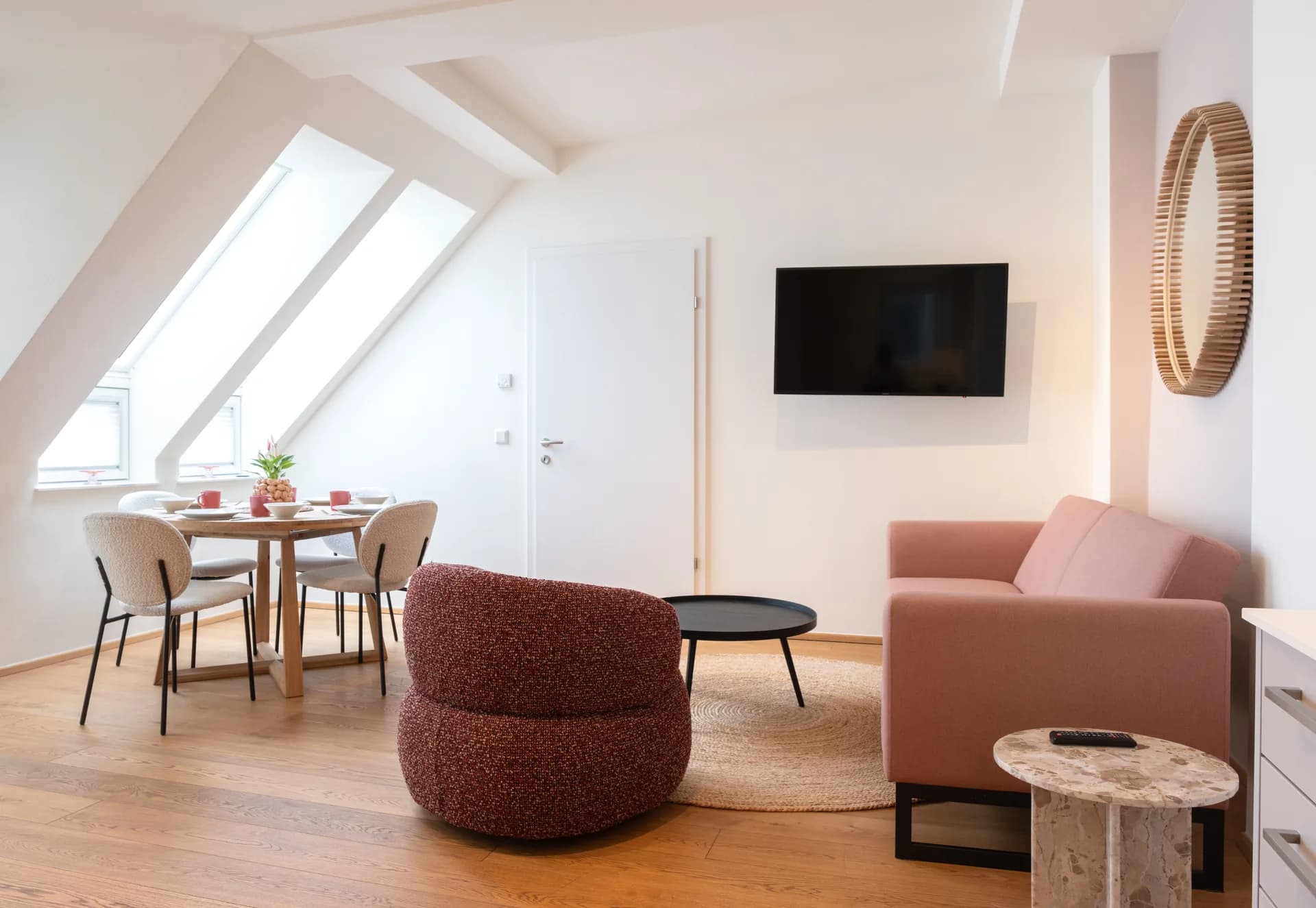
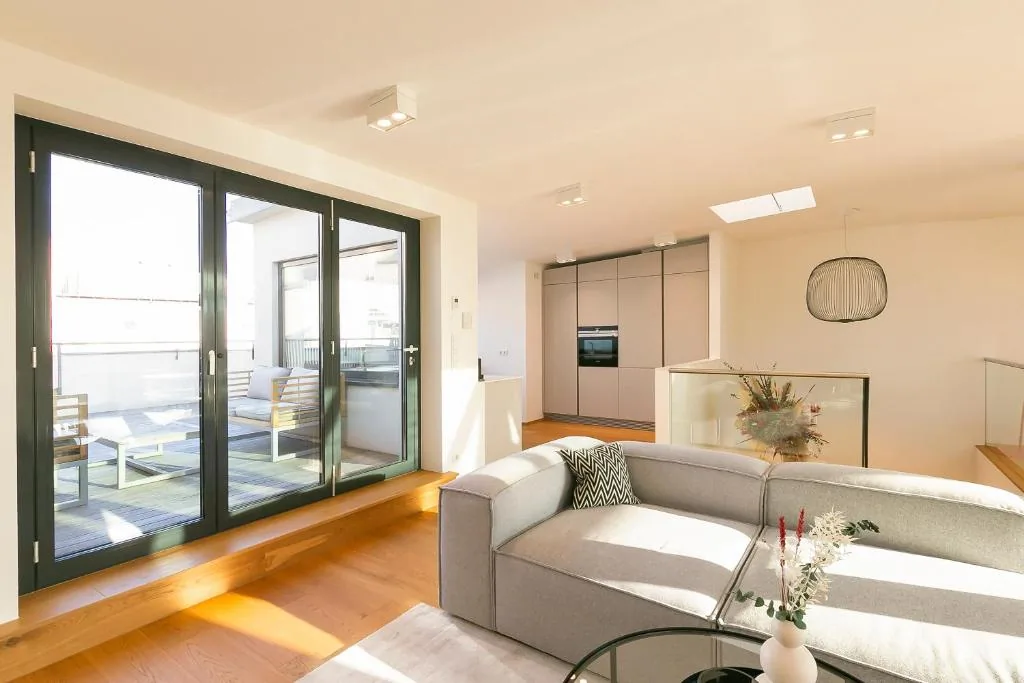
Looking for a two-bedroom base in Vienna's 6th district? MINT's Penthouse Maisonette is an 85 m² two-floor apartment with a private roof terrace - the executive tier from €375 per night, sleeping up to four. The format matters for client-facing trips: two separate bedrooms (so a partner or a colleague has their own space), a full living area with a kitchen, and the roof terrace as the kind of place you'd actually invite a counterpart to for an evening coffee or a working drink. The maisonette is the apartment we built for the trip where the accommodation is itself part of the brief - where the brand impression of where you stay matters as much as where you meet.
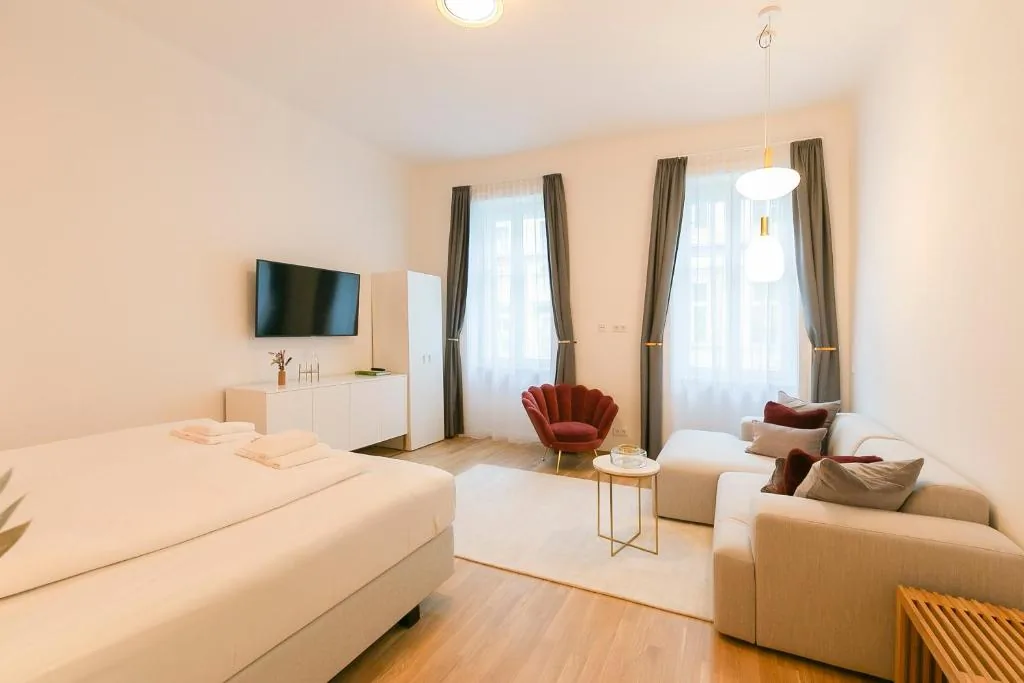
Most everyday corporate-rate bookings cluster around the Double MINT - 55 m² of kitchen-living-bedroom-bathroom, sleeping up to four, from €205 per night. The deliberate point of comparison is hotel ADR: at €205, a Double MINT sits €6 below Vienna's hotel ADR of €211 - for roughly 1.8x the floorspace, a fully equipped kitchen, a workspace separate from the bed, and one minute to the Naschmarkt for groceries or a coffee. For a 10-day consulting assignment, the everyday utility of having a kitchen and a desk usually outweighs a daily hotel breakfast and a minibar.
The amenity baseline is the same across all five MINT apartments: fully equipped kitchen, high-speed internet, air conditioning, washing machine, elevator, free luggage storage. We don't run a 24-hour front desk and we don't claim daily housekeeping. What we offer instead is direct hospitality: I personally host the apartments, my message thread is your concierge, and I know the neighbourhood because I live in it. For a deeper-dive on executive-tier features and the criteria C-suite travelers ask about specifically, that comparison sits in its own dedicated article.
Booking smart: rate periods, minimum stays, and what to ask
The booking mechanics for serviced apartments are different from hotels in three ways business travelers should know before they pick a property.
The first is stay tiers. Most boutique and many chain aparthotel operators discount nightly rates as length-of-stay grows. At MINT, the tier structure looks like this:
- 2+ nights - standard baseline (no discount; this is the minimum stay)
- 7+ nights - Wochenend+ (-15%)
- 14+ nights - Fortnight (-20%)
- 28+ nights - Resident (-25%)
The Resident tier is where MINT's pricing diverges most from a hotel: a 28+ night assignment at the Double MINT lands at roughly €154 per night net of the discount, against Vienna's hotel ADR of €211. For an assignment that's likely to extend, lock in the longest tier you'll plausibly use.
Local tip: Two nights, minimum. Vienna doesn't reveal itself in twenty-four hours. The first is for arriving; the second is for being here. We set the minimum at two for a reason - anything shorter and the apartment doesn't earn its place over a hotel.
The second is the 7-21 night assignment gap. This is the structural underservice we mentioned at the top. A standard hotel night in Vienna is €211 - at 14 nights, that's €2,954 for ~30 m² without a kitchen, before food. A corporate-housing platform like Blueground is built around longer-stay corporate bookings where pricing comes through corporate accounts, not nightly rack rates - so for a 10-day project trip the platform model is awkward to navigate and may not match your assignment length. Boutique operators sit in between: 2-night minimums, length-of-stay discounts, and a pricing mechanic that scales with however long you stay.
If your assignment runs to 28 nights or longer, Vienna's relocation-apartment market operates on different terms - that segment has its own decision tree (corporate housing, longer-term furnished rentals, registration rules) that we cover separately.
The third is regulatory trust signalling. Per Vienna's Bauordnungsnovelle 2023, a short-term-rental host operating illegally in a residential zone faces fines up to €50,000. A 2025 EU-wide STR registration regulation now requires operators across the EU to display registration numbers in listings - Vienna's stricter local rules sit on top of that. For a corporate booking, the practical question is: is this a licensed professional operator, or is it an individual home-sharer? Licensed operators handle the Ortstaxe (Vienna's 3.2% city tax), the guest registration, and the regulatory paperwork automatically. Individual hosts may or may not - and if they don't, that's the booking that gets cancelled three weeks before you fly in.
What corporate travel managers should ask before booking any furnished business apartment in Vienna:
- Is the rate inclusive of Vienna's 3.2% Ortstaxe (city tax)?
- Is the operator a licensed commercial host with a building permit consistent with the zoning?
- What's the cancellation policy if your project dates shift by a week?
- Is there a real, contactable human at the operator, or only a platform support queue?
- What are the work-setup specifics - desk separation from the bed, internet speed, second monitor possibility? (We'll cover the work-setup comparison across operators in a dedicated piece.)
The 2026 outlook
The directional indicators for 2026 are unusually consistent across sources.
Pricing. GBTA's 2025 forecast projects EMEA hotel ADR growth of approximately 1.9% in both 2025 and 2026 from a $157 base - the post-pandemic surge has flattened into single-digit annual growth. As Patrick Andersen, CEO of CWT, put it, "This year's forecast shows encouraging signs that business travel pricing is normalizing further - and that's creating real opportunities for corporate travel buyers." Vienna specifically - where 2025 hotel ADR jumped 6.2% to €211 - is more likely to track the European average for 2026 than to sustain that pace.
Demand. Vienna's congress pipeline is structurally visible through 2038 via the 250 active bids the Vienna Convention Bureau is currently working. Engine's 2026 forecast puts global business travel spending at USD 1.62 trillion in 2026 (3.2% growth) and notes group travel for offsites and conferences growing at 8-10% YoY. Extended-stay bookings are increasing as average business trip length is up 10% since 2023.
Supply. The European serviced-apartment pipeline adds 16,500 rooms by 2030 (GSAIR 2025), and the 14-to-25 brand expansion documented in the Savills 2026 report confirms the segment is now mainstream-validated. Vienna will get its share. Locally, the Bauordnungsnovelle 2023 continues to consolidate informal residential supply into licensed commercial operators.
Operator stance. Res:harmonics reports 51% of serviced-apartment guests are now leisure rather than corporate, in a sector that was historically corporate-led. The implication is that the boutique tier - where leisure and business stays naturally blend in the same building - is the operator format best positioned for a hybrid demand profile.
The editorial summary, for what it's worth: Vienna's business-apartment market in 2026 is a measurably-growing, professionalising segment with structural demand visibility through the late 2030s. The pricing gap between hotels (€211) and serviced apartments (€115-€205 across tiers) is wide enough to drive ongoing migration of corporate stays from the hotel column to the apartment column, and the 7-21 night assignment gap is exactly where boutique direct-book operators have the structural fit. We're biased about that - but the biases are documented and the data is the data.
Ready to pick dates? Check availability and book direct - no platform fees, message Christian if you need anything before arrival.
Frequently asked questions
A short stub list for the page TOC; the full Q&A renders below from the post's FAQ data.
- What's the average nightly rate for a business apartment in Vienna in 2026?
- How does MINT compare to Blueground or other corporate-housing platforms?
- Is the Naschmarkt area well-connected for business travel?
- What's the 7-21 night assignment gap?
- How do Vienna's STR regulations affect business travelers?
- What's the Resident-tier discount and when does it apply?
- Which Vienna district is best for a business stay?
- What amenities should I expect in a Vienna business apartment?
- How do I book direct without a platform fee?
Sources
- Vienna 2025: Best Year Ever for Tourism with 20 Million Overnight Stays - Vienna Tourist Board, 2026
- Vienna tops ICCA Ranking 2024 as leading congress city - Vienna Convention Bureau, 2025
- Vienna Hotel Market Spotlight YE June 2025 - Hospitalitynet
- 2025 GSAIR reveals £145 ADR and rising corporate relocation - Serviced Apartment News, October 2025
- Spotlight: European Serviced Apartment Report 2026 - Savills
- Vienna Building Code Updates: How 2023 Changes Affect Rentals (Bauordnungsnovelle) - Wunderflats, July 2024
- Global Business Travel and Events Prices Set to Stabilize Through 2025 and 2026 - GBTA, 2025
- What to Expect for the 2026 Business Travel Season - Engine, 2025
- Serviced Apartment Challenges and Opportunities for Growth in 2025 - Res:harmonics
- Where is the Naschmarkt Vienna & how to get there? - naschmarkt-wien.at
- Vienna Airbnb Data 2026: Occupancy, Revenue & STR Market Report - AirROI
- First-class Business Apartments Vienna - Vienna Residence
Last updated: May 2026. Christian, Host & Founder - MINT @Naschmarkt.