
For most first-time visitors in 2026, the short answer is: base yourself in the 1st district (Innere Stadt — Vienna's historic old town) if your priority is walking to every major sight; in the 6th (Mariahilf), beside the Naschmarkt (Vienna's largest open-air food market), if you want central access plus real daily life at a fairer price; in the 7th (Neubau) for museums, design shops and a good night out; and in the 9th (Alsergrund) if you want a quiet, residential base. Vienna's 23 districts spiral outward from the centre, and the inner ring (districts 1 through 9) is where almost every visitor should stay. We run MINT Vienna boutique apartments at the Naschmarkt in the 6th, so we have a clear view of that corner — but this article is the wider map of the whole city. If the 6th is where you land, our Naschmarkt neighbourhood accommodation guide goes deeper than this page can.
Demand is real and rising: the Vienna Tourist Board's 2025 performance report recorded 20,065,000 overnight stays across full-year 2025, the latest complete year, up 6% year on year and an all-time record, with roughly 83% of those stays coming from international visitors. The momentum has carried into 2026: Vienna logged roughly 1.2 million overnight stays in February 2026, up about 5% year on year, according to aviation.direct, citing Statistik Austria. So if choosing a district feels crowded with options, that is because it is.
What you'll find on this page
- The best Vienna districts to stay in, with a comparison table (vibe, who it suits, price band, walk to the centre)
- A quick orientation on apartment vs hotel vs Airbnb — without re-running the full economics
- Why the Naschmarkt and the 6th district make a strong value-plus-local-life base
- Honest notes on safety, the 2026 tourist-tax change, and Vienna's Airbnb rules
- A short FAQ that re-answers the questions above
Best areas and neighbourhoods to stay in Vienna
Vienna is compact by big-city standards, and the inner districts are all genuinely central. The choice is less about distance than about character. Vienna's own tourist board frames its districts as Grätzel — small neighbourhood communities, each with, in its neighbourhoods guide's words, "a heartbeat" of their own. That is the real decision: which heartbeat suits your trip.
A note before the table: all of Vienna's inner districts are safe for tourists. Vienna ranked 1st in the Economist Intelligence Unit's Global Liveability Index 2024, and Austria placed 4th most peaceful country worldwide in the 2025 Global Peace Index. Standard city sense still applies around major transit hubs late at night, but district choice in Vienna is about fit, not safety.
The nightly price bands below are indicative — there is no public per-district average-rate dataset, so these are cross-referenced ranges for mid-range hotels and will vary sharply by season and category. Walking and transit times use the U-Bahn (Vienna's metro), which covers the inner districts densely.
| District | Vibe | Best for | Typical nightly band (mid-range) | Walk / transit to centre |
|---|---|---|---|---|
| 1st — Innere Stadt | Grand, historic, busy; the postcard Vienna | First-timers prioritising sightseeing on foot | Roughly €200–€550+, according to Go Ask A Local (indicative) | You are in the centre |
| 6th — Mariahilf | Walkable, café-led, "accessibly hip"; Naschmarkt on the edge | Value-with-character; couples, repeat visitors, longer stays | Generally below 1st-district rates | 5–10 min on foot / 1 U-Bahn stop |
| 7th — Neubau | Creative, design-led, lively after dark | Culture, dining, nightlife without 1st-district prices | Below 1st-district rates | ~1.5 km to the Rathaus; 1–2 U-Bahn stops |
| 9th — Alsergrund | Quiet, residential, local "French flair" | A calm base; apartment stays over hotels | Roughly €110–€230, according to Go Ask A Local (indicative) | 5–10 min by tram / U-Bahn |
| 2nd — Leopoldstadt | Green, relaxed, family-friendly; Prater park | Families wanting space and parks | Generally below 1st-district rates | 1–2 U-Bahn stops |
The 1st district is the convenient default, but convenience has a cost. As Time Out Vienna's local expert Susanne Garber puts it in the publication's where-to-stay guide, "The 1st district is a bit like Vienna's open air museum; very touristy, and pretty pricey." That is the trade-off in one line: maximum walkability and the grandest streets, at the highest rates and amid the most tourists.
The 7th (Neubau) is the standard counter-recommendation. It sits about 1.5 km from the Rathaus (City Hall), as Connecting Vienna's district guide notes, with the MuseumsQuartier — one of the world's ten largest cultural complexes — on its edge, plus the U3 U-Bahn line running through it. It is creative, walkable and well-connected. The 9th (Alsergrund) is the quiet option: residential, lower rates, but with limited hotel inventory, so apartment rentals tend to be the better find there. Families often prefer the 2nd (Leopoldstadt) for the green space and the Prater. And the 6th (Mariahilf) — the subject of the last section below — is the one we'd point most value-conscious visitors toward.
Apartment vs hotel vs Airbnb in Vienna: a quick orientation
This is the second big decision, and the honest version of it is short. A simple rule of thumb works for most trips: for a 3-to-5-night first visit, a hotel is usually the path of least resistance — daily housekeeping, a front desk after a long flight, no logistics. For 7 nights or longer, or for families and groups who want a kitchen, laundry and separate sleeping areas, an apartment is almost always the better fit. That heuristic isn't a hard rule, just a starting point.
| Accommodation type | Best for | Watch for |
|---|---|---|
| Hotel | 3–5 night first visits; solo or couple; minimal logistics | Higher per-night cost for groups; no self-catering |
| Serviced apartment | 4+ nights, families, groups, business and relocation stays | Fewer in number than hotels; book ahead in peak season |
| Airbnb / private short-let | Flexible group stays | Vienna's 90-day cap (below) can mean last-minute cancellations |
| Boutique apartment-hotel hybrid | Travellers wanting hotel service with apartment space | Varies widely by operator |
Two 2026 facts shape this decision. First, Vienna restricted private short-term tourist rentals to a maximum of 90 days per apartment per year from July 2024 — The Local Austria explains the rules and the registration requirement that came with them. The practical risk for a guest: when a host hits their annual cap, a booking can be cancelled close to the date. Licensed professional operators (serviced apartments and hotels) are not subject to that cap, so the cancellation risk doesn't apply to them.
Second, Vienna's Ortstaxe (local tourism tax) is changing. The Vienna Tourist Board confirms that "from 1 July 2026, the local tax will increase to 5% and from 1 July 2027, it will increase to 8%" — up from 3.2% today, following legislation adopted by the Vienna Provincial Parliament on 12 December 2025. This applies equally to all commercial accommodation: hotels, apartments and Airbnb listings alike. If you're staying after July 2026, factor it in across the board.
As a structural backdrop, serviced apartments are the fastest-growing accommodation format in Europe. Serviced Apartment News, reporting the Savills 2026 European Serviced Apartment Report, found the sector grew underlying demand at a 5.9% compound annual rate since 2019, versus 1.0% for hotels, reaching 79% occupancy and a €136 average daily rate across Europe in 2025. As Savills' Thomas Emanuel put it, this is "driven by a combination of longer travel durations, increased flexibility in working patterns and Europe's continued position as the world's largest tourism region."
We've kept this deliberately brief — the full economics, the regulatory detail and the use-case routing live in our dedicated hub. For the complete picture, read our full comparison of Vienna accommodation types.
Where to stay near the Naschmarkt and the 6th district
If you want one recommendation that balances central access, character and value, it is the 6th district (Mariahilf), with the Naschmarkt on its doorstep. The market runs along the Wienzeile on the 4th/6th district border — several guides file it under the 4th (Wieden), but the heart of the neighbourhood, and where we are based, is the 6th.
Key fact: From the Naschmarkt it's roughly 3 minutes' walk to the Secession, 5 to the Vienna State Opera, 10 to the MuseumsQuartier and 15 to Stephansdom, per our Naschmarkt neighbourhood accommodation guide. You are central without being in the tourist crush.
The 6th has what the 1st mostly doesn't: daily life. Vienna Würstelstand's guide to Mariahilf captures the district's bohemian-meets-hipster character — Gumpendorferstraße's café and craft-beer scene, vintage shops, and a weekend flea market beside the food stalls. It's highly walkable, and in September 2025 the new Naschpark green space (6,820 m², 70 trees, more than 50,000 plants) opened on the market's former car park, as the neighbourhood guide notes. This is a place locals actually live, not a postcard you visit and leave.
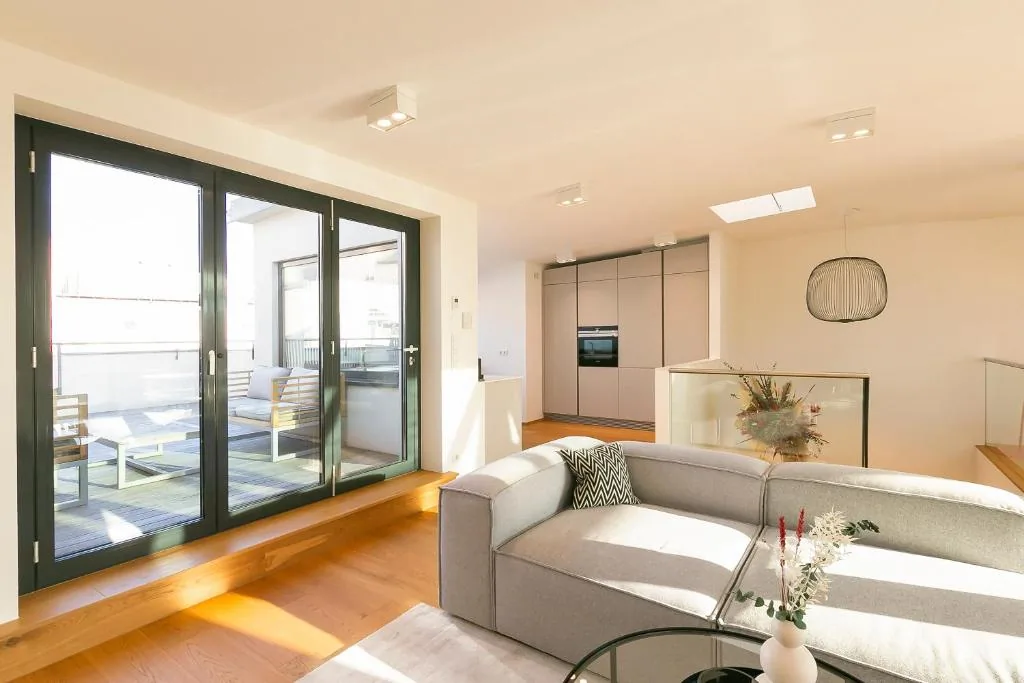
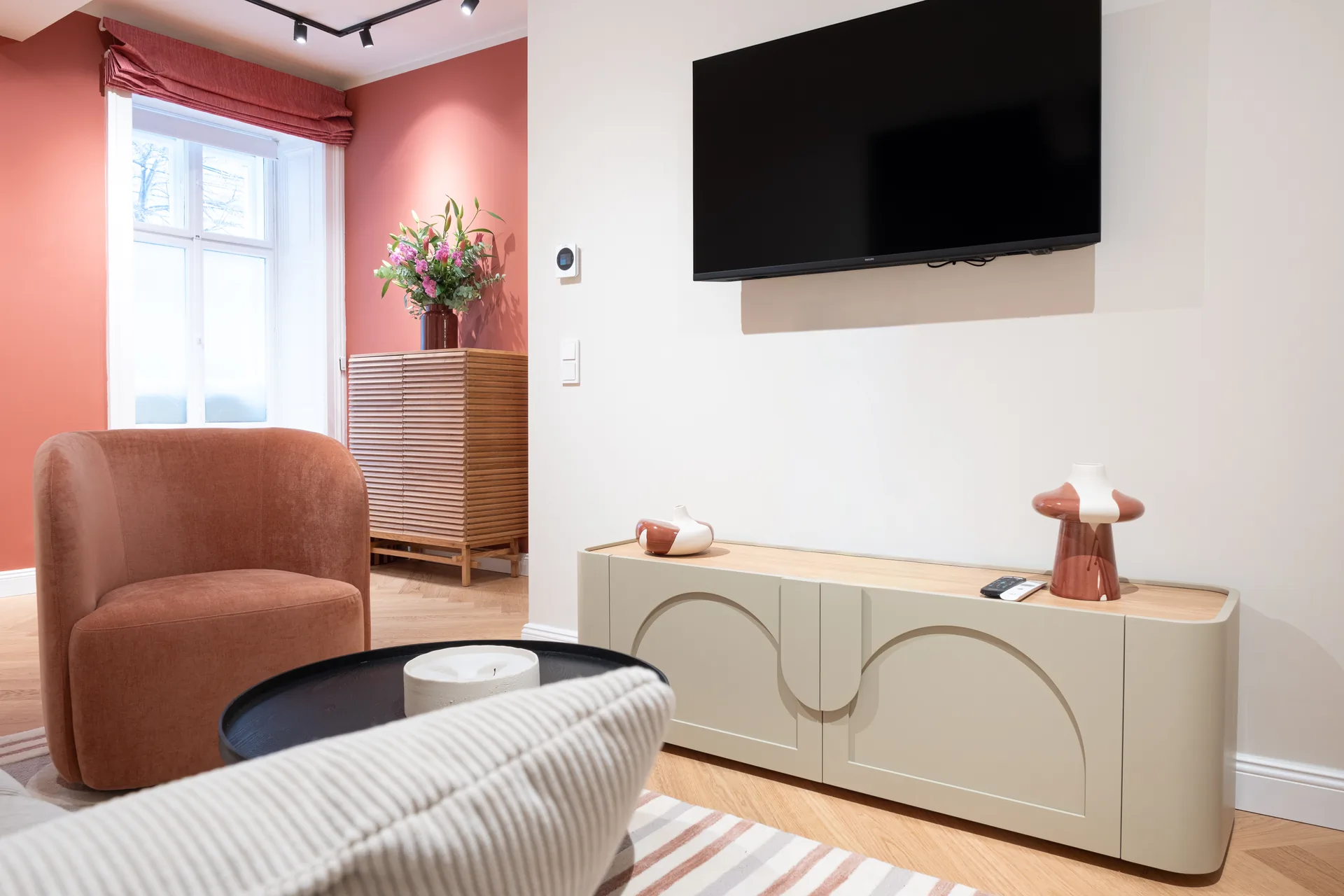
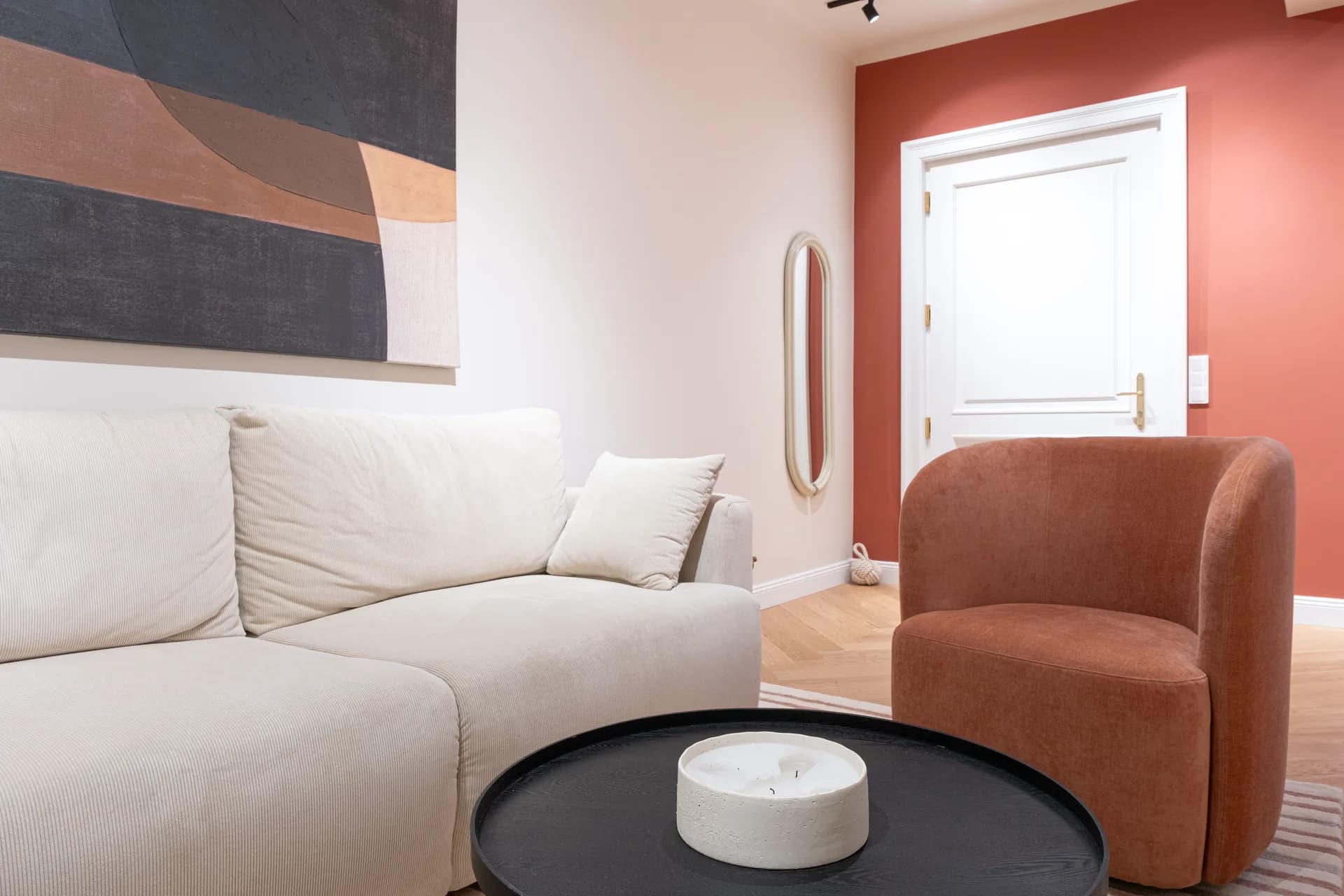
Looking for a base one minute from the market? Our flagship here is MINT Artisan — Viennese character, gallery vibes: 65 m² for up to four guests, with warm terracotta walls, herringbone oak floors and curated art, from €185 a night and a one-minute walk to the Naschmarkt. For groups or families who want outdoor space, the Double MINT with Balcony offers 55 m² for four with a private balcony, from €215 a night. The smaller Mini MINT studio (35 m², two guests, from €185) suits solo travellers and couples; Double MINT (55 m², four guests, from €205) is the standard family layout; and the Penthouse (85 m², four guests, from €375) is the premium maisonette with a rooftop. All five sit in the 6th, all within a minute of the market.
For the full breakdown of every accommodation type around the market — hotels, serviced apartments, private rentals and hostels, with rates and minimum stays — the Naschmarkt neighbourhood accommodation guide is the deep resource. This page is the map of the whole city; that one is the close-up of the corner we know best.
When you're ready, you can check availability and book direct — booking direct means your message reaches Christian, not a call centre, and there's no 90-day cancellation risk to worry about.
Frequently asked questions
Where should a first-time visitor stay in Vienna?
The 1st district (Innere Stadt) if walking to every sight matters most; the 6th (Mariahilf), beside the Naschmarkt, for central access with more local life and fairer prices; the 7th (Neubau) for museums and nightlife; and the 9th (Alsergrund) for a quiet residential base. All of Vienna's inner districts (1–9) are central and safe.
Which is the best-value area to stay in Vienna?
The 6th (Mariahilf) and 9th (Alsergrund) are the usual value picks. The 6th gives you Naschmarkt-side café culture and a 5–10 minute walk or one U-Bahn stop to the centre, generally below 1st-district rates. The 9th is quieter and cheaper still, though hotel inventory is limited, so apartments tend to be the better find there.
Is Vienna safe for tourists?
Yes. Vienna ranked 1st in the Economist Intelligence Unit's Global Liveability Index 2024, and Austria placed 4th most peaceful country worldwide in the 2025 Global Peace Index. All inner districts are safe for visitors; ordinary city caution applies around major transit hubs late at night.
Should I book a hotel, an apartment or an Airbnb in Vienna?
For a 3-to-5-night first visit, a hotel is usually simplest. For 7 nights or more, or for families and groups wanting a kitchen and space, a serviced apartment fits better. Note that private Airbnb-style rentals face Vienna's 90-day annual cap (since July 2024), which can mean a last-minute cancellation when a host hits the limit — licensed apartments and hotels are not affected.
Where should I stay to be near the Naschmarkt?
In the 6th district (Mariahilf). The market runs along the Wienzeile on the 4th/6th border, and the 6th side puts you a short walk from the State Opera (about 5 minutes), the MuseumsQuartier (about 10) and Stephansdom (about 15). Our apartments are a one-minute walk from the market.
Is Vienna's tourist tax changing in 2026?
Yes. Vienna's Ortstaxe (local tourism tax) rises from 3.2% to 5% on 1 July 2026, and to 8% from 1 July 2027, following legislation adopted in December 2025. It applies to all commercial accommodation equally — hotels, apartments and Airbnb listings.
How many days do you need in Vienna?
For a first visit, plan at least two full nights so you have time to settle in and actually experience a neighbourhood rather than just passing through. Longer stays of four nights or more are where a serviced apartment, with a kitchen and more space, starts to pay off over a hotel.
Sources
- Vienna 2025 Performance Report — Vienna Tourist Board, 2026
- Vienna Tourism Reports Significant Growth in Overnight Stays at the Start of 2026 — Aviation.Direct, 2026
- Fall in Love with Vienna's Neighborhoods — Wien.info (Vienna Tourist Board)
- Where to Stay in Vienna: A Local's Guide — Susanne Garber, Time Out Vienna, 2024
- How Safe is Vienna? — visitingvienna.com
- 6 (+6) Reasons to Love Vienna's 6th District (Mariahilf) — Vienna Würstelstand
- Local's Guide to Neubau, the 7th District — Connecting Vienna, 2024
- Where to Stay in Vienna — A Local's Neighborhood Guide — Jennifer Walker, Go Ask A Local, 2026
- EXPLAINED: What Are the New Airbnb Rules in Vienna? — Julia Hjelm Jakobsson, The Local Austria, 2024
- Changes to Vienna's Local Tax (Ortstaxe) — Vienna Tourist Board, 2026
- European Serviced Apartments Record €1.2 Billion Deals in 2025 — Serviced Apartment News, 2026
- Where to Stay Near the Naschmarkt: a 2026 Guide — MINT Vienna
Last updated: June 2026. Christian, Host & Founder — MINT @Naschmarkt.