
Naschmarkt Vienna is two markets sharing one address, and which one you get depends entirely on where you stand and what time you arrive. Walk in from the Karlsplatz end at one in the afternoon and you will meet menu hawkers, unlabelled prices and a row of restaurant terraces built for people who will never come back. Walk in from the Kettenbrückengasse end on a Tuesday morning and you will find a working food market where Viennese still buy their groceries. Both descriptions are true. Guides that pick one and call it the whole market are wrong about half of it. Here is where the line falls, what everything actually costs, what the renovation has and has not finished, and the one thing worth refusing to buy.
What the Naschmarkt is, and the 500 metres that change it
The Naschmarkt runs roughly 500 metres along the Wienzeile, between Karlsplatz at its eastern end and Kettenbrückengasse at its western end, in Vienna's 6th district. It holds about 130 stalls plus a market hall with 13 businesses, according to the City of Vienna. Other sources claim around 170; that figure is not official.
Its history has no single clean start date. The Vienna city history wiki records 1774 for the informal beginning, 1793 for the formal mandate, 1902 for the permanent market pavilions and 1905 for the adoption of the name Naschmarkt. Anyone telling you it was founded in one specific year has picked one of four.
What matters more for your visit is the gradient along those 500 metres. The eastern end, nearest Karlsplatz and the Secession, is the shop window: restaurant terraces, people with laminated menus trying to seat you, and open bowls of dried fruit, spices, nuts and olives, frequently with no price per kilo on display. The western end, nearest Kettenbrückengasse, is where the farmers' stalls are, where the new market hall opened, and where the Saturday flea market runs.
The single most useful sentence in this article: the further west you walk, the better the market gets.
Opening hours: three different schedules, and the Sunday trap
Most guides compress the hours into one line. That is why people turn up on Sunday with a shopping bag and find everything shut. Three schedules run side by side.
| Monday to Friday | Saturday | Sunday and public holidays | |
|---|---|---|---|
| Sales stalls | 06:00 to 21:00 | 06:00 to 18:00 | closed |
| Farmers' market stalls | 06:00 to 19:30 | 06:00 to 18:00 | closed |
| Restaurants and bars | 06:00 to 23:00 | 06:00 to 23:00 | 09:00 to 21:00 |
Every stall and restaurant is additionally required to be open Tuesday to Friday between 15:00 and 18:00, a mandatory core trading window. These hours come from the City of Vienna's own page, last updated at the end of June 2026.
So: on Sunday the Naschmarkt is closed as a market and open as a restaurant strip. If you want to shop, Sunday is the one day that cannot work. If you want a relaxed lunch without the Saturday crush, Sunday from 09:00 is the best window in the week. Note that the Vienna Tourist Board gives 10:00 rather than 09:00 for Sunday restaurants. Where the two disagree, the city's page is the fresher and more authoritative one.
Is the Naschmarkt a tourist trap? Half of it, and the gap is about 15x
This deserves a direct answer rather than a diplomatic one.
At the honest end, a glass of Grüner Veltliner at Urbanek, a tiny and much-loved stall, runs about €4.50, and a board of cured meats and cheese between about €10 and €30 depending on size. A main course at NENI runs about €15 to €25, with the Jerusalem Plate around €18.50. Fiakergulasch at a market restaurant costs about €16.90. These are ordinary Vienna prices.
At the other end, reviewers report a different market. Dated reviews from December 2024 and January 2025 on TripAdvisor describe roughly €10 for 100 grams of cheese, and 260 grams of Dutch cheese sold for €17.94, which works out at about €69 per kilo. A food guide reports dried fruit priced up to about €40 per kilo. These are customer accounts rather than posted prices, but the same complaints recur across years and cluster around the same few product categories.
A glass of good wine for €4.50 at one end and cheese at an effective €69 per kilo three hundred metres east is not an anomaly. It is the structure of the market.
The specific way to get this wrong: arriving at the Karlsplatz end around 13:00 on a Saturday. Peak crowds, peak hawking, and the farmers' stalls at the far end already packing up. The same person arriving Tuesday at 09:00 at the Kettenbrückengasse end sees a different place entirely.
What to eat, and the one thing to refuse
Rough prices so you have a yardstick. These are indicative figures drawn from market guides and reviews, not guaranteed tariffs.
| Item | Roughly | Verdict |
|---|---|---|
| Glass of Grüner Veltliner at Urbanek | €4.50 | the most honest price on the market |
| Cured meat and cheese board at Urbanek | €10 to €30 | shareable, and the reason people queue |
| Main course at NENI | €15 to €25 | Jerusalem Plate about €18.50, fair restaurant pricing |
| Cheese at Käseland | €5 to €25 | prices are displayed, which is the whole point |
| Fiakergulasch at a market restaurant | €16.90 | normal Vienna level |
| Public toilet near stall 350 | €0.50 | bring coins |
| Dried fruit, nuts and spices at the eastern end | up to about €40 per kilo | do not buy this |
The one firm recommendation this article makes: do not buy dried fruit, nuts or spices from the open bowls at the Karlsplatz end. They are commodity goods available in any supermarket for a fraction of the price, the per-kilo rate is often not displayed, and the portion is scooped before you have agreed to a quantity. This is the single category where the complaints have been consistent for years.
If your goal is genuinely to shop rather than to look, Viennese will send you to the Brunnenmarkt in the 16th district instead. That advice shows up in reviews nearly a decade apart, and it is sound.
The Saturday flea market: 06:30 to 15:00, about 400 stalls
For a lot of people this is the actual reason to come on a Saturday, and it is running normally in 2026.
The flea market sets up along the linke Wienzeile by the Kettenbrücke, at the western end, every Saturday from 06:30 to 15:00. Roughly 400 pitches, a mix of private sellers and professional dealers, run by Marktgruppe Süd. Our Vienna flea market guide covers the best hours, how to buy and how to book a pitch.
It closes on 25 and 26 December and on 1 and 6 January, and finishes early at 12:00 on 24 and 31 December.
You will find conflicting hours online. Older sources say it ends at 14:00, and one travel blog claims 18:00, which probably counts the restaurant hours. The city's page, updated 30 June 2026, gives 06:30 to 15:00. Arrive before 09:00 for the version worth travelling for. After midday it is mostly crowded.
What the renovation finished, and what is still open in 2026
Guides get this wrong constantly, so here it is in order. Two things are done.
The Naschpark opened on 19 September 2025 on the former asphalt car park. About 6,820 square metres, roughly 70 newly planted trees, pergolas, hammocks, a slackline, three drinking fountains and four water features, a children's balancing area and a raised viewpoint. That converts about 58 percent of the old parking area into green space.
The Marktraum, the new market hall at the Kettenbrückengasse end, opened on 21 November 2025 with 13 businesses inside, including a coffee roastery, a delicatessen and a surplus-food project that works with rescued produce. Earlier reporting named September 2025; that was a pre-opening estimate, and November is the confirmed date.
Still unfinished: the redevelopment of the flea market area. The City of Vienna project page, last updated 20 April 2026, still lists that section as outstanding, and the overall project runs to the end of 2027. If you read that the Naschmarkt renovation is complete, you are reading something inaccurate.
There is also live construction you may still meet. Sealing work on the U4 underpass has displaced part of the farmers' market since March 2026, with stalls in unfamiliar positions. The announced end date was the end of August 2026, which lands right about now, and no source confirms it finished on schedule. Expect it to look different from the photographs.
Getting there: 2 ends, 2 stations
The market has two ends and each has its own station. Picking the right one matters more than it sounds.
- U4 Kettenbrückengasse puts you at the western end: the flea market, the farmers' stalls and the new market hall. This is the stop if you intend to buy anything.
- Karlsplatz sits at the eastern end and is the U1, U2 and U4 interchange. It is the only Vienna U-Bahn station served by at least three U-Bahn lines, and also connects trams 1 and 62, bus 4A and the Badner Bahn. From Karlsplatz it is about 5 to 7 minutes on foot to the middle of the market.
- Bus 59A, which is a bus and not a tram, stops at Bärenmühldurchgang directly on the Wienzeile, a short walk from the Kettenbrückengasse end.
From the airport, the CAT reaches Wien Mitte in 16 minutes, and the U4 runs from there to Kettenbrückengasse without a change.
When to go: 5 windows that actually differ
| When | What you get |
|---|---|
| Tuesday to Friday, 08:00 to 11:00 | the quietest working market, farmers' stalls fully stocked |
| Tuesday to Friday, 15:00 to 18:00 | mandatory core hours, everything is guaranteed open |
| Saturday, 06:30 to 09:00 | the flea market at its best, before the crowds |
| Saturday from 12:00 | loud and full, farmers' stalls closing, good for looking not buying |
| Sunday from 09:00 | restaurants only, but calm and uncrowded |
There is no admission charge for the market, and the Naschpark next to it is public space.
Why the 6th district is the best base in Vienna
Everything above is about visiting. This last part is about staying, because the address that makes the Naschmarkt worth a morning also happens to be the most practical place in Vienna to sleep.
Mariahilf, the 6th district, has about 31,000 residents and sits between Mariahilfer Straße and the Wienzeile. It is a residential district with a functioning daily life rather than a museum quarter, and it sits exactly where Vienna converges:
- Karlsplatz a few minutes away on foot, which means U1, U2 and U4 from a single station and most of the city without a second change.
- The Staatsoper and the Ring about 8 minutes on foot.
- The Innere Stadt and Stephansplatz about 1.45 kilometres, comfortably walkable.
- The MuseumsQuartier a few minutes up Mariahilfer Straße.
- The Belvedere about 7 minutes by tram from Karlsplatz.
- A real food market at the door, which matters more than it sounds the moment you have a kitchen.
The 1st district is closer to the monuments, more expensive, emptier at night and has no everyday shopping in any practical sense. Which district suits which trip is worked through in our guide to choosing where to stay for a Vienna weekend, and the accommodation types around the market are compared in the 6th district accommodation guide. If you are still building the itinerary, see which Vienna sights are worth your time and the fuller Vienna activities guide.
MINT @Naschmarkt: 1 minute from the market, 5 apartments
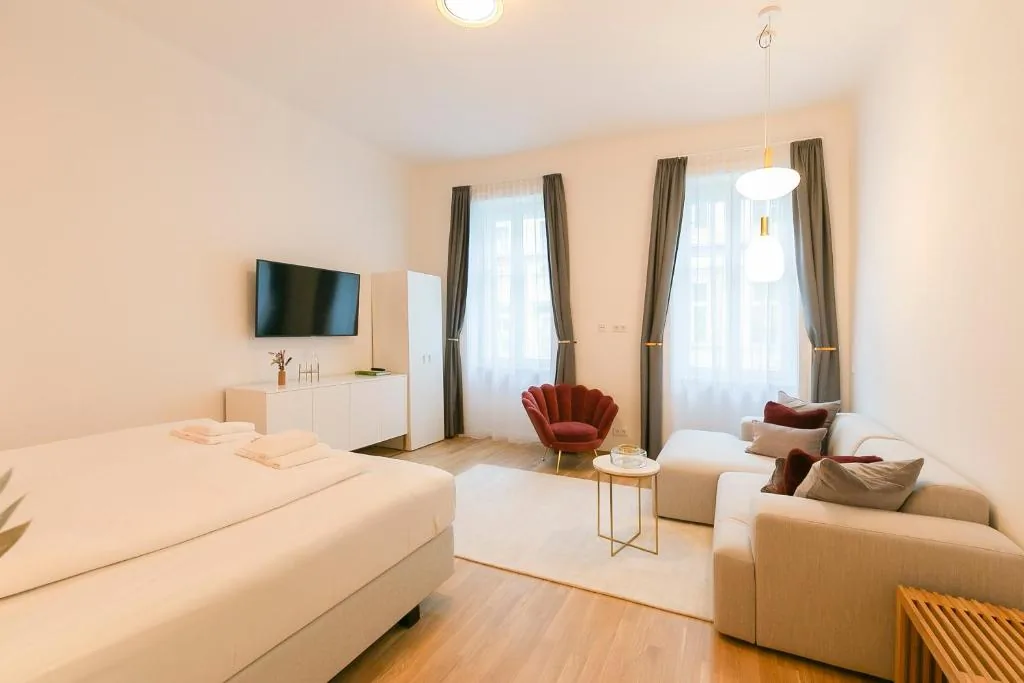
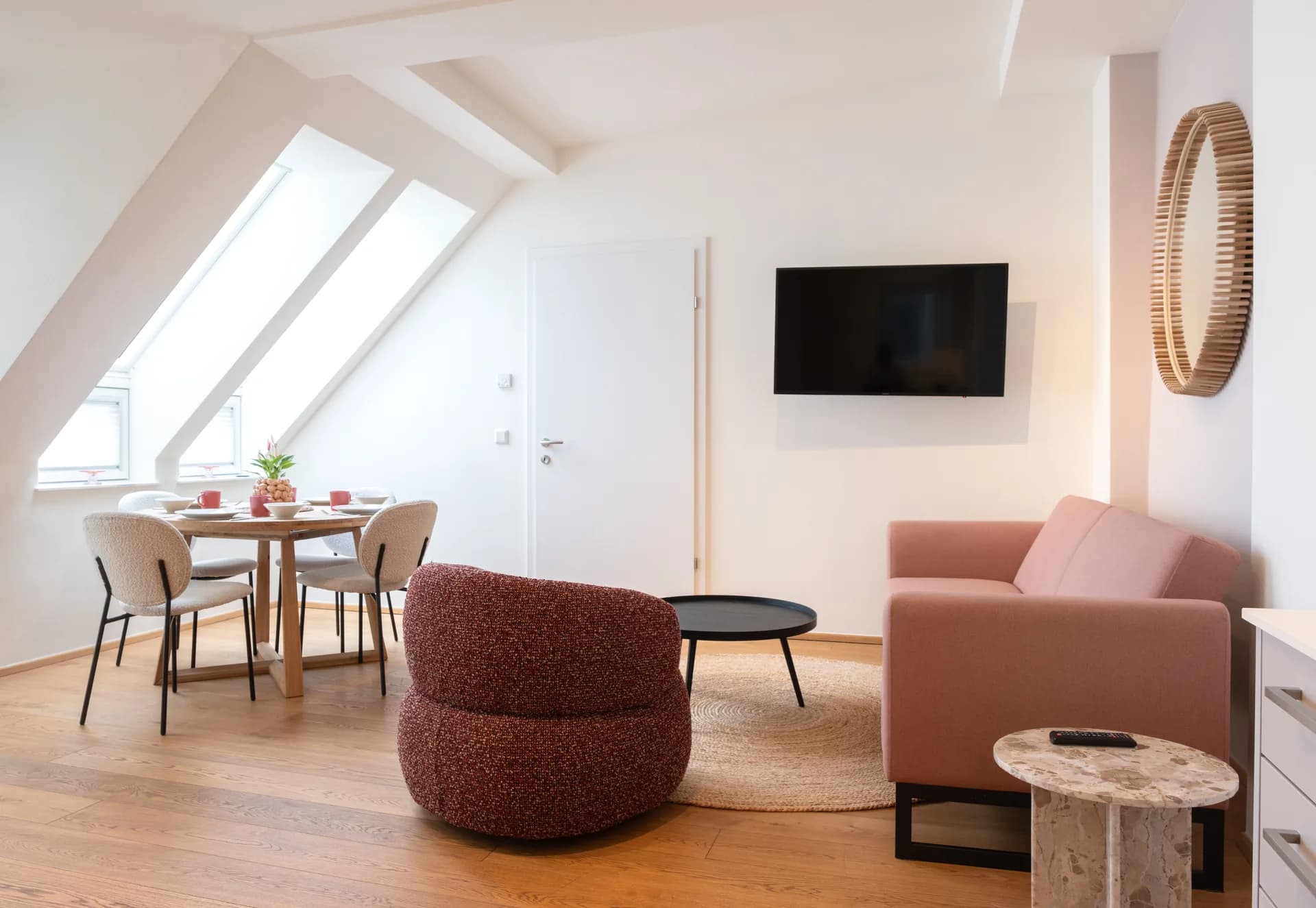
We run MINT @Naschmarkt one minute's walk from the market in the 6th district. Five apartments, each with a full kitchen and self check-in.
| Apartment | Size | Sleeps | From |
|---|---|---|---|
| Mini MINT | 35 m² | 2 | €185 |
| Double MINT | 55 m² | 3 | €205 |
| Double MINT with Balcony | 55 m² | 3 | €215 |
| MINT Artisan | 65 m² | 4 | €185 |
| Penthouse | 85 m² | 4 | €375 |
Every rate is a from-rate, and seasonal demand pushes the actual nightly price higher. Stays of 7 nights or more get the Wochenend+ tier at 15 percent off, 14 nights or more the Fortnight tier at 20 percent, and 28 nights or more the Resident tier at 25 percent. A party of four books the Penthouse or the Artisan; the Doubles sleep three.
What we do not have: private parking, or a 24 hour reception. What we do have is self check-in and a named contact who knows which stalls are currently displaced by the U4 works.
On the city tax, since it comes up: Vienna's Ortstaxe is 5 percent, in force since 1 July 2026, and rises to 8 percent on 1 July 2027. It falls away only beyond a continuous stay of more than three months. The Resident tier at 28 nights is unrelated to that; it is our pricing decision, not a tax rule. Someone staying 30 nights gets the full discount and still pays Ortstaxe on every night.
Rates per apartment and what each includes are set out in serviced apartment pricing near the Naschmarkt. You can check availability here.
Frequently asked questions
What are the Naschmarkt opening hours? Sales stalls open Monday to Friday 06:00 to 21:00 and Saturday 06:00 to 18:00. Farmers' market stalls run Monday to Friday 06:00 to 19:30 and Saturday 06:00 to 18:00. Restaurants and bars open Monday to Saturday 06:00 to 23:00, and 09:00 to 21:00 on Sundays and public holidays. Everything must be open Tuesday to Friday from 15:00 to 18:00.
Is the Naschmarkt open on Sunday? Not as a market. All sales stalls are closed on Sundays. The restaurants and bars are open from 09:00. Sunday is a place to eat, not a place to shop.
When is the Naschmarkt flea market? Every Saturday from 06:30 to 15:00, along the linke Wienzeile by the Kettenbrücke, with about 400 pitches. It is closed on 25 and 26 December and 1 and 6 January, and closes at 12:00 on 24 and 31 December.
Is the Naschmarkt a tourist trap? Half of it is. The Karlsplatz end is built for passing trade, with menu hawkers and frequently undisplayed per-kilo prices. The Kettenbrückengasse end is a working market at normal prices. About 300 metres separates the two.
What should you not buy at the Naschmarkt? Dried fruit, nuts and spices from the open bowls at the eastern end. Reviewers report per-kilo prices up to about €40 and 260 grams of cheese sold for €17.94. The same goods cost a fraction of that in a supermarket.
How do you get to the Naschmarkt? Take the U4 to Kettenbrückengasse for the flea market and farmers' market end, or go to Karlsplatz for the eastern end. Karlsplatz is the only Vienna station with at least three U-Bahn lines, namely U1, U2 and U4. Bus 59A stops at Bärenmühldurchgang.
Is the Naschmarkt renovation finished? No. The Naschpark opened on 19 September 2025 and the Marktraum market hall on 21 November 2025 with 13 businesses. The flea market area redevelopment was still listed as outstanding on the City of Vienna project page as of 20 April 2026, and the full project runs to the end of 2027.
How old is the Naschmarkt? There is no single clean answer. Vienna's own history wiki gives 1774 for the informal beginning, 1793 for the formal mandate, 1902 for the permanent pavilions and 1905 for the adoption of the name.
How many stalls does the Naschmarkt have? About 130 stalls plus the new market hall with 13 businesses, which is the official figure. Some sources claim around 170, which is not supported by the city.
Is there an entrance fee for the Naschmarkt? No. The market and the adjoining Naschpark are public. Budget €0.50 for the toilet near stall 350.
Sources
- City of Vienna, Naschmarkt
- City of Vienna, Naschmarkt flea market
- City of Vienna, Naschmarkt project page
- City of Vienna, Ortstaxe
- City of Vienna, fees from 2026
- Vienna history wiki, Naschmarkt
- Vienna Tourist Board, Naschmarkt
- Falstaff, Naschmarkt district guide
- MeinBezirk, farmers' market and the U4 works
- Austria-Forum, Karlsplatz U-Bahn station