
Vienna in 2026 is a city at peak global appeal: a record-breaking 20 million overnight stays in 2025, this spring's Eurovision Song Contest still rippling into early-summer demand, and a transport, ticketing and pricing landscape that has shifted in the last six months. This guide covers what to see, where to stay, how to get around, and what changed for 2026 - written for foreign visitors arriving over the next several months and planning trips of three to seven nights.
We've structured it so you can scan or read end-to-end. There is a verified-price attractions matrix, the new 2026 Wiener Linien fare reality, neighbourhood orientation, seasonal notes, and a table of five apartments at MINT Vienna - our serviced apartment building one minute from the Naschmarkt in the 6th district. Mint sits inside the area most visitors end up wandering anyway, so the geography here is also the geography of your stay.
What you'll find on this page
- Why visit Vienna in 2026 - the numbers, the moment, the months that matter
- The core cultural attractions, with verified 2026 prices where they are publicly available
- The 2026 transport reality (the 48-hour and 72-hour passes are gone)
- The neighbourhoods foreign visitors actually use, and which one to base from
- Coffee houses, the Naschmarkt, and how Vienna actually eats and drinks
- Seasonal context - summer, Christmas markets, day trips, families
- The practical tips that quietly save first-time visitors money and embarrassment
- Where to stay near these attractions - the five Mint apartments at the Naschmarkt
- A frequently-asked-questions section pulling together the smaller details
Why Vienna in 2026
Vienna had its biggest tourism year on record in 2025. According to a Wien Tourismus 2025 performance report published in January 2026, the city crossed the 20-million-overnight-stays threshold for the first time, reaching 20,065,000 - a 6 percent year-on-year increase. Around 83 percent of those stays were generated by international visitors. The United States supplied 1,259,000 of those overnight stays, the third-largest source market. The United Kingdom was fifth at roughly 800,000. Visitors from Canada were up 17 percent year-on-year and Japan up 24 percent.
A separate Wien Tourismus quote from CEO Norbert Kettner captures the scale: "2025 was the most successful year for city tourism in Vienna since records began: with 20 million overnight stays, Vienna set a new marker."
Two practical implications of that for your trip in 2026:
Bottom line: Demand is strong year-round and pinched at known peaks. Eurovision was in May (residual demand into June), the long summer runs through August, and Christmas markets fill the city from mid-November to late December. Book accommodation early, especially across June 2026 and the last six weeks of the year.
The city has the infrastructure to absorb that demand. Vienna runs around 450 hotels with about 42,400 rooms, and serviced-apartment supply has expanded across the central districts in the last several years. But the most desirable inventory - anything walkable to the Innere Stadt or sitting on a U-Bahn line into the centre - moves fast. Direct booking with the host typically gets you better pricing and more flexibility than the third-party platforms.
Vienna's reputation as one of the world's most liveable cities is not branding. A Mercer Quality of Living 2024 study published by the City of Vienna - comparing 241 cities worldwide - ranked Vienna second globally, behind Zurich, the first time Vienna had not held the top spot since 2009. The metrics are not subjective: safety, healthcare, education, infrastructure, environment. As a visitor you feel this in the small things - clean trams, free public drinking-water fountains, parks that actually function as parks, late-night U-Bahn that runs on weekends.
The biggest cultural moment of 2026 has already happened - the Eurovision Song Contest in May. Time Out Vienna described it as "the leading event in Vienna's cultural calendar this year." Residual demand from the contest still pushes June and early-July bookings; if your trip is in that window, book sooner rather than later.
Top cultural attractions: palaces, museums, and landmarks
Vienna's headline sights cluster within a 30-minute walking or U-Bahn radius of the Innere Stadt. The combined cost of seeing the most-cited ones in a single day runs roughly €60-€120 per adult - which is why a longer base in one apartment tends to make more economic sense than splitting nights across hotels.
Schönbrunn Palace
The summer residence of the Habsburgs and Vienna's most-visited single attraction. The palace and grounds are a UNESCO World Heritage Site.
Per the official Schönbrunn Palace ticket page, the Palace Ticket (adult) is €42.00 and covers 40 state rooms with audio guide. The Classic Pass at €49.00 adds the Privy Garden, Maze, Gloriette and Orangery Garden, and is available during the summer season (27 March - 2 November 2026). State Apartments only is €30.00. The gardens are free and open daily 06:30-21:00.
Local tip: Start at the gardens before 09:00 in summer - early light, almost empty paths, and the Gloriette view from outside the palace before the queues form. Then enter the palace mid-morning when the bus tours have already arrived and the timed-entry rhythm has settled.
Belvedere
Two palaces and a contemporary-art annex set in a free baroque garden. Upper Belvedere holds the world's most significant Klimt collection, including The Kiss.
Per the official Belvedere visit page, Upper Belvedere is €23.00 adult and open Monday to Sunday 09:00-18:00. Lower Belvedere is €20.00. A 2-in-1 ticket combining both is €32.00. A 3-in-1 ticket adding Belvedere 21 (contemporary art, €12.00 standalone) is €34.00. Children under 19 are free across all three. The gardens, like Schönbrunn's, are free.
For most first-time visitors, the Upper Belvedere single ticket is the right choice - Klimt's gold-period paintings are the centrepiece and the room they hang in tends to be the entire reason most visitors came. If you want the Lower as well, do them in sequence with a coffee in between.
Kunsthistorisches Museum
Hapsburg-era art and antiquities - Bruegels, Vermeers, Egyptian collections, the Imperial Treasury.
Per the official KHM visit page, the adult ticket is €22 online or €24 on-site, with under-19s free. Hours are Tuesday to Sunday 10:00-18:00, with Thursdays open until 21:00. In June, July and August the museum opens on Mondays as well - useful to know if you are travelling in summer and want to avoid the standard Monday museum-closure pattern.
Albertina
Twenty-first-century home for graphic arts, modernist painting, and rotating exhibitions in a former Habsburg residence above the Hofburg.
Per the official Albertina tickets page, the adult ticket is €19.90. The museum opens daily 10:00-18:00, with Wednesdays and Fridays until 21:00. Tickets are valid for one year from purchase - useful if you are in Vienna for an extended stay and want to spread visits across weeks.
Hofburg
The winter residence of the Habsburgs, in the heart of the 1st district. The Imperial Apartments, Sisi Museum and Silver Collection are typically sold as a combined ticket. For up-to-date pricing, check the official Hofburg site at hofburg-wien.at before you go - we deliberately don't quote a current price here because the available secondary sources have not been refreshed consistently against the official ticket page.
Two adjacent experiences are worth flagging:
- Spanish Riding School performances in the Winter Riding School - the Lipizzaner horses in their classical training routines. Performance tickets and morning-exercise tickets are sold separately. Book in advance.
- Imperial Treasury and National Library State Hall - separate ticketing, both magnificent, both quieter than the main palace tour.
Vienna State Opera
Standing-room (Stehplatz) tickets at the Vienna State Opera are the city's most famous cultural deal - a fully-staged opera or ballet performance for less than a Naschmarkt lunch. Per the official State Opera ticket-information page, standing-room tickets are released from 10:00 on the day of the performance, both online and at the box office, with an additional quota released 80 minutes before curtain. Prices start well under €20, with several tiers depending on whether you are standing in the parterre, gallery or balcony - check the live booking page on the morning of the performance for current prices and availability.
Other major museums
Vienna's MuseumsQuartier - a former imperial-stables complex now reshaped into one of the largest cultural districts in Europe - sits at the southern edge of the Innere Stadt and is a 10-minute walk from the Naschmarkt. The Leopold Museum (Egon Schiele and Gustav Klimt), mumok (modern art, with periodic temporary closures - check mqw.at before visiting), Kunsthalle Wien (rotating contemporary exhibitions) and the Architekturzentrum all live inside the complex, alongside the ZOOM children's museum. The MQ courtyards themselves are free and function as Vienna's outdoor "city lounge" in summer.
The Naturhistorisches Museum (natural history), the Wien Museum (the city's own history, recently reopened with permanent exhibitions) and the Technisches Museum (science and technology) round out the second tier of museums most foreign visitors include in a longer stay.
| Attraction | District | Type | Adult ticket | Time needed | Walk from Naschmarkt |
|---|---|---|---|---|---|
| Schönbrunn Palace | 13th | Palace + UNESCO gardens | €42 (Palace Ticket) | 3-4 hours | U4 (~15 min) |
| Belvedere (Upper) | 3rd | Palace + Klimt collection | €23 | 2 hours | 20-min walk or U-Bahn |
| Kunsthistorisches Museum | 1st | Fine art + antiquities | €22 online / €24 on-site | 2-3 hours | 12-min walk |
| Albertina | 1st | Graphic arts + modern painting | €19.90 | 1.5-2 hours | 10-min walk |
| Hofburg complex | 1st | Imperial palace + museums | See hofburg-wien.at | 2-3 hours | 12-min walk |
| Vienna State Opera | 1st | Opera + ballet (standing under €20) | from under €20 (standing) | 2.5-4 hours | 8-min walk |
| MuseumsQuartier (free courtyards) | 7th | Museums + open courtyards | free entry to courtyards | 30 min-full day | 10-min walk |
| Wiener Riesenrad (Prater) | 2nd | Historic Ferris wheel | €14.50 adult / €6.50 child | 30 min | U2 (~12 min) |
Key fact: Children under 19 enter the Belvedere, Albertina, KHM and most other major Vienna museums free of charge. If you are travelling with school-age children, you can build an entire museum day with two adult tickets covering the whole family.
Entertainment, coffee houses, and nightlife
The cultural rhythm of Vienna is not the rhythm of London or New York. The pace is slower, the table-time longer, the operator-style hospitality replaced with the assumption that nobody is rushing you out.
Vienna's coffee house culture
Per the Austrian UNESCO Commission inscription, Viennese coffee house culture was inscribed as intangible cultural heritage in 2011. UNESCO's own characterisation describes a coffee house as "a place in which time and space are consumed, but only the coffee is listed on the bill" - which is functionally a permission slip to occupy a marble-topped table with a single Melange and a stack of newspapers for two hours.
Three to anchor a visit:
- Café Central (1st district, Palais Ferstel) - the postcard coffeehouse. Time Out Vienna's editors note its "cathedral-like domed ceilings and accomplished patisserie selection." Expect a queue at peak hours; go before 11:00 or after 16:00.
- Café Sperl (6th district, walking distance from Mint) - quieter, older-school, billiards in the back, less photographed. The local 6th-district favourite.
- Café Schwarzenberg (on the Ringstrasse, 1st district) - the morning-coffee-and-paper place if you want windows onto the Ring.
This is not an exhaustive list - there are dozens of historic kaffeehäuser still operating in Vienna. For a deeper food and dining map of the city, see our Where Locals Actually Eat in Vienna guide, which covers 33 venues with current pricing and booking requirements.
Opera and classical music
The Vienna State Opera, Musikverein (home of the Vienna Philharmonic, in the 1st district) and Konzerthaus (3rd district) are the three anchor venues. Standing-room at the State Opera, as covered above, is the budget-accessible point of entry to a fully-staged performance. The Musikverein's Golden Hall - the room you see on New Year's Day every year on television - is open year-round; for any prestige programme, book months ahead. The Konzerthaus runs a broader contemporary and chamber programme.
All three sit within a 20-minute walk or one U-Bahn stop of the Naschmarkt via Karlsplatz.
Naschmarkt and dining
Per the Vienna Tourist Board's Naschmarkt page, the market runs Monday to Friday 06:00-21:00 and Saturday 06:00-18:00 (closed Sundays for the market itself; restaurants stay open). The Saturday flea market runs 06:30-14:00 and is where local Vienna actually shops the weekend.
The market has around 130 stalls plus a covered market hall. The mix runs Turkish, Greek, Lebanese, Vietnamese, Austrian, Italian, Spanish - Vienna in microcosm, on the pavement of the Wienzeile. The restaurant strip running along the market is open until 23:00 on weekdays and Saturdays. Free Wi-Fi covers the area.
From a guest: The morning rhythm at the market is the actual local rhythm. Get a coffee at one of the stand-ups by 08:30, pick up fruit, cheese and bread on the way back to the apartment, and that's your light lunch. Save the sit-down meals for evenings.
For sit-down dining outside the market, our Where Locals Actually Eat in Vienna guide covers neighbourhood venues across the 1st, 6th, 7th and 4th districts with pricing for two and booking requirements.
Parks and outdoor space
A genuine differentiator: Vienna treats free outdoor space as infrastructure, not amenity. The Prater is a 4-kilometre ribbon of green stretching east of the centre, accessible 24 hours and free. Schönbrunn's gardens are free and open 06:30-21:00. The Belvedere gardens are free. The Stadtpark - the Johann Strauss statue, the Wienfluss promenade - is free and a 10-minute walk from the Naschmarkt. The MuseumsQuartier courtyards are free. The MQ Libelle rooftop terrace on the Leopold Museum is free from March to October.
In summer, Alte Donau - an old river arm at the eastern edge of the city - is the local swimming spot, seven U-Bahn stops from Stephansplatz. The Vienna locals get there for free swimming, free sunbathing and rented boats; it is a real part of summer Vienna.
Best neighbourhoods in Vienna
The numerical district system can be confusing on arrival. The 1st district (Innere Stadt) is the inner ring inside the Ringstrasse - the imperial historic core. The districts radiate outward in spiral fashion through to the 23rd. As a foreign visitor, you will mostly be moving between the 1st, 6th, 7th, 4th and possibly the 2nd.
| District | Common name | Character | Why visit / stay |
|---|---|---|---|
| 1st | Innere Stadt | Imperial historic core | Most sights (Hofburg, Stephansdom, Opera, KHM, Albertina). Tourist-dense. Pricier hotels. |
| 6th | Mariahilf | Hip residential + Naschmarkt | Best base for visitors. Mariahilferstrasse shopping, Naschmarkt, walkable to the 1st district. |
| 7th | Neubau | Creative + boutique-shopping | Spittelberg's cobbled streets, vintage shops, MuseumsQuartier-adjacent. |
| 4th | Wieden | Quieter café-and-residential | Karlskirche, Belvedere proximity, local café culture. |
| 2nd | Leopoldstadt | Prater + Danube Canal | Family-friendly, Prater amusement park, swimming at Alte Donau via U-Bahn. |
The 6th district (Mariahilf) is where Mint sits and is - in our view, having hosted foreign visitors there for years - the right base for a 3-to-7-night Vienna trip. The reasons are operational rather than scenic. From the Naschmarkt edge of the 6th, you can walk to the Opera in 8 minutes, the Albertina in 10, the Hofburg in 12, the KHM in 12, the MuseumsQuartier in 10, and Karlskirche in 5. You are on Vienna's only U-Bahn interchange (Karlsplatz, U1/U2/U4) within a 3-minute walk. The neighbourhood itself is residential, with cafés, wine bars and bakeries that exist for the people who live there. It is not staged for visitors.
Watch out: Don't pick accommodation by photograph alone. A "beautiful 1st-district hotel" can mean a 25-minute walk to the Opera if the building sits at the wrong edge of the Innere Stadt. Use walking-distance to the specific landmarks you actually want to visit - not the district name - as your criterion.
Per Expatica's Vienna residency guide, over 30 percent of Vienna residents hold non-Austrian citizenship (as of 2019). The city is genuinely international - most service staff are comfortable in English, and the 6th and 7th districts in particular are home to a large foreign-resident community.
If you are weighing your accommodation type as much as your neighbourhood, our Naschmarkt accommodation types and neighborhoods guide compares the categories - hotels, serviced apartments, Airbnb whole-flats - for the area. For a fuller cross-category comparison, Airbnb vs hotels vs serviced apartments Vienna walks through the trade-offs by stay length and group type.
Getting around Vienna: the 2026 transport reality
Vienna's transport network is one of the better-functioning in Europe. The U-Bahn (metro), Strassenbahn (tram), buses, and S-Bahn (suburban rail) all share a single Wiener Linien fare zone within the city - meaning the ticket price is the same regardless of distance or how many transfers you make inside the city.
There is a significant 2026 change you need to know about.
Watch out: Per a Wiener Linien notice on the new fare structure from 1 January 2026, the 48-hour and 72-hour Wiener Linien tickets have been discontinued. Older travel guides still cite these as current options. They are no longer sold.
The current 2026 Wiener Linien tourist options are:
| Ticket | Standard price | Digital price | Best for |
|---|---|---|---|
| Single journey | €3.20 | €3.00 | One-off ride |
| 24-hour ticket | €10.20 | €9.70 | Day-of arrival or a single full sightseeing day |
| 7-day ticket | €28.90 | €25.20 | Stays of 3+ nights with regular U-Bahn use |
Digital tickets through the WienMobil app are roughly 5 percent cheaper than printed.
If you need 2-to-5-day coverage and the discontinued 48h/72h passes were your default plan, you now have two practical paths: buy several 24-hour passes back-to-back, or move to the Vienna City Card (which still offers 48h and 72h bundles and adds attraction discounts; check viennacitycard.at for current pricing). Alternatively, the Vienna Pass is a separate product - free entry to 90+ attractions including all major palaces plus the hop-on hop-off sightseeing bus - and is described in more detail on viennapass.de. We deliberately don't quote either card's prices here because the publicly indexed prices have not been current; check the official sites before buying.
The other practical transport rule that costs unsuspecting visitors money:
Key fact: Per a Vienna public transport guide from Grete Walz, the fine for travelling with an unvalidated printed ticket is over €100. Digital tickets through the WienMobil app activate automatically and do not need separate validation. Printed paper tickets must be inserted into the validation machine at the U-Bahn entrance, tram door, or bus door before your first ride. Inspectors do check.
The geography of where you stay matters more than which pass you buy. Mint sits one minute from the Naschmarkt and three minutes from the Karlsplatz U-Bahn - which is Vienna's only triple-line interchange (U1, U2, U4). From there, every major sight in the Innere Stadt is one to three U-Bahn stops, and most are within a 15-minute walk. A guest staying three nights in the 6th district often uses the U-Bahn fewer than four times across the stay; a guest staying in a less central district is buying transit constantly.
If you are travelling for work and need a base for two or three weeks, our Vienna business apartments market overview walks through what changes for a longer business stay (workspace, weekly turnover, congress timing). If you are coming for a month or more - relocation, sabbatical, or just a long base - our extended stay apartments Vienna relocation guide is the right starting point.
Seasonal Vienna: summer, Christmas, day trips, families
Vienna reads differently across the year. The headline differences are summer (June-August) and Christmas-market season (mid-November-late December), with a quieter and frankly very pleasant shoulder season in September-October and again in early March.
Christmas markets 2026
The Christmas markets are one of Vienna's strongest seasonal draws - multiple markets across the city run from mid-November through late December. Per the VisitingVienna.com 2026 guide, the Rathausplatz Christkindlmarkt - the largest - runs from 13 November to 26 December 2026, daily 10:00-22:00, closing earlier (at 18:30) on Christmas Eve. The market has around 96 booths plus the adjacent ice rink in front of the illuminated city hall. Access is via trams 1, 71, or D (Rathausplatz/Burgtheater) or the U2 (Rathaus) and U3 (Volkstheater) stations.
The Rathausplatz market is the headline event but it is also the most crowded. For a quieter and more design-led version, the Spittelberg market in the 7th district (artisan crafts, cobbled streets, less hustle) and the Schönbrunn Palace market are the local alternatives. The Austrian National Tourist Office's Vienna Christmas markets overview lists the major ones with dates.
Local tip: Visit Rathausplatz at dusk in early December - the market lights come on, the cold is bearable, and the crowds have not yet thickened into the weekend rush. If you can stay in the city for the full Christmas-market window, late November weekdays are quieter than mid-December weekends.
Summer
June through August is bright, warm and long-evening. The MuseumsQuartier courtyards fill with people drinking spritz on the modular concrete furniture. The Kunsthistorisches Museum opens on Mondays in June, July and August - useful for re-routing around the standard Monday museum-closure problem. Alte Donau (seven U-Bahn stops east of the city) is the local outdoor swimming spot. The Eurovision Song Contest in May 2026 added a discrete early-summer demand spike that still ripples into June bookings.
Day trips
Several worthwhile day trips out of Vienna are accessible by train or river. Per the ViennaPass day-trips guide, the most commonly cited are:
- Wachau Valley (UNESCO World Heritage) - vineyards and historic abbeys along the Danube between Krems and Melk. Train and river-cruise combinations are popular.
- Bratislava - accessible within roughly an hour from Vienna; a different country and a different city centre in a single morning.
- Klosterneuburg Abbey - closer in, a working monastery on the outskirts of the city.
For the river cruise specifically, DDSG Blue Danube runs services from Schwedenplatz in Vienna out towards the Wachau. A common pattern is to train to Melk in the morning, cruise downstream to Krems, and train back.
Families
The family-friendly Vienna picture is genuinely strong. Schönbrunn Zoo (within the Schönbrunn Palace grounds) is one of the most visited attractions in the city, paired with the palace itself and the Children's Museum at Schönbrunn (an exhibition where children can dress up as imperial children). The ZOOM Kindermuseum in the MuseumsQuartier runs hands-on workshops - book in advance, places fill. The Naturhistorisches Museum and Technisches Museum are both family-mainstays. The Riesenrad in the Prater is the icon ride: per the official Wiener Riesenrad ticket page, the adult ticket is €14.50 and the children's ticket is €6.50.
If you are travelling with a family of four and weighing the apartment-vs-hotel decision specifically - kitchen for cereal in the morning, washing machine for a school holiday, two bedrooms - our family apartments Vienna amenities guide walks through the trade-offs in detail.
Practical tips for first-time visitors
A small set of city-specific things that quietly improve a Vienna trip:
- Validate printed transit tickets. As noted, the fine is over €100 for an unvalidated paper ticket, even if you paid for the ticket. Digital tickets in the WienMobil app validate automatically.
- Monday museum closures are the norm. Most major museums are closed Mondays; the KHM is the notable exception in June-August. Build your itinerary so Monday is a walking day (Ringstrasse circuit, Naschmarkt, coffeehouse hours) and you'll lose no time.
- Tipping is light. Around 10 percent in restaurants and coffeehouses is generous and standard; service is not added by default in most places. You hand the tip directly to the server (it's normal to say the total with the tip included, rather than leaving it on the table).
- Sundays close the Naschmarkt itself. The market stalls close on Sundays. The restaurants along the market stay open Sunday 10:00-21:00. Supermarkets are mostly closed on Sundays - plan groceries by Saturday evening.
- English is widely spoken. In restaurants, museums, on transport, at hotels and apartments. You will not need German for a leisure trip. A simple "Grüß Gott" (hello, in Austrian German) or "Danke" goes down well but is not required.
- Cash is still more common than in much of Western Europe. Cards are widely accepted at major attractions, restaurants and hotels - but smaller venues, market stalls, some bakeries and traditional Würstelstand sausage stands often want cash. Carry €40-€80 in small notes.
- Free outdoor water. Vienna's tap water comes directly from Alpine springs and is some of the highest-quality municipal water in Europe. The drinking fountains in parks and on streets are safe and free.
Bottom line: The two specific things that catch first-timers off-guard are the validation fine (more than €100) and Sunday closures (market and supermarkets). Avoid those two and you'll have a frictionless Vienna trip.
For budget-conscious visitors, the lowest-cost meals come from the Naschmarkt food stalls (Turkish, Lebanese, Vietnamese, Austrian - all affordable and authentic), the Würstelstand stands throughout the city, and self-catering from supermarkets like Billa, Spar or Hofer. Anyone staying in a serviced apartment with a full kitchen - for example, in any of the five Mint apartments below - can shop the Naschmarkt or a supermarket and bring food costs down significantly across a longer stay.
Where to stay near these attractions
The five Mint apartments below sit one minute from the Naschmarkt in Vienna's 6th district - which puts them inside or within a short walk of most of the attractions covered above. They share a baseline: fully equipped kitchen, air conditioning, king-size bed, washing machine, elevator, free luggage storage. The differences are size, layout, and what kind of stay they are best for.
| Property | Best for | Size + sleeps | Nightly from | Link |
|---|---|---|---|---|
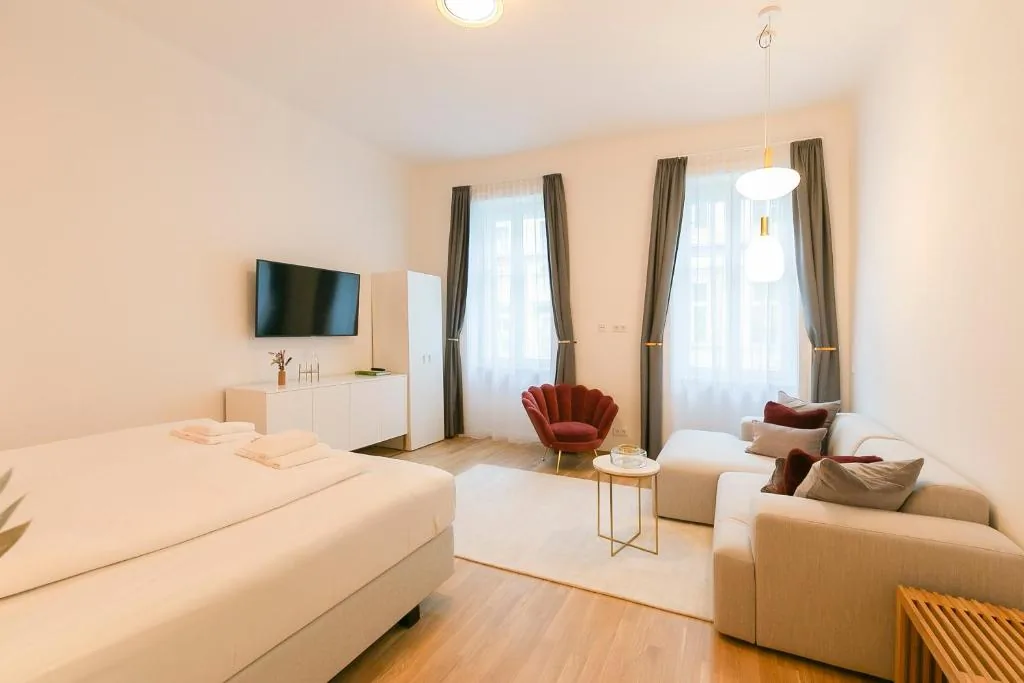
| Mini MINT | Solo travellers and couples - compact, well-designed studio steps from the Naschmarkt | 35m², up to 2 guests | €185 | Mini MINT |
| Double MINT | Couples or three travellers wanting extra space - full kitchen, king bed + pull-out sofa | 55m², up to 3 guests | €205 | Double MINT |
| Double MINT with Balcony | Groups wanting outdoor space - private balcony for morning coffee or evening drinks | 55m², up to 3 guests | €215 | Double MINT with Balcony |
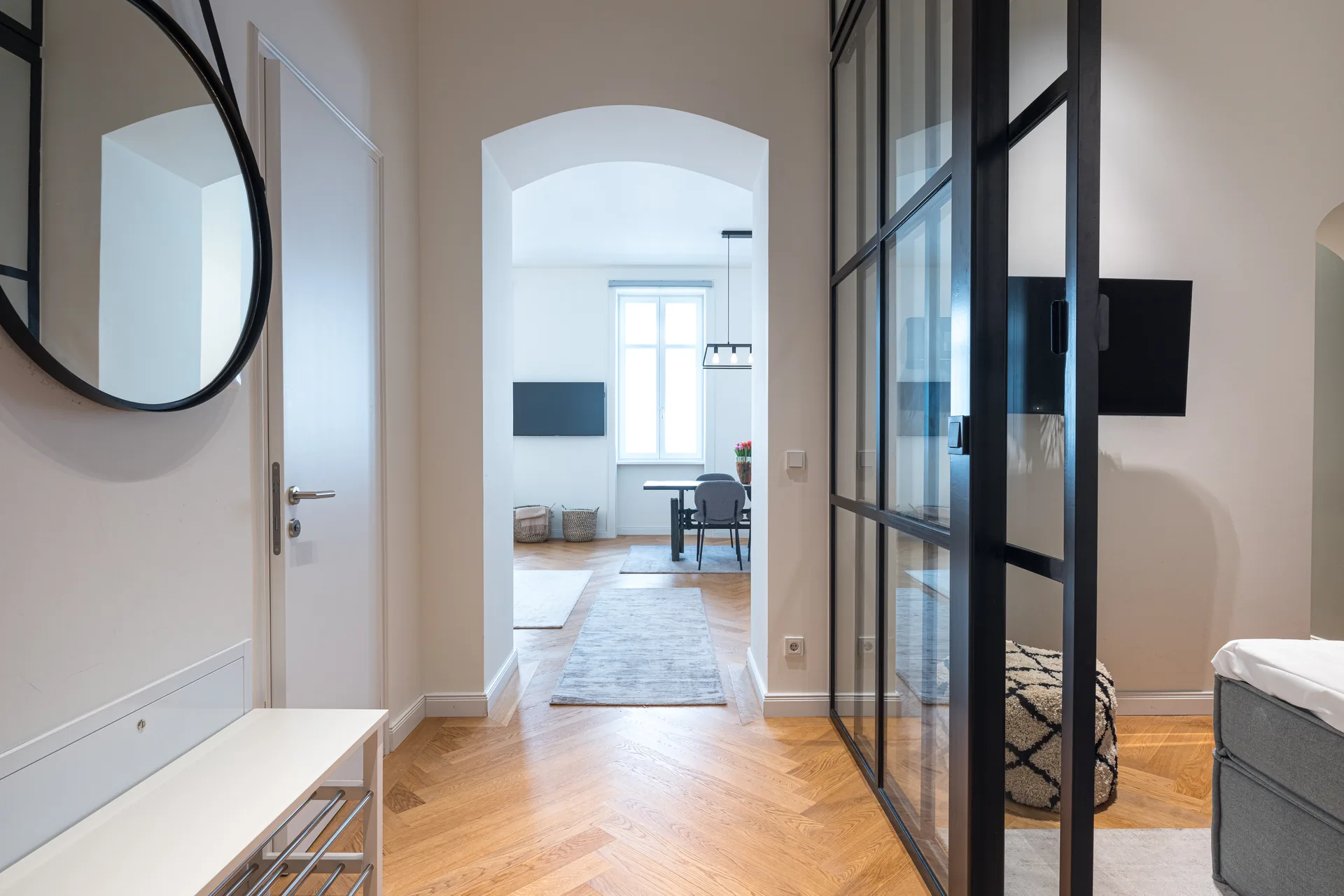
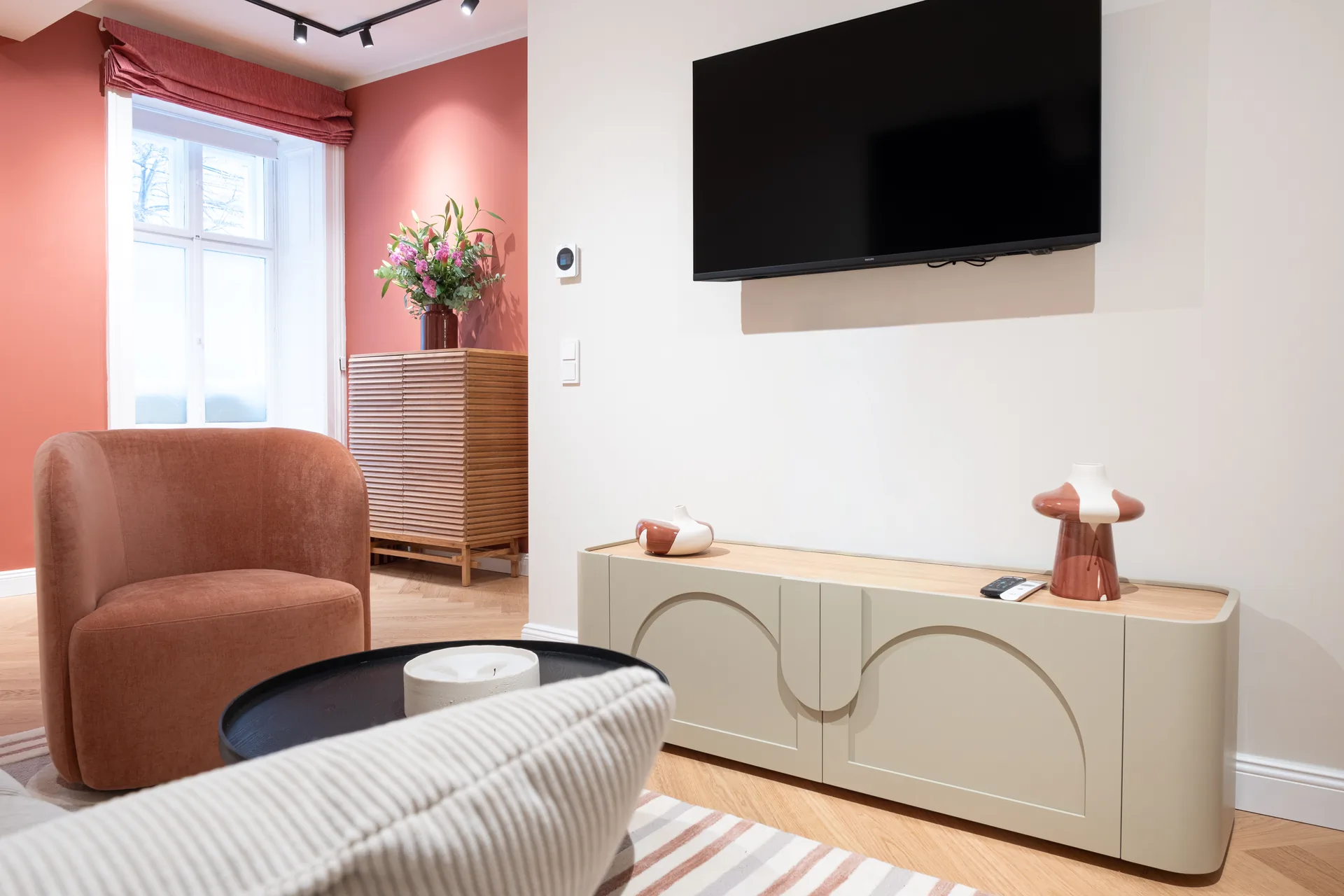
| MINT Artisan | Design-conscious visitors - terracotta walls, herringbone oak floors, gallery character at the Naschmarkt | 65m², up to 4 guests | €185 | MINT Artisan |
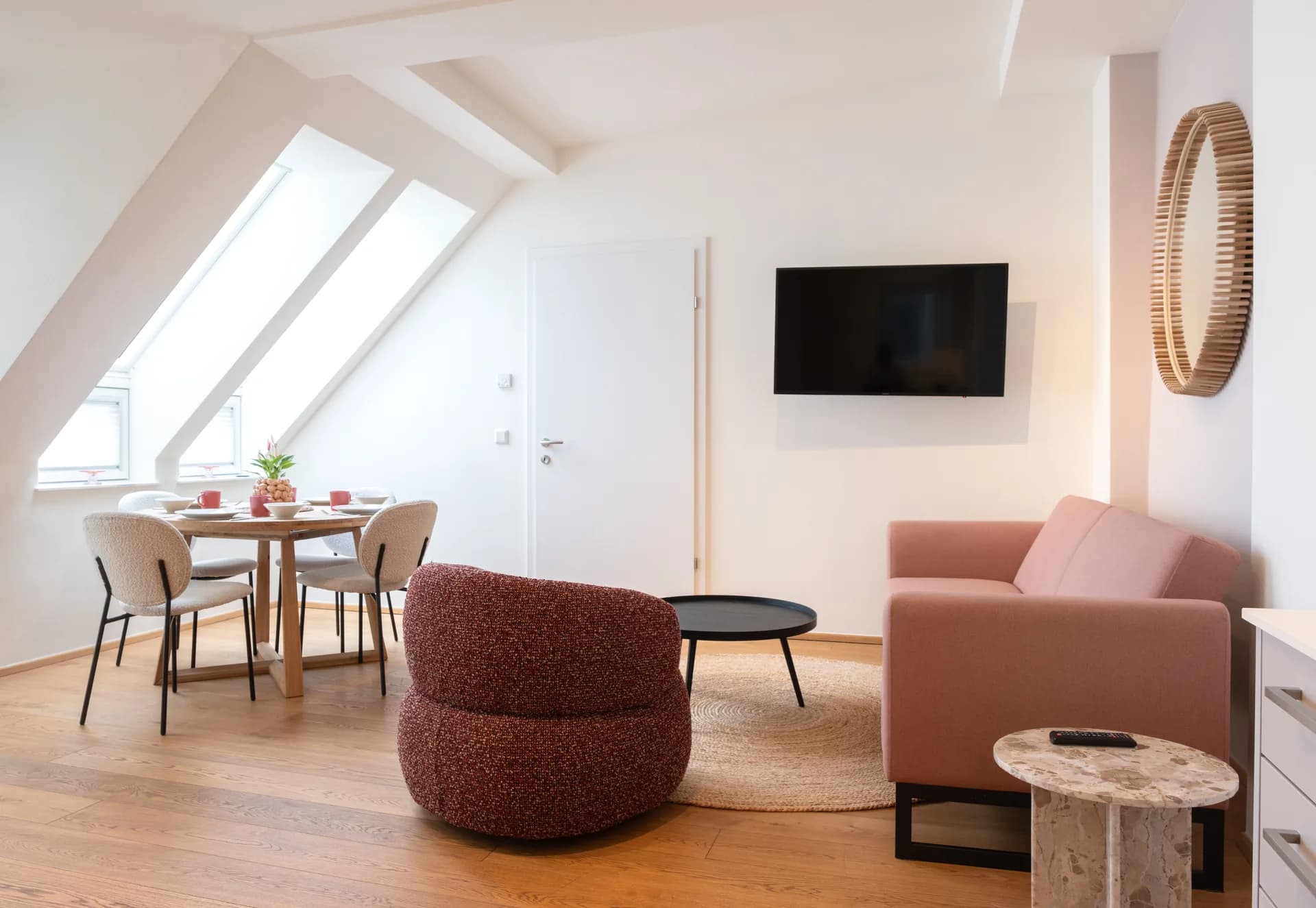
| Penthouse Maisonette | Premium stays or two couples - two floors, two bedrooms, private roof terrace with Vienna views | 85m², up to 4 guests | €375 | Penthouse Maisonette |
Mint Vienna isn't another serviced apartment trying to be a hotel. There is no reception desk, no breakfast buffet, no tour groups blocking the lobby. The trade-off is that you are in a quieter building inside a residential neighbourhood - which is, in our view, what most people actually want from a Vienna stay. Direct booking with the host gets you better pricing and a real person on the other end of the message for things like an early check-in, a coffee recommendation, or anything else. Our stay-tier discounts apply for longer stays: Wochenend+ (7+ nights, −15%), Fortnight (14+ nights, −20%), Resident (28+ nights, −25%).
For a deeper comparison of all the Naschmarkt-area options - including the broader accommodation-type landscape - our Naschmarkt accommodation types and neighborhoods guide is the right next read. If you are evaluating design and host-led operations specifically, see our boutique apartment hotels Vienna overview.
Looking to book? Check availability and book direct - direct booking sends your message to Christian (host and founder) and gets you better pricing than the third-party platforms.
Planning your visit: itineraries
A 3-day Vienna trip - the most common length for foreign visitors - covers the headline cluster (palaces + Klimt + an opera or coffeehouse evening + the Naschmarkt) without rushing. A 5-to-7-day stay opens up secondary museums, a day trip to the Wachau or Bratislava, and the seasonal rhythm of a real neighbourhood.
For a day-by-day plan with transparent timing and costs, see our own 3 Days in Vienna, Based at the Naschmarkt itinerary - customisable to your length of stay, anchored on the 6th district, and structured so the morning sights are walkable and the afternoons make sense.
More from MINT
For more Vienna travel guides - itineraries, food maps, neighbourhood breakdowns - see the full guides index.
Frequently asked questions
Is 3 days enough to see Vienna for the first time? Three days covers the headline cluster (Schönbrunn or Belvedere, the Hofburg or KHM, an opera evening or coffeehouse afternoon, the Naschmarkt) without rushing. Four to five days lets you add the MuseumsQuartier in depth, a day trip to the Wachau or Bratislava, and a slower evening rhythm in the 6th or 7th district.
How early should I book Vienna accommodation in 2026? Vienna had a record tourism year in 2025, and 2026's remaining peaks are the long summer through August (with extra pressure into June from residual Eurovision demand) and Christmas markets from mid-November to late December. For those periods, book at least 8-12 weeks ahead. Shoulder seasons (mid-March, late October, early November) are more flexible and you can often book 3-4 weeks ahead with good availability.
What's the cheapest way to see Vienna State Opera? Standing-room (Stehplatz) tickets start from under €20 and are sold from 10:00 on the day of the performance, both online and at the box office, per the official State Opera ticket page. An additional standing-room quota is released 80 minutes before curtain. Get to the queue early on the day; it's the cheapest way into a fully-staged opera or ballet in Europe.
Is the Wiener Linien 72-hour pass still available? No. As of 1 January 2026, the 48-hour and 72-hour Wiener Linien tickets have been discontinued. The current tourist options are the 24-hour ticket (€10.20 standard / €9.70 digital) and the 7-day ticket (€28.90 / €25.20). If you need 2-to-5-day transport, either buy multiple 24-hour passes, switch to the Vienna City Card (which still offers 48h and 72h bundles with attraction discounts), or use the Vienna Pass.
Is the Vienna Pass worth it? It depends on your sightseeing intensity. The Vienna Pass covers free entry to 90+ attractions including Schönbrunn, Belvedere, Albertina, Hofburg, KHM and the hop-on hop-off bus. For 2-to-3 days of intensive sightseeing where you would otherwise pay €60-€120 per adult per day in admissions, the pass typically pays for itself. For a slower 5-to-7-day trip where you might visit 3-4 attractions total, individual tickets are usually the better deal. Check current pricing at viennapass.de before deciding.
What are the Naschmarkt opening hours? Per the Vienna Tourist Board's Naschmarkt page, the market is open Monday to Friday 06:00-21:00 and Saturday 06:00-18:00. It is closed on Sundays (the market stalls; the restaurants along the market stay open Sunday 10:00-21:00). The Saturday flea market runs 06:30-14:00. Free Wi-Fi covers the area.
Which Vienna museums are free for children? Children and teenagers under 19 enter the Belvedere, Albertina, Kunsthistorisches Museum and Naturhistorisches Museum free of charge. This applies to Austrian and foreign visitors equally. For a family of four, this means two adult tickets cover the entire museum bill - making a museum-heavy itinerary genuinely affordable.
Where should I stay in Vienna as a foreign visitor? The 6th district (Mariahilf) is the most practical base for a 3-to-7-night trip: walkable to the Opera (8 min), Albertina (10), Hofburg (12), KHM (12) and MuseumsQuartier (10); on Karlsplatz U-Bahn (3 minutes from the Naschmarkt) which is Vienna's only triple-line interchange. The 1st district is closer to the sights but more tourist-dense and pricier. The 7th (Neubau) is good for design-conscious shorter stays. For a fuller breakdown of the trade-offs at and around the Naschmarkt, see our Naschmarkt accommodation types and neighborhoods guide.
Do I need German to visit Vienna? No. English is widely spoken in restaurants, museums, on transport, at hotels and serviced apartments, and at most major sights. A few basic German phrases ("Grüß Gott", "Danke", "Bitte") are appreciated but not required for a leisure trip.
Sources
- Wien Tourismus - Vienna 2025 Performance Report (January 2026)
- Wiener Linien - New Fare Structure from 1 January 2026
- Schönbrunn Palace - All Tickets & Tours (official)
- Belvedere Museum Vienna - Visit (official)
- Albertina Museum Vienna - Tickets (official)
- Vienna State Opera - Ticket Information (official)
- Kunsthistorisches Museum - Opening Hours (official)
- Vienna Tourist Board - The Vienna Naschmarkt
- City of Vienna - Mercer Study 2024
- VisitingVienna.com - Rathausplatz Christkindlmarkt 2026
- Grete Walz - Vienna Public Transport Guide
- Time Out Vienna - Best Things to Do in Vienna
- Austrian National Tourist Office - Christmas Markets in Vienna
- Austrian UNESCO Commission - Viennese Coffee House Culture
- Hofburg Vienna - Plan Your Visit (official)
- ViennaPass - Advantages of the Vienna PASS
- ViennaPass - 9 Best Day Trips from Vienna
- Wiener Riesenrad - Tickets (official)
- Expatica - Living in Vienna
Last updated: May 2026. Christian, Host & Founder - MINT @Naschmarkt.