
Cost of living Vienna works out at roughly €1,300 to €1,500 a month for one person before rent, and that number is less useful than the two facts underneath it. Vienna is genuinely cheap on the things that are expensive elsewhere, which is why it keeps winning liveability rankings. But the international cost-of-living indices measure an expatriate shopping basket, not the regulated housing most Viennese renters actually live in, so they systematically misprice the city for anyone who rents and takes the U-Bahn. And the figure that breaks a newcomer's budget is never the monthly rent. It is what it costs to get through the front door in the first place. Here is the real monthly arithmetic, the entry costs nobody warns you about, and two widely repeated numbers that are now simply wrong.
The €365 transit pass no longer exists: it is €467
Start here, because it is the fastest way to tell whether a Vienna guide has been updated this year.
For more than 13 years the Wiener Linien annual pass cost €365, one euro a day, and it became a piece of the city's identity. Since 1 January 2026 it costs €467, or €461 if you buy it digitally. That is about 30 cents more per day. From 1 January 2027 fares will be indexed annually rather than held flat.
It is still a good deal for unlimited travel across a capital city. It is just no longer the deal that every relocation article written before 2026 is quoting at you. If a guide still says €365, it has not been touched this year, and you should treat its other numbers with the same suspicion.
Shorter options, checked mid-August 2026: a 24 hour travel card from €9.70, and a 7 day pass at €25.20 personalised or €28.90 otherwise.
What a month in Vienna actually costs: about €1,330 before rent
A worked single-person budget, dated 29 June 2026 on April 2026 data, comes out like this.
| Category | Per month |
|---|---|
| Groceries | €280 |
| Utilities (electricity, heating, water) | €180 |
| Mobile and internet | €40 |
| Dining out and entertainment | €150 |
| Transit (annual pass, monthly equivalent) | about €39 |
| ORF household contribution | €15.30 |
| Total before rent | about €1,330 |
The ORF-Beitrag is a compulsory household broadcasting contribution of €15.30 a month, charged nationwide with no Vienna surcharge. It applies per household, not per person, and it catches most newcomers by surprise because it arrives whether or not you own a television.
For utilities in a larger flat, Numbeo puts basic services for an 85 m² apartment at €284.43 a month with a range of €198 to €480. That is crowd-sourced rather than official, but it brackets the range sensibly. A Schnitzel with a side runs about €14.90 as of mid-August 2026.
Rent: 3 different numbers, and only one of them is a Vienna market rate
This is where most guides mislead, usually without meaning to. Three figures circulate and they measure three different things.
| Figure | Value | What it actually measures |
|---|---|---|
| Austrian national average | €10.50 per m² including operating costs, Q1 2026 | Austria as a whole, not Vienna |
| Vienna Richtwert | €6.74 per m², from 1 April 2026 | a legal ceiling for regulated older stock, not an average paid rent |
| EHL market report | €11.90 to €17.50 per m², Q1 2026 | actual Vienna asking rents by district |
The national Statistik Austria figure of €10.50 per m², or €695.10 per dwelling, gets quoted as a Vienna number constantly. It is not one.
The Richtwert is a calculation base, not a market price. It applies to older buildings under the full scope of the Austrian rent act, and surcharges for location, condition and fittings are added on top. It rose 1.00 percent on 1 April 2026, capped.
If you want a real Vienna market range, use the EHL figure: €11.90 to €17.50 per m² depending on district in the first quarter of 2026. Some property data portals claim considerably higher figures, roughly €18 to €25 per m². Those could not be independently verified for this article, so treat them as a signal that sources disagree rather than as a number to budget against.
For a practical bracket, Numbeo puts a one-bedroom flat in the city centre at €1,180.85 a month on average, ranging €850 to €1,800, and one outside the centre at €858.75, ranging €700 to €1,200.
The 2026 rent cap protects the tenant already living there, not you
This one is counterintuitive and it matters more than anything else on this page if you are about to sign a lease.
Austria introduced a rent cap effective 1 January 2026. It limits the annual indexation of rents that have already been agreed, to 1 percent in 2026 and 2 percent in 2027, applied each 1 April, across both regulated tenancies and free-market leases carrying an index clause.
What it does not do is cap what a landlord may charge a brand new tenant on day one. Sign your first Vienna lease in 2026 and the headline rent freeze does nothing for you. It protects your neighbour who moved in during 2019.
Meanwhile the entry price keeps moving. EHL forecasts Vienna rents rising about 7.0 to 8.5 percent across 2026, from 6.7 percent in the expansion areas north of the Danube, in Favoriten and Simmering, up to 9.4 percent in central and prime locations.
The real barrier: about €3,600 before you have slept a night
Here is the arithmetic that no per-square-metre statistic captures, and the reason relocations get derailed.
The deposit (Kaution). Three gross monthly rents is the market standard in Austria. The Austrian Supreme Court has held that up to six months is permissible, and there is no statutory cap. On a €900 flat that is €2,700 locked away for the life of the tenancy.
The kitchen. There is no legal obligation on an Austrian landlord to provide one, and it is common for tenants to bring or finance their own. Not every flat is handed over bare, but it is frequent enough that you must plan for it. A fitted kitchen is a four-figure cost that you either remove or sell on when you leave.
The agency commission. Good news that often gets missed: since July 2023 Austria applies the Bestellerprinzip, meaning whoever hired the estate agent pays them, which for a rental is normally the landlord. Do not budget two months' commission as a matter of course; that is out-of-date advice.
The lease term. Fixed-term residential leases typically run three years. You can usually give three months' notice after the first year, but you are committed at the outset.
| Getting into a Vienna lease | On a €900 monthly rent |
|---|---|
| Deposit, 3 gross monthly rents | €2,700, locked up |
| First month's rent | €900 |
| Kitchen, if not supplied | four figures |
| Agency commission | usually €0 since July 2023 |
| Minimum commitment | typically a 3 year fixed term, notice earliest after 12 months |
So before your first night you are roughly €3,600 down, potentially more with a kitchen, and tied in for years. That is the number that decides most relocations, and it never appears in a cost-of-living index.
Why Vienna scores worse on the indices than it feels
Vienna was ranked the world's second most liveable city in July 2026 by the EIU's Global Liveability Index, behind Copenhagen. Yet cost-of-living rankings tend to place it as a mid-to-expensive European capital. Both can be true, because they are not measuring the same city.
Mercer's cost-of-living methodology explicitly assumes a convergence of spending patterns among expatriates of different nationalities, priced at vendors chosen because expatriates can buy goods of international quality there. That is a real basket for some people. It is not the basket of the roughly three quarters of Viennese renter households sitting in municipal, cooperative or otherwise regulated housing. Note also that no 2026 edition of Mercer's cost-of-living ranking was locatable as of 1 September 2026; anything you read quoting Mercer is likely citing the 2024 edition.
The practical consequence: Vienna is cheaper than the indices suggest if you rent in the regulated segment and use public transport, and roughly as expensive as they suggest if you eat out often and shop at international-brand retailers.
When a serviced apartment is the better long-term choice, and when it is not
We should be straight about where our own interest lies, and about the case against us.
We have already published the pure cost comparison, and it does not resolve entirely in our favour. Our guide to the three-month line states plainly that Vienna's Ortstaxe city tax falls away beyond a continuous stay of more than three months, and that from around six months your own flat almost always wins on monthly cost. That remains true and we are not walking it back.
But monthly cost is one axis, and it is not the one most relocations actually turn on. The other axis is entry cost and flexibility.
| Your situation | What fits |
|---|---|
| 1 to 6 nights | a hotel, an apartment has not amortised |
| 1 week to 3 months | a serviced apartment, clearly |
| Over 6 months, ready to commit and furnish | your own flat, it is cheaper per month |
| Over 6 months, but no 3 year lease, no €2,700 deposit, no kitchen to buy | a serviced apartment, despite the higher monthly cost |
| Assignment with an uncertain end date | a serviced apartment, flexibility is the whole point |
That fourth row is the argument. If you are in Vienna for six months or more but will not sign a three year fixed term, cannot tie up three months' rent as a deposit, and have no intention of buying a kitchen, a serviced apartment remains the better answer even though the month-by-month comparison past half a year favours the flat. You are paying a premium for flexibility and for having nothing to arrange on day one, and for a lot of people that premium is worth it.
If you know you are staying, want to furnish a place and can absorb the entry cost, take the flat. We would tell you the same thing in person.
MINT @Naschmarkt: from €138.75 a night on a 28 night stay
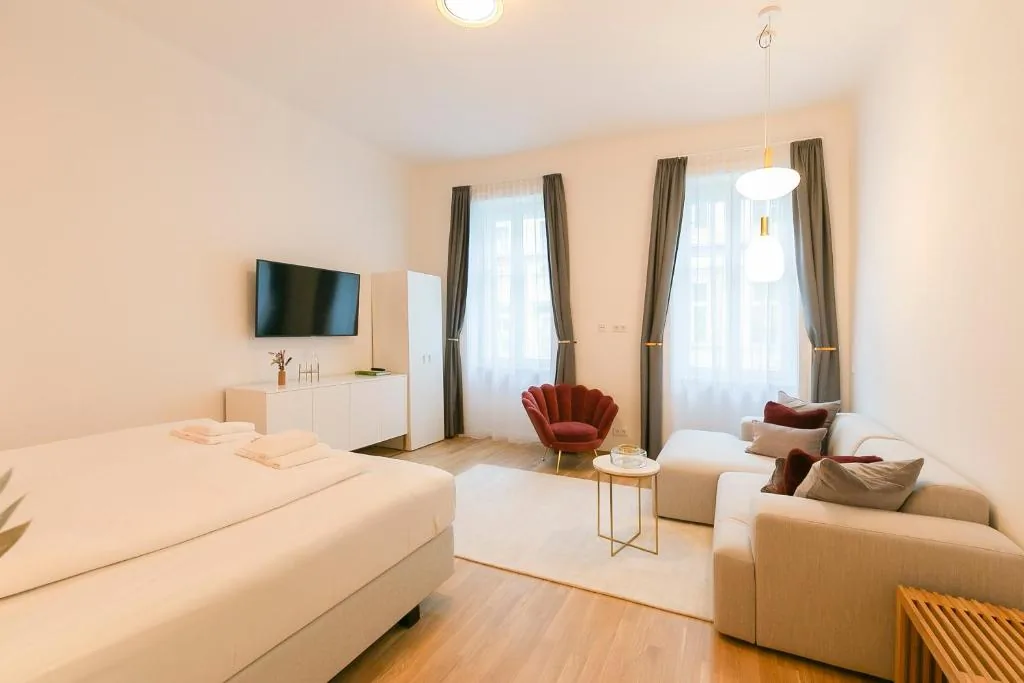
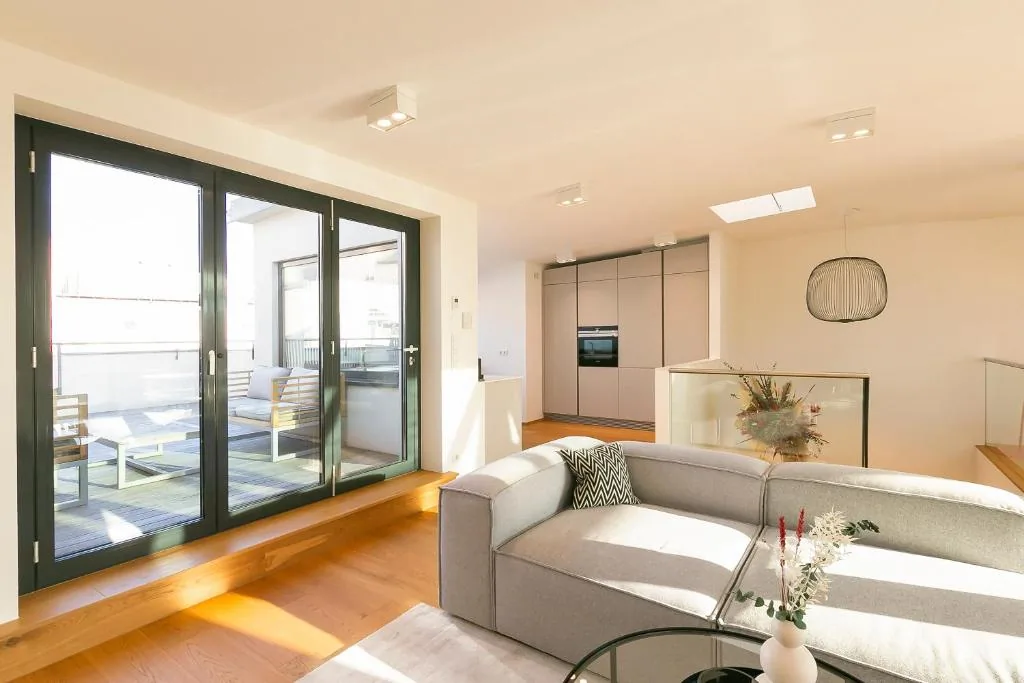
We run five apartments a minute from the Naschmarkt in Vienna's 6th district. The nightly rate steps down with length of stay: Wochenend+ from 7 nights at 15 percent off, Fortnight from 14 nights at 20 percent, and Resident from 28 nights at 25 percent.
On the Resident tier the Mini MINT and the Artisan start from €138.75 a night, so 28 nights comes to from €3,885, with no deposit and no agency fee. Every figure is a from-rate and seasonal demand pushes the actual nightly price higher.
| Apartment | Size | Sleeps | From |
|---|---|---|---|
| Mini MINT | 35 m² | 2 | €185 |
| Double MINT | 55 m² | 3 | €205 |
| Double MINT with Balcony | 55 m² | 3 | €215 |
| MINT Artisan | 65 m² | 4 | €185 |
| Penthouse | 85 m² | 4 | €375 |
Set that €3,885 against the €3,600 a conventional lease wants before you move in, except that the €3,885 buys you a furnished month with a working kitchen, bills included and registration handled, and none of it is locked up as a deposit.
Two things that get conflated constantly, so plainly: the Resident tier at 28 nights is our pricing decision and has nothing to do with the city tax. Vienna's Ortstaxe is 5 percent, in force since 1 July 2026 and rising to 8 percent on 1 July 2027, and it only falls away beyond three continuous months. Stay 30 nights and you get the full Resident discount and still pay Ortstaxe on every night.
We have no private parking and no 24 hour reception. We have self check-in, a full kitchen in every apartment and a named contact.
Monthly terms are set out in furnished apartment monthly rates, the move itself in the relocation guide. If you are visiting rather than moving, the visitor budget guide answers the daily-spend question instead. You can check availability here.
Frequently asked questions
How much does it cost to live in Vienna per month? About €1,330 a month for one person before rent, covering groceries at €280, utilities at €180, mobile and internet at €40, dining and entertainment at €150, transit at roughly €39 and the ORF contribution at €15.30. Add rent on top, which for a one-bedroom runs roughly €860 outside the centre to €1,180 in it.
Is the €365 annual transit pass still available in Vienna? No. Since 1 January 2026 the Wiener Linien annual pass costs €467, or €461 digitally, after holding at €365 for more than 13 years. Fares will be indexed annually from 1 January 2027.
What is the average rent per square metre in Vienna? It depends which figure you mean. The EHL market report gives Vienna district rents of €11.90 to €17.50 per m² for Q1 2026, which is the closest thing to a market rate. The Richtwert of €6.74 per m² is a legal ceiling for regulated older stock, not an average. The frequently quoted €10.50 per m² is an Austria-wide figure, not a Vienna one.
Does Austria's 2026 rent cap apply when I sign a new lease? No. It caps the annual indexation of existing tenancies at 1 percent in 2026 and 2 percent in 2027, applied each 1 April. It does not limit what a landlord may charge a new tenant at the start of a tenancy.
How much deposit do I need for a Vienna apartment? Three gross monthly rents is standard. The Austrian Supreme Court has allowed up to six, and there is no statutory cap. On a €900 rent that is €2,700 held for the duration of the tenancy.
Do Vienna apartments come with a kitchen? Not necessarily. There is no legal obligation on an Austrian landlord to provide one, and it is common for tenants to bring or finance their own. Budget a four-figure sum in case.
Do I have to pay an estate agent commission to rent in Vienna? Usually not. Since July 2023 Austria applies the Bestellerprinzip, so whoever hired the agent pays, which for a rental is normally the landlord.
What is the Ortstaxe and do I have to pay it? It is Vienna's accommodation tax, charged on paid stays. It is 5 percent as of 1 July 2026 and rises to 8 percent on 1 July 2027. It falls away only beyond a continuous stay of more than three months, so most short and medium stays pay it.
Is Vienna expensive compared to other European capitals? Less than the indices imply if you rent in the regulated segment and use public transport, and about as much as they imply if you eat out frequently and shop international brands. Mercer's methodology prices an expatriate basket at international-quality vendors, which is not what most Viennese renters actually spend.