
The three easiest day trips from Vienna are Bratislava (about an hour away), the Wachau valley (roughly an hour to Melk or Krems), and Baden bei Wien (just over an hour on a tram from the city centre). Those are the safe wins. The more useful question is which trips are not worth a full day, because a couple of the famous ones will cost you eight hours of travel for five hours on the ground. The honest answer to both questions is the same: pick one base in Vienna, run each trip as a return journey, and never repack a suitcase.
What you'll find on this page
- The three easiest day trips, and the ones that are not worth a full day
- A matrix of eight destinations: travel time, how to get there, 2026 costs, and an honest verdict
- The Bratislava, Wachau and Baden easy wins, plus why Prague is a no as a day trip
- The truth about the Vienna to Budapest boat (it no longer runs)
- The base-camp math: what a week in one apartment actually costs
- How to book cheaply, and which trips work with kids
Why Vienna is the right base camp
Every destination in this guide has one thing in common: you can be back in your own bed in Vienna the same night. That is the whole idea behind the Basislager (base camp) method. Instead of dragging luggage from a Vienna hotel to a Prague hotel to a Budapest hotel, you keep one apartment for the entire trip and fan out from it, one day at a time. German-speaking travelers call this a Sternfahrt (a star-shaped journey: you leave from a single fixed point and return to it each evening).
Vienna is unusually well suited to it. Three of the easy wins sit within commuting distance: Bratislava is 56 minutes by train (a Seat61 rail guide credits the October 2025 electrification for the new sub-hour time), Baden is just over an hour, and the Wachau is roughly an hour away. The city's main station then puts Budapest, Salzburg and Prague on direct fast trains. If you are still deciding where in the city to stay, our guide on where to base yourself in Vienna for a long weekend covers the trade-offs by neighbourhood.
This article is only about trips outside the city. For the museums, palaces and markets inside Vienna itself, see our full guide to things to do inside Vienna; and if you are staying long enough to combine both, pair these day trips with a 3-day Vienna itinerary.
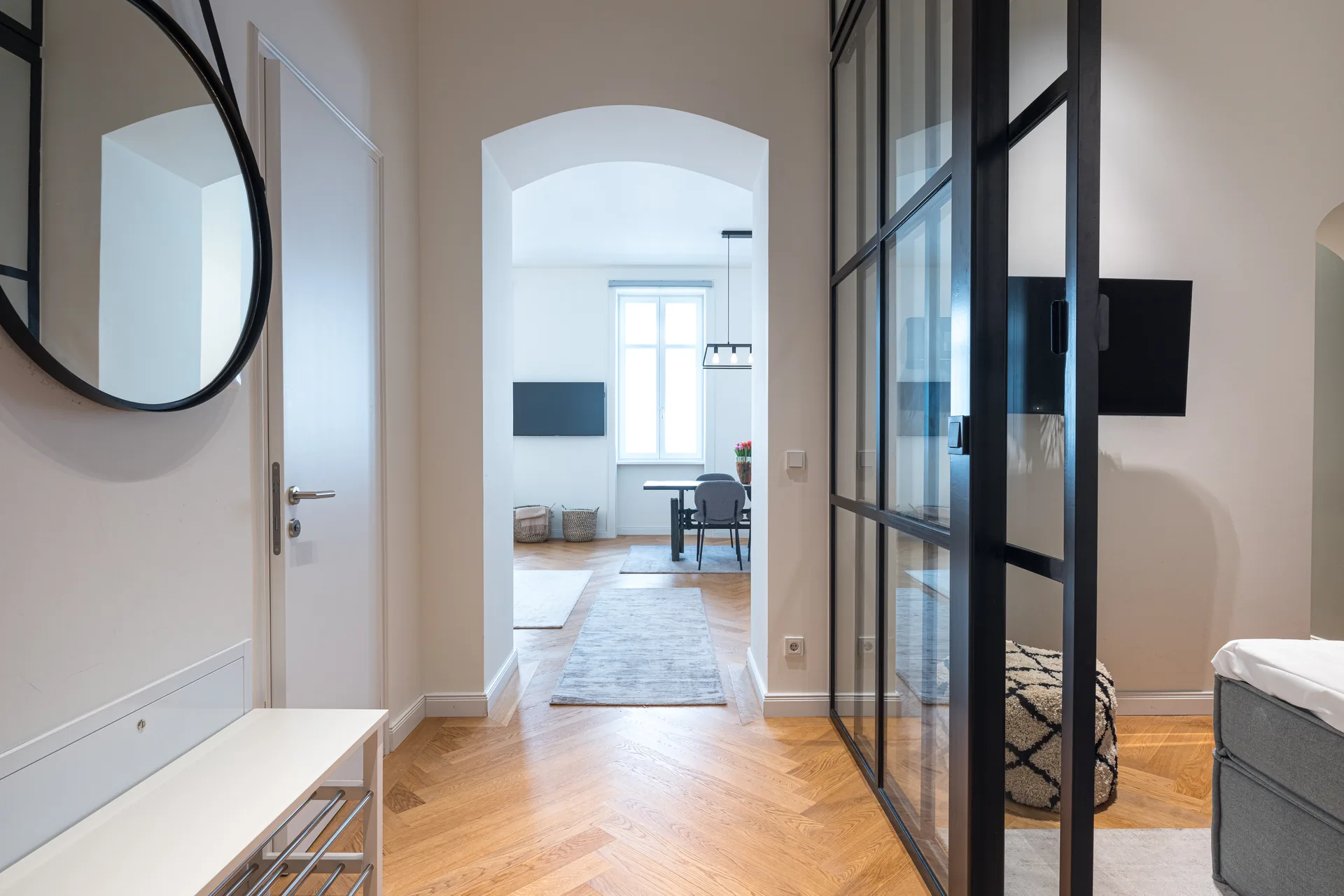
We run MINT as a small, host-managed set of apartments at the Naschmarkt (Vienna's open-air food market in the 6th district), which is the kind of base the method needs: a kitchen, a washing machine, and no reception desk or check-out clock standing between you and the morning train.
The day-trip matrix: time, cost, and the honest verdict
Here is the whole slate in one view. Every time and fare below is dated to 2026 and traced to the operator or a rail reference, not estimated. The verdict column is the point of this guide: not every popular search term is a good day trip.
| Destination | Time each way | How | Typical 2026 cost | Worth it as a day trip? | Best for |
|---|---|---|---|---|---|
| Bratislava | 56 min (train), 75 min (boat) | REX train, Twin City Liner boat, or coach | Train from €12.70 one-way; €19 round-trip Bratislava-Ticket | Yes, the easiest | A half-day contrast, a second capital |
| Wachau (Melk, Dürnstein) | About 1 hr to Melk or Krems | Train, then Danube boat | Boat €25 to €43 one-way; combo ticket €77 | Yes, the classic | Wine, river scenery, a slow day |
| Baden bei Wien | Just over 1 hr | Badner Bahn tram from Wien Oper | Badner Bahn tram fare | Yes, low-effort | An easy afternoon, a spa town |
| Klosterneuburg | Short S-Bahn ride | S-Bahn (S40 line) | Monastery €10 (plus S-Bahn fare) | Yes, half-day | History and wine, closest of all |
| Budapest | 2h37 | Railjet or EuroCity train (no boat) | Advance from €13 to €19.90 (2nd class) | Doable, but long | A long single day, or an overnight |
| Salzburg | 2h22 to 2h53 | ÖBB Railjet or Westbahn | Sparschiene from €19.90; Westbahn from €13.99 | Yes, if booked ahead | The Old Town on a booked-ahead fare |
| Hallstatt | 3.5 to 4.5 hr | Train, train, then ferry | Multi-leg rail plus ferry | Yes, if timed right | Alpine scenery in shoulder season |
| Prague | About 4 hr | Railjet or RegioJet train | Early-bird from ~€15; walk-up €60 to €80 | No, overnight instead | A two-day trip of its own |
The four rows below in detail, then the two honest "no or not quite" cases, then the math that makes the whole thing cheaper than hotel-hopping.
Bratislava: the easiest yes
Bratislava is the lowest-effort international day trip from Vienna, full stop. ÖBB's own Bratislava-Ticket page describes REX regional trains running up to twice an hour and reaching the city "in just one hour," and Seat61 times the fastest run at 56 minutes since the October 2025 electrification. A single fare starts at €12.70, and the round-trip Bratislava-Ticket is €19, with children under 15 at €6.40 each way. Our Vienna to Bratislava guide compares the train, the bus and the boat in detail.
The scenic alternative is the boat. The Vienna Tourist Board puts the Twin City Liner catamaran crossing at 75 minutes, leaving from the Vienna City ship station near Schwedenplatz up to three times a day in the warmer months, and notes that you need a passport or EU ID for the Slovak side. Fares are the one figure the operator does not publish plainly: according to Vienna Ticket Office, one-way tickets run roughly €34 to €39 depending on the day, so confirm the current price at booking.
Is it worth a whole day? Honestly, the old town is compact and does not need one. As the travel writers at BBQboy put it, "If you've spent more than 2 days in Vienna, then I think Bratislava is worth a visit, just because of the contrast and different vibe." Treat it as a half-day: train over in the morning, walk the old town and the castle hill, boat or train back. If your Vienna trip is only three days, it may not be worth giving one of them up.
The Wachau: the classic yes
If you do one Austrian day trip, do this one. The Wachau is the stretch of the Danube between Krems and Melk, and the Austrian National Tourist Office notes it has been a UNESCO World Heritage site since 2000: terraced vineyards, apricot orchards, and a river you can travel by boat.
The boat is the way to see it. DDSG Blue Danube, the main operator, runs sailings up to four times a day in each direction between Krems and Melk, stopping at Dürnstein, Weißenkirchen, Spitz and Emmersdorf, from late March to early November. One-way fares are €25 for the short Krems to Dürnstein leg, €34 as far as Spitz, and €43 for the full Krems to Melk cruise. The two anchor towns are worth the stops: Stift Melk, the Baroque abbey above the river, is open daily from 1 April to 31 October, 09:00 to 17:30, with adult admission at €16 self-guided (a guided tour adds €4). Downriver, a local Austria guide ties Dürnstein's castle ruins to the 12th-century imprisonment of Richard the Lionheart, and its blue-and-white Baroque church tower is the valley's most photographed landmark.
Lunch is a Heuriger (a wine tavern serving the grower's own wine alongside simple, hearty food), a format the Austrian National Tourist Office describes as the region's own. Weißenkirchen and Spitz, the smaller villages between Dürnstein and Melk, draw fewer day-trippers than Dürnstein itself if you want a quieter stop. If you would rather buy one ticket for the whole outing, ÖBB Rail Tours sells a Wachau-Ticket that bundles the round-trip train, the Melk to Krems boat and basic abbey entry for €77 an adult, or €49 for children aged 6 to under 15. This is the romantic pick of the whole guide, and the clearest yes.
Baden bei Wien and the Niederösterreich easy wins
Not every day trip needs a two-hour train. Some of the best sit inside Niederösterreich (Lower Austria), the province wrapped around Vienna, and take less effort than crossing the city.
Baden is the easiest of all. Wiener Lokalbahnen, which runs the Badner Bahn, times the tram from Wien Oper to Baden at just over an hour, leaving every 7.5 minutes on weekdays; it carried 14.7 million passengers in 2024. You board in the middle of Vienna and step out in a spa town with a rose garden and thermal baths, no station changes involved.
Klosterneuburg is the closest destination in this guide. Stift Klosterneuburg, the monastery on the edge of the city, charges €10 for basic entry (free for under-14s), includes four hours of free parking, and is open daily, 10:00 to 16:00 in winter and 09:00 to 18:00 in summer. One practical note that trips a lot of visitors up: reach it by S-Bahn on the S40 line, not the U4, which terminates at Heiligenstadt and does not run there.
For quieter, slower options, the Vienna Tourist Board also features Laxenburg's castle park and its garden landscaping. Kreuzenstein, a museum castle north of the Danube, is another wildcard, though it takes noticeably more effort to reach than Baden or Klosterneuburg, so treat it as a half-day for people who want a castle to themselves rather than an easy win.
Budapest: doable but long
Budapest is the borderline case, and the honest verdict is "yes, but plan a long day, or better, stay the night." Seat61 lists Railjet and EuroCity trains running hourly from Wien Hauptbahnhof to Budapest in 2 hours 37 minutes, with advance second-class fares from about €13 to €19.90 and RegioJet's low-cost class from €9. At 2h37 each way, a day trip is entirely feasible if you take an early train and a late one back, but you will only get one full day out of a city that rewards two. Our Vienna to Budapest guide weighs the day trip against a night in Budapest.
One thing to clear up, because searchers still ask for it: there is no boat. MAHART PassNave, the Hungarian Danube operator, no longer runs a scheduled Vienna to Budapest passenger service. Its own customer service put it plainly years ago, that it does "not operate the Budapest [to] Vienna regular service any more," and no regular Vienna route appears in its current timetable. The old hydrofoil is a memory; the train is the only realistic option now. If the two-city pull is strong, the base-camp answer is simple: run Budapest as one long day from Vienna, or book a single Budapest night and keep the rest of your trip in one apartment.
Salzburg: worth the half-day if you book ahead
Salzburg works as a day trip mainly for people who plan ahead. ÖBB's route page says trains run twice an hour with no changes, and Seat61 times the fastest Railjets between 2 hours 22 and 2 hours 53 minutes, with the private Westbahn service at 2 hours 28. The catch is the fare. Buy on the day and it is expensive; buy ahead and it is cheap. ÖBB's Sparschiene saver fares start at €19.90 second class, and Westbahn's advance fare from €13.99, both a fraction of the walk-up price. The Koralm Railway that opened in December 2025 is reshaping travel across southern Austria, but for Salzburg the Westbahn line is still the route.
The city itself is small enough to see on foot: the Old Town, the fortress and the Mozart connections fill a comfortable half-day. At two and a half hours each way it is a real commitment for a single day, so it earns a qualified yes, best done on a cheap advance ticket rather than a same-day fare.
Prague: the honest no
This is the one to be blunt about. Prague as a single-day round trip from Vienna is not worth it. Seat61 times the fastest Railjet at just over four hours, running every two hours with nine departures a day, while RegioJet runs four trains a day with a similar journey time. Do the arithmetic: four hours out and four hours back is roughly eight hours of travel for five or six rushed hours in a city that deserves at least two full days. Our Vienna to Prague by train guide has the trains, the fares and when to book.
The fares tell the same story of "plan this properly." Best Prague Guide lists early-bird tickets from around €15 to €20, standard advance fares of €30 to €50, and walk-up fares of €60 to €80 on the day. RegioJet's last-minute fares rise less steeply than the others, so it is usually the cheaper option if you are booking late. But the fare is not the problem, the time is. The honest recommendation: give Prague an overnight, or save it for its own trip. If you would rather keep basing in Vienna, the money you would have spent on a bad rushed day trip is better spent on two extra Vienna nights (more on that below).
Hallstatt: worth it, but timed right
Hallstatt is the hardest test of the "Lohnt sich der Tagesausflug?" question ("is the day trip worth it?"), because the answer is a yes with conditions attached. The scenery earns the journey. The journey is long, and the village is crowded.
Start with getting there. Hallstatt's official travel portal recommends a Railjet from Wien Hauptbahnhof to Attnang-Puchheim, a change onto the Salzkammergut regional railway, and then a ferry across the lake, because the station sits on the opposite shore from the village; the ferry crossing takes about 15 minutes. All in, that is 3.5 to 4.5 hours each way, so a day trip means an early start and a late return for a few hours in the village.
Then the crowds, which are not a traveler's grumble but a municipal issue. The Local Austria reports that Hallstatt has about 750 residents and sees up to 10,000 visitors on peak days, which is why local leaders have proposed capping arrivals at 5,000 to 5,500 a day. Coach traffic is already limited: The Local reported a ceiling of 54 buses a day, roughly half the pre-cap volume, and quoted the mayor, Alexander Scheutz, on the system: "This is already working very well." The practical takeaway from a Salzkammergut specialist, Mountain Tours, is to go in May or September for the best balance of weather and lighter crowds, and to arrive early or late rather than at midday. Shoulder season also lines up with Vienna's own quieter months; see our note on Vienna's best time to visit. So: yes, worth it, if you time it for a shoulder-season morning and accept the long day.
The base-camp math: what you actually save
Run four or five of these trips and one apartment starts to cost less than the hotel-hopping alternative, for a simple reason: MINT's nightly rate drops the longer you stay. The ladder is 15% off at seven nights (we call it Wochenend+), 20% at fourteen nights, and 25% at twenty-eight (the Resident tier). Hotel-hopping across three cities means three check-ins, three check-outs, and no laundry; one apartment removes all of it.
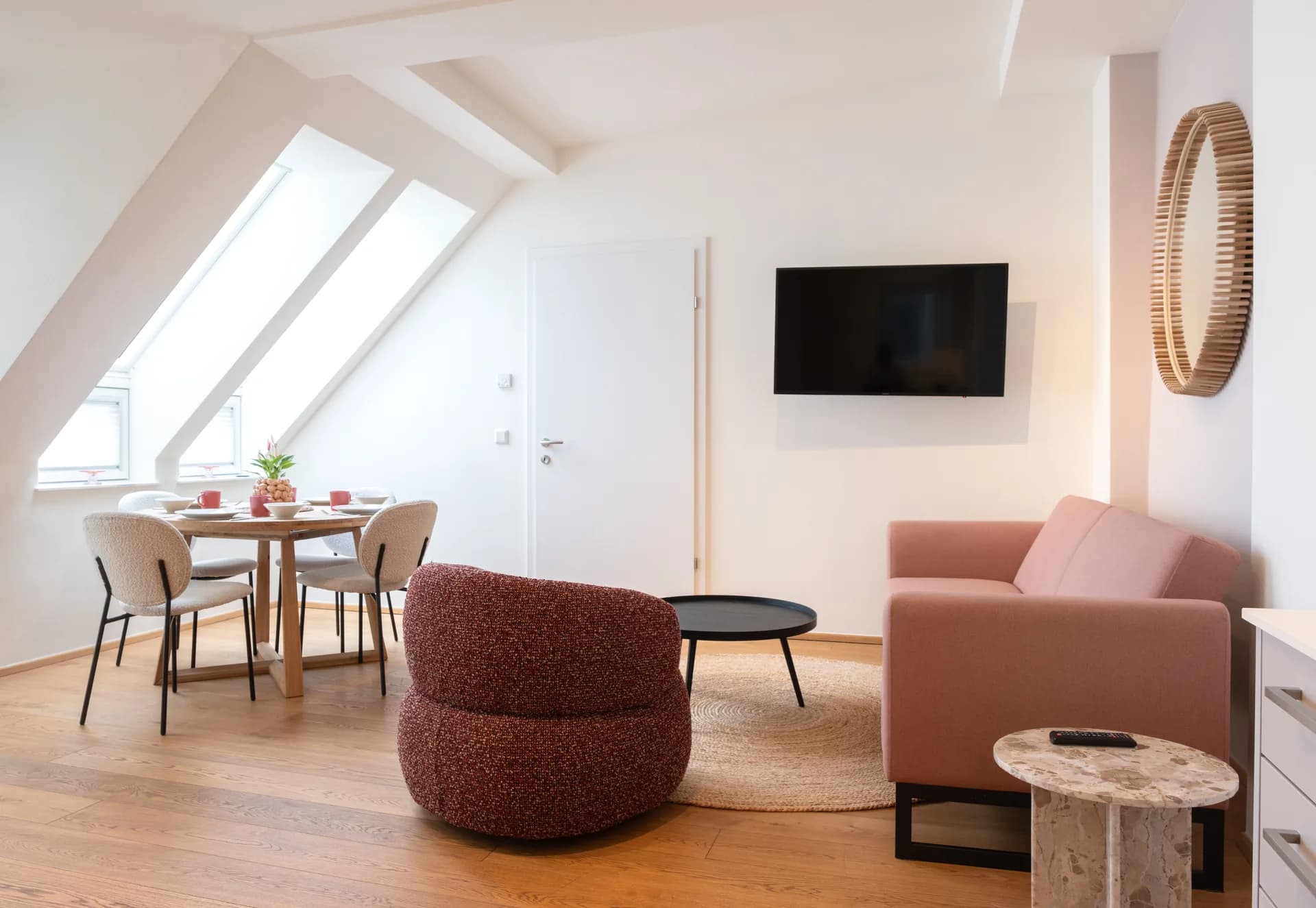
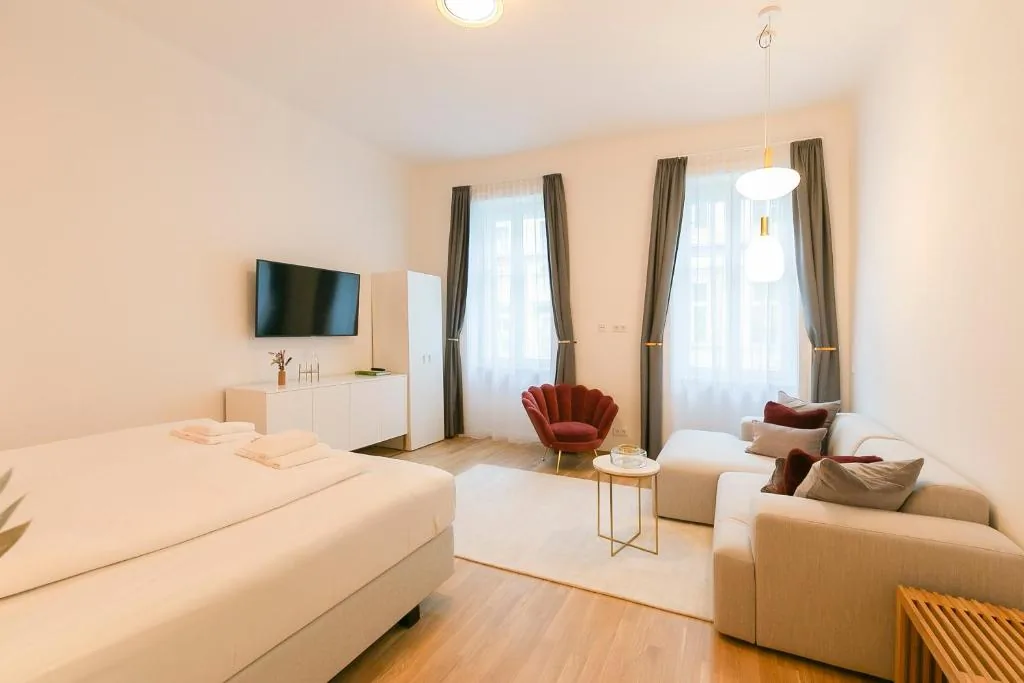
Looking for one base to run every day trip from? Double MINT is a 55 m² apartment for up to three, one minute from the Naschmarkt. Seven nights at its €205 rate come to €1,435 before the discount, and about €1,220 after the 15% saving. For a solo traveler or a value-minded pair, Mini MINT is a 35 m² studio for up to two at €185 a night, about €1,101 for the same seven nights. Both figures are before Vienna's Ortstaxe (the local accommodation tax), which is 5% as of 1 July 2026.
| Apartment | From, per night | 7 nights, before discount | 7+ nights, net (Wochenend+, 15% off) | Sleeps | Size |
|---|---|---|---|---|---|
| Double MINT | €205 | €1,435 | about €1,220 | Up to 3 | 55 m² |
| Mini MINT | €185 | €1,295 | about €1,101 | Up to 2 | 35 m² |
The apartment also does two things a hotel room cannot. The kitchen means a proper breakfast before an early train, instead of waiting for a buffet to open at 07:00. The in-apartment washing machine means you pack for four days, not fourteen, and run a mid-week wash between trips.
On a check-out day you can still fit one last trip in. ÖBB's luggage storage at Wien Hauptbahnhof runs €2 to €4 for three hours depending on locker size (a little more for 24 hours), so you drop the bags, take the train, and collect them before the evening departure home.
And the departure itself is short. MINT's nearest station, Kettenbrückengasse on the U4, is one stop from Karlsplatz, and from Karlsplatz the U1 reaches Wien Hauptbahnhof in a few minutes. That station is where the fast trains to Bratislava, Budapest, Salzburg and Prague leave from, so the front-door-to-platform chain is one U-Bahn change, start to finish.
Day trips with kids
Most of the easy wins work with children, and the ticketing helps. On ÖBB's domestic saver fares, up to four children under 15 travel free with each paying adult, according to ÖBB's Sparschiene terms. Baden's tram ride, the Klosterneuburg monastery (free entry for under-14s, with a park and four hours of free parking) and the Wachau boat are all short, low-stress outings that suit younger travelers better than a four-hour train.
For the in-city side of a family trip, and for why an apartment with a kitchen and separate sleeping areas beats a hotel room with children, see our family apartment guide, which covers Schönbrunn Zoo, the Wurstelprater and the Donauinsel water playground with current 2026 prices.
One seasonal note: from late November, the Christmas markets around Vienna and in towns like Melk, Bratislava and Salzburg turn several of these routes into a different kind of day out, worth planning on their own calendar.
When your dates are set, you can check availability and book direct with us.
Frequently asked questions
How do I get from Vienna to Bratislava? Three ways. The REX regional train from Wien Hauptbahnhof takes about 56 minutes and runs up to twice an hour, per Seat61 and ÖBB. The Twin City Liner catamaran takes 75 minutes from the Vienna City dock near Schwedenplatz, up to three times a day in the warmer months, per the Vienna Tourist Board. A RegioJet or Slovak Lines coach is the third option. Bring a passport or EU ID for the border.
Is a day trip from Vienna to Bratislava worth it? Generally yes, with one caveat: the old town is compact and does not need a full day. As the writers at BBQboy put it, "If you've spent more than 2 days in Vienna, then I think Bratislava is worth a visit, just because of the contrast and different vibe." If you only have three days in Vienna, it may not be worth giving one up.
Is there a boat from Vienna to Budapest? No. MAHART PassNave, the Hungarian Danube operator, stopped running the scheduled Vienna to Budapest passenger service and confirmed to a customer that it does "not operate the Budapest [to] Vienna regular service any more." No regular Vienna route appears in its current timetable, so the train is the only realistic option.
How much is a train from Vienna to Budapest? Advance second-class fares start at about €13 to €19.90 on ÖBB and MÁV, and RegioJet's low-cost class starts at €9, according to Seat61. Fully flexible tickets are around €52.70. Book ahead for the low fares.
Is Prague worth a day trip from Vienna? No, not as a single-day round trip. The fastest train is just over four hours each way, per Seat61, so a day trip means roughly eight hours of travel for five or six hours in the city. Prague is worth an overnight or a dedicated two-day trip; if you want to keep basing in Vienna, spend the extra nights there instead.
What is the cheapest way to reach these day-trip cities? For the longer routes, ÖBB's Sparschiene saver fares are cheapest and start at €9.90 domestically, per ÖBB. Skip the annual Klimaticket: as CheckEverything explains, it is a yearly pass with no standard tourist day version, so single tickets or Sparschiene fares are the better call for a one or two-week visit.
How far ahead should I book Sparschiene tickets? Up to 180 days (six months) before departure, per ÖBB, and the cheapest fares tend to go first. They are refundable for free up to 15 days before travel, then at a 50% fee closer in. Each ticket is valid for one specific train only.
How long does the Danube boat through the Wachau take, and what does it cost? DDSG Blue Danube runs boats up to four times a day each direction between Krems and Melk, from late March to early November. One-way fares are €25 (Krems to Dürnstein), €34 (to Spitz) and €43 (the full Krems to Melk cruise). A combined Wachau-Ticket bundling the train, boat and abbey entry is €77 for an adult.
How do I get from Vienna to Hallstatt, and is it worth it? The route is a Railjet to Attnang-Puchheim, a change onto the Salzkammergut railway, and a 15-minute ferry across the lake, per Hallstatt's travel portal, for a total of 3.5 to 4.5 hours each way. It is worth it for the scenery, but the village is overcrowded in summer, so go in May or September and take an early train. The Local Austria reports up to 10,000 visitors a day at peak against 750 residents.
Do I need a car for day trips around Vienna? No. Every easy win in this guide (Bratislava, the Wachau, Baden, Klosterneuburg and Salzburg) is reachable by train, tram, boat or S-Bahn, which is exactly why the base-camp method works so well from a central apartment. A car helps only for a few rural, car-dependent spots outside this guide's scope.
Sources
- Vienna to Bratislava by train, Seat61, 2026
- Bratislava-Ticket, ÖBB, 2026
- Twin City Liner, WienTourismus (Vienna Tourist Board), 2026
- Boat Trip With The Twin City Liner, Vienna Ticket Office, 2026
- Is Bratislava worth a day trip from Vienna?, BBQboy
- Vienna to Budapest by train, Seat61, 2026
- MAHART PassNave, Hungarian Danube passenger operator, 2026
- Prague to Vienna by train, Seat61, 2026
- Prague to Vienna Train 2026, Best Prague Guide
- Mit dem Zug von Wien nach Salzburg, ÖBB, 2026
- Vienna to Salzburg by train, Seat61, 2026
- Austria by Rail, getting to Hallstatt, Hallstatt.net, 2026
- Hallstatt overtourism, The Local Austria, 2025
- Will Austria's Hallstatt restrict tourism this season?, The Local Austria, 2024
- Best Time to Visit Hallstatt, Mountain Tours
- Sightseeing Cruises Wachau, DDSG Blue Danube, 2026
- Wachau-Ticket, ÖBB Rail Tours, 2026
- The Wachau: World Heritage region on the Danube, Austrian National Tourist Office
- Opening hours, prices, guided tours, Stift Melk, 2026
- How to Visit Dürnstein, Austrian Vegan Derlust
- Wine taverns and wine cellars in the Wachau, Austrian National Tourist Office
- Badner Bahn, Wiener Lokalbahnen, 2026
- Admission to Klosterneuburg Monastery, Stift Klosterneuburg, 2026
- Excursions around Vienna, WienTourismus (Vienna Tourist Board)
- ÖBB Sparschiene, ÖBB, 2026
- Klimaticket Austria 2026, CheckEverything.at
- Luggage storage, ÖBB, 2026
Last updated: July 2026. Christian, Host & Founder, MINT @Naschmarkt.