
Vienna Christmas markets 2026 open on 6 November and run to 23 or 26 December, with the Belvedere market staying until 31 December and Schönbrunn and the Prater's Winter Market stretching to 6 January 2027. Every major market has now published its 2026 dates, which was not true earlier this year, and one of them has changed shape: the Belvedere market no longer stands directly in front of the palace, and a smaller replacement is announced for 20 November to 31 December in front of the Upper Belvedere. For a first visit, three markets carry the weight: Rathausplatz (the official Christkindlmarkt, Vienna's flagship Christmas market) for the spectacle, Spittelberg for atmosphere, and Karlsplatz for craft. The efficient way to see them is to stay once, near the 6th district by the Naschmarkt (Vienna's open-air food market), and walk to the best three.
What you'll find on this page
We are the host team at MINT Vienna, a small group of serviced apartments on the Naschmarkt, and we wrote this the way we would brief a guest arriving for Advent.
- The full 2026 date table: every market's dates and opening hours, plus the Belvedere market's smaller new format and two Advent markets most guides miss
- A walkable-base strategy: reaching the best markets on foot from one address near the Naschmarkt
- Honest verdicts: which markets deserve an evening, and which are mostly a tourist funnel
- November versus December: the real trade-off in crowds, price, and atmosphere
- What a visit actually costs: Punsch, mug deposits, food, transit, and the city tax
- Day trips, a myth worth correcting, and answers to the questions guests ask most
Vienna Christmas Markets 2026: All Dates and Opening Hours
The season opens earlier than most people expect. Schönbrunn and Stephansplatz both start on 6 November, a full week before the Rathausplatz flagship, and Schönbrunn and the Prater's Winter Market run past Christmas to 6 January 2027. Most of the rest close on 23 December, which catches out visitors who assume a market will still be standing between Christmas and New Year. If you are travelling on 27 December, only three markets are still standing: Schönbrunn, the Prater Winter Market and the new Belvedere market, which closes on 31 December. Everything else has been dismantled.
We checked each market against its own operator's site rather than a listings page, and where the two disagree we say so. Since our August check most of the open questions have closed: the Altwiener Christkindlmarkt at the Freyung now states its 2026 dates plainly, without the "in Vorbereitung" (in preparation) label it carried in August, and the Stephansplatz operator now publishes its own opening hours. Three caveats remain. Art Advent at Karlsplatz has no single operator sentence naming the whole season, so its dates rest on the tourist board and the market's own stall-rotation schedule agreeing. The City of Vienna's page for Hirschstetten, whose flower gardens the city runs, now gives 22 December as the last day while the tourist board still says 20 December, and nobody has published its 2026 hours. And the Türkenschanzpark operator now says it opens on 13 November, a day earlier than the tourist board's listing.
Four of the markets share a single operator, which is worth knowing because their dates and hours tend to move together: Stephansplatz, Maria-Theresien-Platz, Schwarzenbergplatz and the Campus market all publish through the same portal. The Rathausplatz Christkindlmarkt and the Prater's Winter Market publish on their own. Am Hof splits its closing time: the craft stalls close at 21:00, and the food and drink stalls stay open until 22:00 every day.
The Belvedere market has changed shape rather than disappeared. In June 2026 the Burghauptmannschaft Österreich, the federal authority responsible for the palace grounds, said in an APA-OTS release that the Christmas market "künftig nicht mehr unmittelbar vor dem Schloss Belvedere stattfinden wird" (will no longer take place directly in front of Belvedere Palace) and would move to a new area near the Teichhof. Since then a replacement has been announced: the K&K Weihnachtsmarkt Schloss Belvedere, organised by Event4You GmbH, with at most 35 huts on the paved areas in front of the Upper Belvedere, from 20 November to 31 December 2026. The tourist board's German market listing carries the same dates; its English listing does not mention Belvedere at all. One piece is still missing: the authority said it would announce the signed lease, and as of 18 September 2026 it had not. Treat the dates as the organiser's, and expect a compact market rather than the one that used to fill the forecourt.
Ordered by opening date, so you can read it as a calendar.
| Market | District | 2026 dates | Daily hours | How firm |
|---|---|---|---|---|
| Schönbrunn Palace | 1130 | 6 Nov 2026 to 6 Jan 2027 | 10:00 to 21:00; 24 Dec to 16:00; 25 Dec to 6 Jan 10:00 to 19:00 | Operator-confirmed |
| Stephansplatz | 1010 | 6 Nov to 26 Dec 2026 | 11:00 to 21:00; 24 Dec to 16:00; 25 and 26 Dec to 19:00 | Operator-confirmed |
| Hirschstetten (Blumengärten) | 1220 | 12 Nov to 22 Dec 2026 | Not yet published | City page says 22 Dec, tourist board 20 Dec |
| Rathausplatz (Christkindlmarkt) | 1010 | 13 Nov to 26 Dec 2026 | 10:00 to 22:00; 24 Dec to 18:30 | Operator-confirmed |
| Spittelberg (Adventmarkt) | 1070 | 13 Nov to 23 Dec 2026 | Mon to Fri 14:00 to 21:30; weekends 11:00 to 21:30 | Operator-confirmed |
| Am Hof | 1010 | 13 Nov to 23 Dec 2026 | Mon to Thu 11:00 to 21:00; Fri to Sun 10:00 to 21:00; food stalls to 22:00 | Operator-confirmed |
| Karlsplatz (Art Advent) | 1040 | 13 Nov to 23 Dec 2026 | 12:00 to 20:00; food stalls to 21:00 | Tourist board and stall schedule agree |
| Schwarzenbergplatz | 1030 | 13 Nov to 26 Dec 2026 | Mon to Fri 11:00 to 21:00; weekends 10:00 to 21:00; 24 Dec to 16:00; 25 and 26 Dec to 19:00 | Operator-confirmed |
| Campus Altes AKH | 1090 | 13 Nov to 23 Dec 2026 | Mon to Thu 14:00 to 22:00; Fri 14:00 to 23:00; Sat 11:00 to 23:00; Sun 11:00 to 21:00; 23 Dec 14:00 to 20:00 | Operator-confirmed |
| Türkenschanzpark | 1180 | 13 Nov to 23 Dec 2026 | Food stalls Mon to Fri 15:00 to 22:00, weekends 12:00 to 22:00; craft stalls close an hour earlier | Operator-confirmed; tourist board says 14 Nov |
| Freyung (Altwiener Christkindlmarkt) | 1010 | 14 Nov to 23 Dec 2026 | 10:00 to 21:00 | Operator-confirmed |
| Maria-Theresien-Platz | 1010 | 20 Nov to 26 Dec 2026 | Mon to Fri 11:00 to 21:00; weekends 10:00 to 21:00 | Operator-confirmed, 20th anniversary |
| Riesenradplatz (Winter Market, Prater) | 1020 | 20 Nov 2026 to 6 Jan 2027 | Mon to Fri 12:00 to 22:00; weekends 11:00 to 22:00; 24 Dec 11:00 to 17:00; 31 Dec 12:00 to 02:00 | Operator-confirmed |
| Belvedere (K&K Weihnachtsmarkt) | 1030 | 20 Nov to 31 Dec 2026 | Mon to Fri 11:00 to 21:00; weekends and holidays 10:00 to 21:00; 24 and 31 Dec 11:00 to 17:00 | Organiser and tourist board; lease not yet announced |
| Böhmischer Prater (Winterzauber) | 1100 | 28 Nov to 20 Dec 2026 | Not yet published | Operator dates |
| Schlosspark Hetzendorf (Mittelalter-Adventmarkt) | 1120 | 4 to 8 Dec 2026 | Opens 4 Dec 14:00, ends 8 Dec 19:00 | Organiser dates |
The 2025-season roster and the district-by-district locations come from the Vienna Tourist Board's market listing, which is the cleanest single overview of where each market sits. For scale, the City of Vienna's official 2025 season press release counted 14 markets citywide with roughly 911 stalls between them; Rathausplatz alone had 96 stalls and Schönbrunn 99. "Wien ist in allen europäischen Rankings höchst prominent als eine der schönsten Städte in der Weihnachtszeit vertreten," the city's market director Andreas Kutheil said in that release, which translates as: Vienna ranks prominently in every European ranking as one of the most beautiful cities at Christmastime.
Maria-Theresien-Platz is the season's comeback story, and it is worth understanding because it shows how late these decisions land. The market was cancelled outright in 2025, went to tender in February 2026, and was only confirmed as returning on 4 June 2026, per an APA-OTS press release, under its established operator MAGMAG Events GmbH. It now runs 20 November to 26 December 2026 for its 20th anniversary. Belvedere followed the same pattern this year: written off in the spring, then resolved in late summer with a smaller replacement market. It is a reminder to check again in October before you commit an evening to any market.
Key fact: Sixteen Vienna Christmas and Advent markets have published 2026 dates. The season runs 6 November 2026 to 6 January 2027 end to end, but the field thins fast. The Hetzendorf medieval market lasts five days (4 to 8 December), the Böhmischer Prater and Hirschstetten close before Christmas, and six markets close on 23 December. Four then run to 26 December (Rathausplatz, Stephansplatz, Schwarzenbergplatz and Maria-Theresien-Platz), Belvedere runs to 31 December, and only Schönbrunn and the Prater Winter Market stay open to 6 January.
Where to Stay for Walkable Access to Every Market
The best decision you make about Vienna's Christmas markets is where you sleep. Base yourself once, in or near the 6th district around the Naschmarkt, and most of the markets that matter are a walk away rather than a transit puzzle. This is the answer to the most common German-language planning question we see, "weihnachtsmärkte wien zu fuß vom naschmarkt" (Vienna Christmas markets on foot from the Naschmarkt), and it is the reason our own guests rarely bother with a car.
From a Naschmarkt base, the walking picture looks like this. The Naschmarkt sits about 7 minutes on foot from Karlsplatz, which is the interchange (U1, U2, U4) that also hosts the Art Advent market in its own Resselpark. Our apartments themselves are 1 minute from the Naschmarkt and about 3 minutes from the Karlsplatz U-Bahn entrance.
| Market | On foot from a Naschmarkt base | Route |
|---|---|---|
| Karlsplatz (Art Advent) | About 3 to 7 min | Straight along to Resselpark |
| Spittelberg | About 15 min | Via the MuseumsQuartier (10 min), then 3 to 5 min more |
| Stephansplatz | About 15 min | Up through the Innere Stadt (the old-town first district) |
| Rathausplatz | One short U-Bahn hop | U4 to Karlsplatz, change to U2 for Rathaus |
| Schönbrunn | 7 to 8 min on the U4 (train time) | Direct from Kettenbrückengasse, no change |
So a Naschmarkt base puts Karlsplatz, Spittelberg and Stephansplatz within a walk, and reaches Rathausplatz and Schönbrunn without changing more than one line. Am Hof adds a few minutes to the Stephansplatz walk, and Maria-Theresien-Platz sits on the Spittelberg route, right at the MuseumsQuartier. For the broader neighbourhood logic of a Vienna base, see our guide on where to stay for a Vienna weekend near the Naschmarkt; this section stays scoped to the market-specific distances. If you are still choosing between the 1st, 6th and 7th districts, our guide to where to stay for Vienna's Christmas markets compares them, with walking times to eleven markets and what 24 to 26 December means for your base.
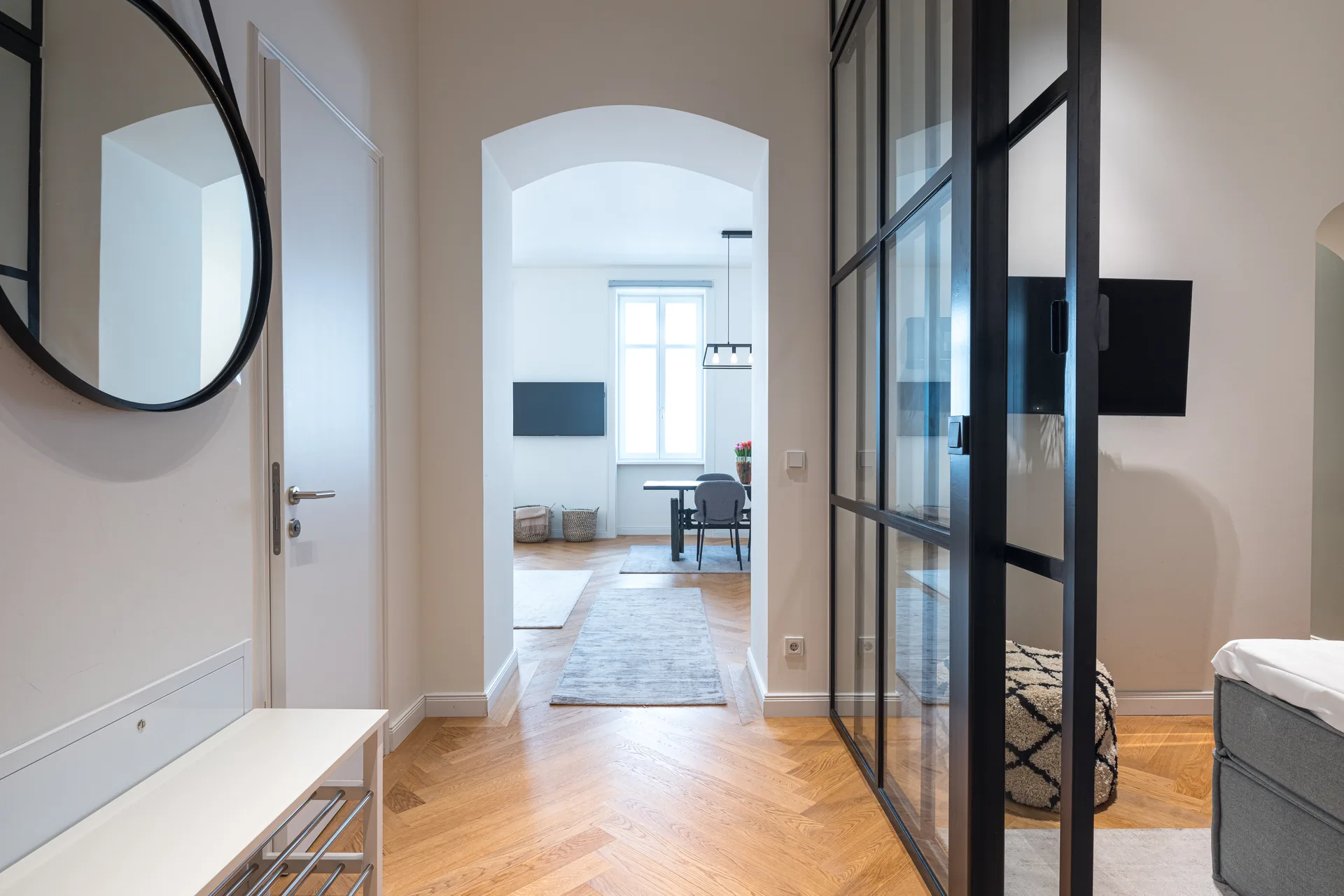
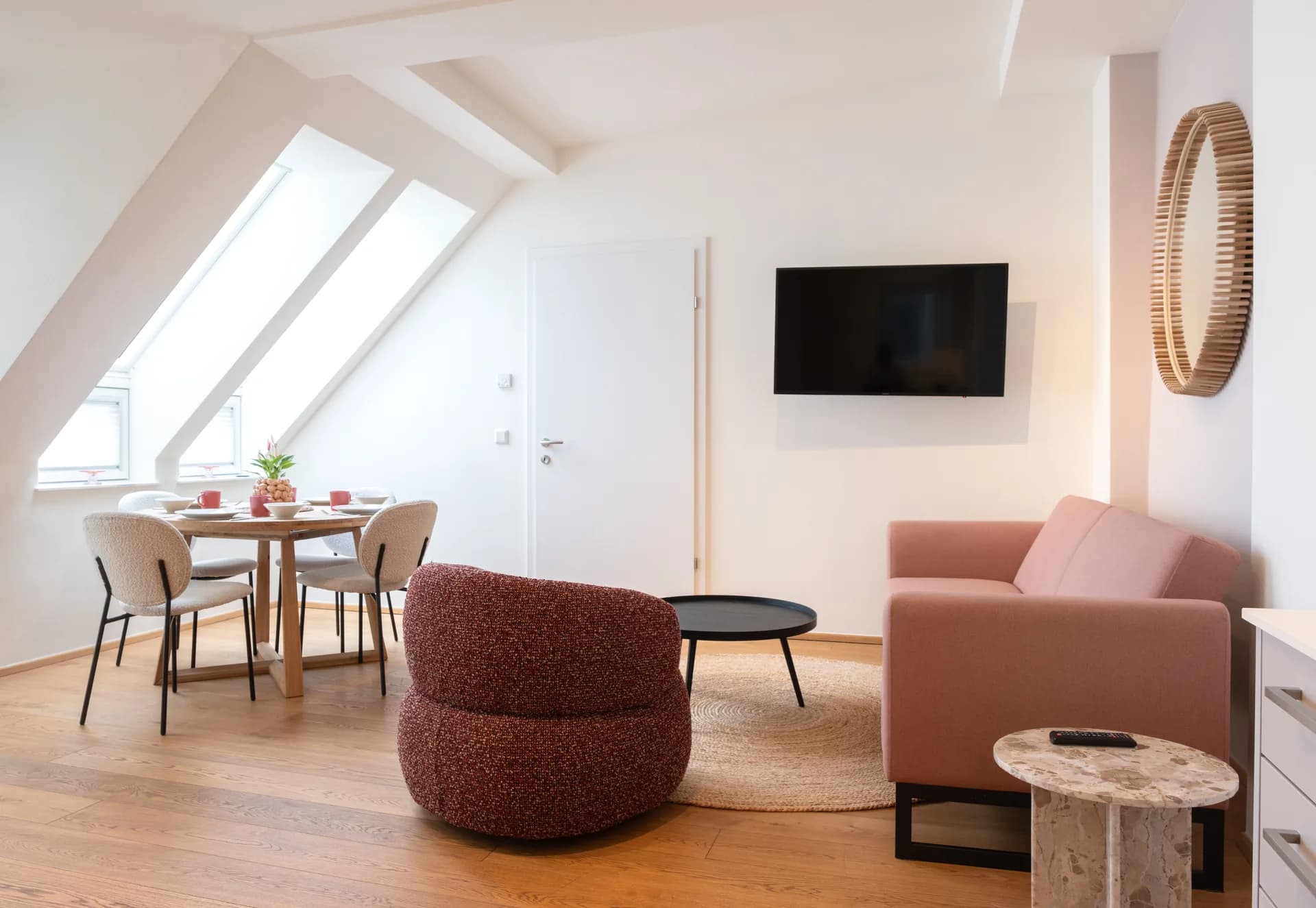
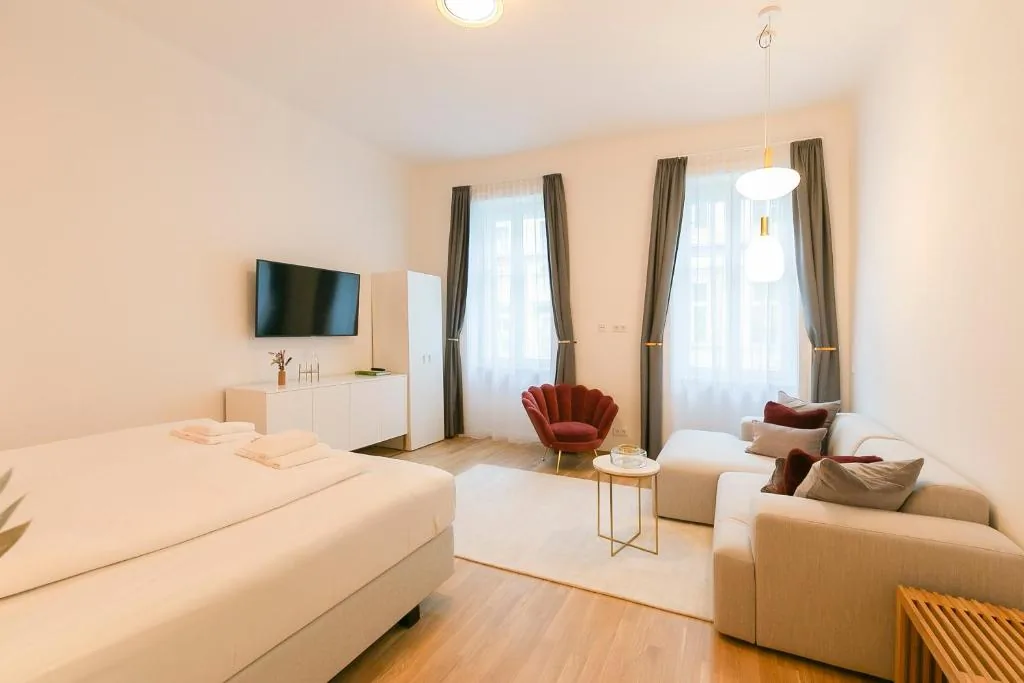
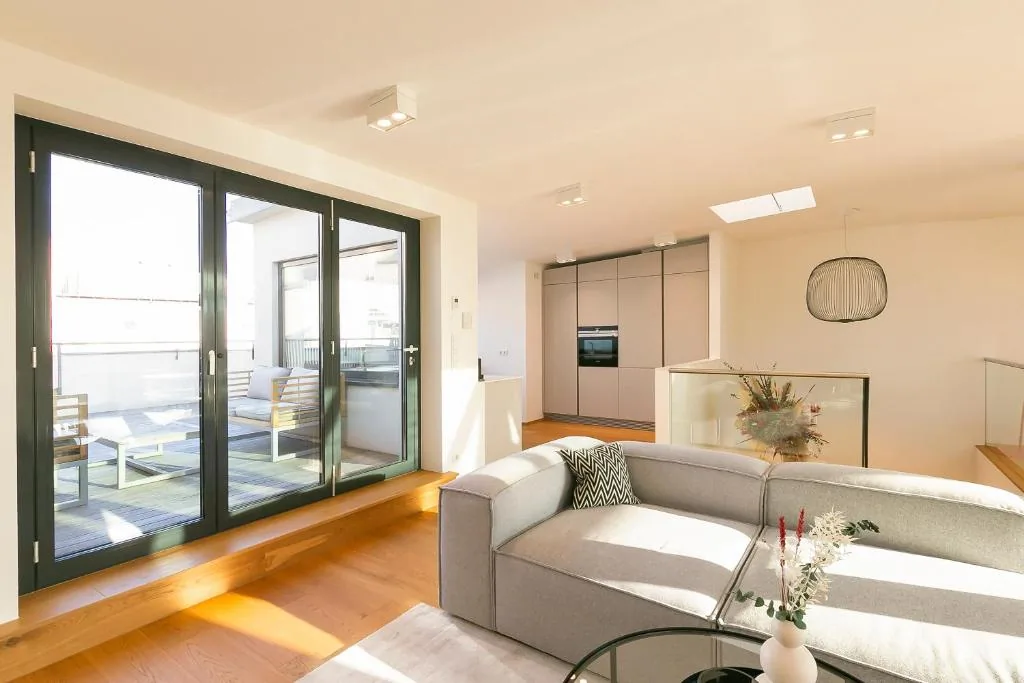
That geography is why we present all five of our apartments as options rather than pushing one. They share the same address and the same walk to the markets, so the real choice is about size, budget, and who you are travelling with. Every apartment has a fully equipped kitchen (useful when a two-year-old will not eat another Kartoffelpuffer), high-speed internet, a washing machine, a building elevator, and a two-night minimum stay.
| Apartment | Best for | Walking distance to key markets | Guests | From €/night |
|---|---|---|---|---|
| Mini MINT | Solo travellers and couples on a budget (35 m²) | Karlsplatz 3 min, Spittelberg 15 min | 2 | €185 |
| Double MINT | Couples and small groups (55 m²) | Karlsplatz 3 min, Spittelberg 15 min | 3 | €205 |
| Double MINT with Balcony | Those who want fresh-air coffee before an evening walk (55 m²) | Karlsplatz 3 min, Spittelberg 15 min | 3 | €215 |
| Penthouse Maisonette | Families and multi-generational trips (85 m², two bedrooms, roof terrace) | Karlsplatz 3 min, Spittelberg 15 min | 4 | €375 |
| MINT Artisan | Design-minded couples (65 m², terracotta and gallery interior) | Karlsplatz 3 min, Spittelberg 15 min | 4 | €185 |
For a family spending three or four nights in the cold, the two-bedroom Penthouse Maisonette earns its rate: separate sleeping zones, a roof terrace, and room to warm up and dry gloves between market runs. A couple who mostly wants somewhere quiet to sleep does fine in Mini MINT at less than half the price. Both are the same 1-minute walk to the Naschmarkt.
Local tip: Do not build your trip around driving. Parking near the markets is restrictive and expensive, and every market on the list above is faster to reach on foot or by U-Bahn. Save the car budget for Punsch.
Honest Picks: Which Markets Actually Deserve an Evening
Most guides recommend all eight markets equally. That is not honest, and it wastes your evenings. Here is where locals and long-tenure residents actually land.
Rathausplatz is the one everyone photographs, and it is worth seeing once: the illuminated City Hall, the tree, the ice rink, the sheer scale of 96 stalls. But it is also the most crowded and the most commercial, and the sharpest criticism comes from the Viennese themselves. The Vienna outlet Pressefeuer reported in December 2025 on a resident backlash to the market's 2022 redesign, which brought an oversized carousel and fewer traditional stalls. A "Rettet den Christkindlmarkt" (Save the Christmas Market) initiative has repeatedly criticised the city's unwillingness to discuss the changes, and one vendor family that had traded at the market for nearly 50 years lost its placement. Pressefeuer also reported a survey finding that 60% of Viennese see the market as overly commercialised; the survey's own source is not traceable, so treat that figure as reported colour rather than hard data. As one Viennese writer, Theresa Komornyik, put it in 1000things Magazine in December 2023: "Es ist einfach von allem zu viel! Zu viel Auswahl, zu viele Menschen und zu viele Lichterketten." (It is simply too much of everything: too much choice, too many people, and too many strings of lights.) Our Rathausplatz Christmas market guide has the 2026 hours and the times of day to go.
Spittelberg is the counterweight, and the one most locals name first. It threads through four narrow alleyways in the 7th district, leans hard into handmade craft over mass-produced ornaments, and keeps a calmer, more human scale. In a readers' poll run by the Austrian gourmet magazine Falstaff, Spittelberg was named Vienna's most popular Christmas market for six years running, as the market's own announcement of the accolade puts it. If you have one evening and want the atmosphere people mean when they romanticise Vienna at Christmas, spend it here, and read our Spittelberg Christmas market guide first for the hours that make or break it.
Karlsplatz Art Advent is the pick for anyone who actually wants to buy something worth carrying home. Set in Resselpark in front of the Karlskirche, its stalls are curated around original, locally made craft rather than imported trinkets, with an organic-food and live-music bent. The Freyung's Altwiener Christkindlmarkt is the traditional, old-Vienna option, quieter and more classic in feel. Schönbrunn wins on setting, in the palace forecourt, and on staying power: it runs into January when everything else has closed.
For what to do with the daytime hours between market evenings, our Complete Vienna Activities & Visitor Guide covers the museums, coffee houses, and walks; this guide stays on the markets.
Bottom line: See Rathausplatz once, early in the evening, for the spectacle. Spend a proper evening at Spittelberg. Shop at Karlsplatz. If you have a fourth slot and a palace mood, add Schönbrunn.
November vs December: The Real Trade-Off
The markets open in mid-November and most close on 23 or 26 December, which gives you two very different experiences depending on when you come.
November, especially the first two weeks after opening and on weekdays, is calmer, cheaper to fly into, and easier to enjoy. You can actually reach a stall, the Punsch queue is short, and the light through the strings of bulbs still feels like a discovery rather than a scrum. The trade-off is that a handful of stalls are still finding their rhythm and the pre-Christmas electricity is milder.
December is the peak, and it feels like it. It is the most atmospheric time to visit and also the most crowded and expensive: Advent weekends fill the city's hotels and apartments exactly when everyone wants to come. Weekends and the evenings of the final week before Christmas are the densest. If December is your only option, the fix is timing within the day rather than the month: go on a weekday, and aim for late morning or the hour just before sundown, which is the crowd-avoidance advice a 30-year Vienna resident gives in VisitingVienna's tips.
For the wider seasonal question of when Vienna is at its best across the whole year, our Best Time to Visit Vienna: Month-by-Month guide covers the non-market context; here the answer is narrow. For fewer crowds and lower prices, come in November. For maximum atmosphere and the willingness to share it with everyone else, come in December and go on a weekday.
What a Christmas-Market Visit Actually Costs
Admission is free at every official Vienna Christmas market, confirmed consistently across every source we checked. What you actually spend is on drinks, food, the mug deposit, transit, and the city tax on your accommodation. None of it is hidden, but the mug deposit surprises first-timers.
Punsch (hot spiced punch, usually fruit-flavoured and often stronger than it tastes) and Glühwein (specifically mulled wine) are the core of the experience. According to a November 2025 survey by the Austrian outlet oe24, a cup ran from about €3.50 for alcohol-free punch at Rathausplatz to €5.80 at Stephansplatz, up to specialty blends near €7.50 at the University Campus market. Those are 2025 figures, the most recent full survey published; the 2026 season prices are not out yet, so treat them as a floor rather than a quote. The same report noted Punsch prices have roughly doubled since 2020. On top of the drink price sits the Häferlpfand, the deposit on the ceramic souvenir mug (Häferl).
| Item | Typical 2026 cost | Notes |
|---|---|---|
| Admission | Free | No official Vienna market charges entry |
| Cup of Punsch or Glühwein | About €3.50 to €7.50 | Varies by market; oe24, November 2025 |
| Mug deposit (Häferlpfand) | €3 to €5, refundable | Spittelberg €3, Karlsplatz €4, most others €5 |
| Hot food plate | About €5 to €9 | Käsespätzle, Kartoffelpuffer, Kaiserschmarrn |
| City tax (Ortstaxe) on your stay | 5% of the net room rate | In force since 1 July 2026, rising to 8% in July 2027 |
The deposit is refundable: return the mug at a drinks stall and you get your €3 to €5 back. Per a 2024 price comparison by Vienna Online, Spittelberg charged the lowest deposit at €3, Karlsplatz €4, and most other markets €5. That deposit stacking on the drink price is why Theresa Komornyik wrote, of the same Rathausplatz market, "Mit einem Zehner kommst du also nicht sehr weit" (so a ten-euro note doesn't get you very far).
One cost applies to the room, not the market. Per the City of Vienna, the Ortstaxe (city accommodation tax) rose to 5% of the net room rate on 1 July 2026 and is at 5% now, rising again to 8% on 1 July 2027. It applies to every night you book anywhere in Vienna, ours included, and we would rather you see it here than be surprised by it at checkout. Booking direct with us keeps everything between the two of us, with no agency layer on top of that tax.
Watch out: Your first cup of Punsch is never just the menu price. A €5.50 Punsch at Schönbrunn plus a €5 mug deposit is €10.50 out of pocket until you return the mug. Bring cash in small notes, because card acceptance at stalls is inconsistent.
Getting Between Markets: Walk, Tram, or U-Bahn
You will not need a car and, for a short Advent trip, you probably will not need to think hard about transit either. Walk to what you can (see the table above), and use the U-Bahn or a tram for Rathausplatz and Schönbrunn.
One change matters for 2026. Per Wiener Linien, the transit operator discontinued its 48-hour and 72-hour tickets on 1 January 2026, which were the old default for a long weekend. The menu now is simpler.
| Wiener Linien ticket (from 1 Jan 2026) | Price | Best for |
|---|---|---|
| Single | €3.20 (child €1.60) | A one-off ride |
| 24-hour | €10.20 | A single busy market day |
| 7-day | €28.90 | Three or more active days |
| 31-day | €75.00 | Month-long stays |
The break-even math is easy. Three separate 24-hour tickets cost €30.60, which is already more than the €28.90 seven-day pass, so for a stay of three or more active travel days the 7-day pass wins outright. For a compact two-day trip where you mostly walk, one or two single tickets or a single 24-hour ticket is enough. Buying through the Wiener Linien app is cheaper than paper, and the gap widens on the longer passes: about 5% on singles and the 24-hour ticket, but around 13% on the 7-day (€25.20 against €28.90) and the 31-day (€65.20 against €75.00). Note that these fares answer the transit intent directly; the parking question answers itself, since driving to the markets is the slowest and most expensive option.
A Quick History (and a Myth Worth Correcting)
Nearly every Christmas guide, and even some major travel outlets, will tell you Vienna's Christmas market "dates to 1298" and is "one of the oldest in the world." Vienna's own official city-history record disagrees, and the correction is a better story than the myth.
The Wien Geschichte Wiki, maintained by the City of Vienna, opens its origins section with a flat statement: "Im mittelalterlichen Wien gab es keine Weihnachtsmärkte." (In medieval Vienna, there were no Christmas markets.) What the city charters of 1296 and 1396 actually granted were general annual-market rights (Jahrmarktrechte), that is, the right to hold trading markets, not Christmas markets as we would recognise them. The date you will see quoted, 1298, does not appear in the city's record at all.
The real, documented timeline is more interesting. The first market described specifically as a Christmas market, a "Nikolo-, Weihnachts- und Krippenmarkt," is recorded in 1722 at the Freyung, with 108 stalls. And the Rathausplatz location, the one that now defines Vienna at Christmas in a thousand photographs, only became the Christkindlmarkt's permanent home in 1975. So the market you are photographing on that famous square is younger than plenty of the people photographing it.
Key fact: Vienna's first documented Christmas market dates to 1722 at the Freyung, not 1298, and the Rathausplatz has only been the flagship's home since 1975, per the City of Vienna's own history record.
Weihnachtsmärkte rund um Wien: Day Trips Beyond the City
If you have an extra day, "Weihnachtsmärkte rund um Wien" (Christmas markets around Vienna) are a change of pace from the city crowds, and they run within the same mid-November to late-December window. These belong to a longer half-day out rather than a market crawl, so we keep this brief and point you to the fuller logistics.
Baden bei Wien, a spa town south of the city reachable by regional rail, hosts an Advent market in its park setting; the Lower Austria tourist board lists it among its castle-and-park Advent events. Schloss Hof, the baroque palace east of Vienna, and Klosterneuburg, the abbey town just north, both run seasonal markets in most years, though their 2026 dates and details were not consistently confirmable at the time of writing, so verify before you commit a day to either. We have deliberately left one much-repeated day-trip market off this list because we could not confirm it is still reliably running; do not assume every market named in older roundups still exists.
For the practical side of any of these, getting there, what else to see in the town, and how to be back before dark, see our guide to day trips from Vienna, which carries the transport and itinerary detail this section deliberately does not duplicate. How Vienna's own markets stack up against Salzburg, Munich, or Prague is a separate comparison, and one we will take on in its own guide.
When your dates are set, you can check availability and book direct with us, with no agency fee between you and the apartment.
Frequently asked questions
When do Vienna's Christmas markets open in 2026? The first two open on 6 November 2026: Schönbrunn Palace and Stephansplatz. Hirschstetten follows on 12 November, and the largest group, including the Rathausplatz Christkindlmarkt, Spittelberg, Am Hof, Art Advent at Karlsplatz, Schwarzenbergplatz, the Campus market and Türkenschanzpark, opens on 13 November. The Freyung follows on 14 November, and Maria-Theresien-Platz, the Prater Winter Market and the new Belvedere market on 20 November. Most close on 23 December; Rathausplatz, Stephansplatz, Schwarzenbergplatz and Maria-Theresien-Platz run to 26 December; Belvedere runs to 31 December; and Schönbrunn and the Prater's Winter Market continue to 6 January 2027.
Are Vienna's Christmas markets wheelchair accessible? Generally yes at the larger squares. Rathausplatz, for example, sits on a flat, paved public square that is straightforward to move around, and most of Vienna's U-Bahn is step-free, with one exception that matters here: Rathaus, the U2 station for this market, can be reached only by stairs when you arrive from Karlsplatz, and a January 2025 report on the station does not expect a lift before the U2 rebuild is finished, around 2030. The same report says Wiener Linien set up a bookable shuttle from Volkstheater and from Schottentor in the meantime. Conditions vary market to market, and some old-town lanes have cobblestones, so if step-free access is essential, check the specific market's own site before you go. We could not find a market-by-market 2026 accessibility audit, so treat this as general guidance rather than a per-market guarantee.
Are Vienna's Christmas markets good for families with kids? Yes. Rathausplatz has a children's carousel and the paired Vienna Ice Dream skating rink (open to 6 January 2027), which keeps younger children busy. Schönbrunn is commonly cited as a calmer, more spread-out option for families than the packed inner-city squares, and the Blumengärten Hirschstetten exhibition is the gentlest of the lot. Belvedere returns in a smaller form this year, with at most 35 huts in front of the Upper Belvedere. A stroller is manageable at the larger markets and harder in Spittelberg's narrow alleyways at peak times.
What should I wear to a Vienna Christmas market? Dress for cold, damp evenings: warm layers, a waterproof or windproof coat, waterproof boots, and gloves, a scarf, and a hat. Late November and December evenings in Vienna are often around or below freezing, and you will be standing outdoors holding a warm mug rather than moving quickly, so warmth matters more than at a daytime sightseeing pace.
Is there an admission fee for Vienna's Christmas markets? No. None of Vienna's official Christmas markets charge admission, as confirmed across the Vienna Tourist Board listing and every other source we checked. You pay only for what you eat, drink, and buy, plus the refundable mug deposit.
What's the difference between Punsch and Glühwein? Glühwein is specifically mulled wine, warm and spiced. Punsch is a broader category of hot punch, often fruit-flavoured (apple, berry) and frequently stronger, and Kinderpunsch is the alcohol-free version for children, per VisitingVienna's Christmas-market glossary. Both Punsch and Glühwein are served in the ceramic Häferl (souvenir mug) that carries the deposit.
Can I pay by card at the market stalls? Not reliably. Card acceptance is inconsistent across stalls, and food stalls in particular often prefer cash. Bring €20 to €40 in small notes per person per evening so you are not stuck at a cash-only Punsch stand, and treat card payment as a bonus rather than a given.
How do I get my mug deposit (Pfand) back? Return the ceramic mug to a drinks stall and you get your €3 to €5 deposit back. If you want to keep the mug as a souvenir, simply do not return it: the deposit is the purchase price. Deposits are lowest at Spittelberg (€3) and typically €5 at the larger markets.
What's the minimum stay at MINT during the Christmas markets season? Two nights. As we tell every guest, Vienna does not reveal itself in twenty-four hours: the first night is for arriving, the second is for being here. For a market trip that usually means two to four nights, which sits comfortably at our standard rate, and the fully equipped kitchen and washing machine make the longer end easy with children.
How far in advance should I book accommodation for Vienna's Christmas markets? Book early, especially for December: it is the peak of the market season, so the best-value apartments and dates go first, and the 5% Ortstaxe, in force since 1 July 2026, applies to every night regardless of where you stay. If your dates are fixed around a specific weekend, booking two to three months ahead is sensible; November stays are easier to secure late.
Sources
- Weihnachtsmärkte in Wien, City of Vienna markets page
- Weihnachtsmärkte in Wien, City of Vienna 2025 season press release, October 2025
- Christkindlmarkt am Rathausplatz, official site
- Weihnachtsmarkt Spittelberg, official site
- Altwiener Christkindlmarkt (Freyung), official site
- Weihnachtsmarkt Schloss Schönbrunn, official site
- Vienna's most attractive Christmas markets, Vienna Tourist Board
- Weihnachtsmarkt kehrt auf den Maria-Theresien-Platz zurück, APA-OTS, June 2026
- Art Advent market on Karlsplatz, Divina Art Association
- Weihnachtsmarkt Am Hof, official site
- Weihnachtsmarkt.at, operator portal for Stephansplatz, Maria-Theresien-Platz, Schwarzenbergplatz and the Campus market
- Wintermarkt am Riesenradplatz, official site
- K&K Weihnachtsmarkt Schloss Belvedere, official site
- Weihnachtsmärkte in Wien, Vienna Tourist Board German listing
- Weihnachtsausstellung und Adventmarkt, Blumengärten Hirschstetten, City of Vienna
- Weihnachtsmarkt im Türkenschanzpark, official site
- Winterzauber im Böhmischen Prater, official site
- Mittelalter-Adventmarkt im Schlosspark Hetzendorf, Met ! Kultur
- Ortstaxe (city accommodation tax), City of Vienna
- Neue Tarifstruktur ab 1. Jänner 2026, Wiener Linien
- So teuer wird heuer der Punsch, oe24, November 2025
- Großer Punsch-Test: Wiener Weihnachtsmärkte im Preisvergleich, Vienna Online, 2024
- Christkindlmarkt, Wien Geschichte Wiki, City of Vienna
- Falstaff chooses Spittelberg as Vienna's most popular Christmas market, Weihnachtsmarkt Spittelberg
- Wiener Christkindlmarkt: Ein Symbol im Wandel der Zeit, Pressefeuer, December 2025
- Unser Senf: Als Wienerin am Rathausplatz-Weihnachtsmarkt, Theresa Komornyik, 1000things Magazine, December 2023
- Where is the Naschmarkt Vienna and how to get there, Naschmarkt Wien
- Top 10 visitor tips for Vienna's Christmas markets, VisitingVienna
- A dictionary for Vienna's Christmas markets, VisitingVienna
- Advent an Burgen und Schlössern, Lower Austria tourist board
Last updated: August 2026. Christian, Host & Founder, MINT @Naschmarkt.